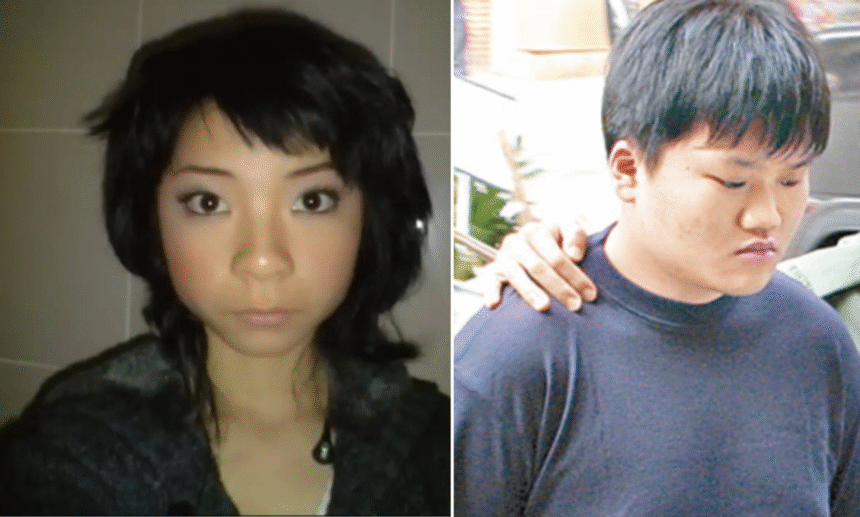
On 27 April 2008, 16-year-old Wong Ka-mui was killed in a flat in Shek Kip Mei. Her client, Ting Kai-tai, later admitted to the crime.
Kiki Wong’s path
Wong Ka-mui, also known as Kiki Wong, was born in 1991 in Hunan, mainland China. She had one older sister. Her family situation changed early in her life. After her mother divorced, she remarried a Hong Kong man in 1994. That marriage later led Wong to move to Hong Kong.
In 2005, Wong immigrated to the city and settled in Tai Po. She attended Tai Po Sam Yuk Secondary School. Reports later described her as a student with strong academic ability.
At the same time, school life was not easy for her. She was not a local-born resident, and classmates noticed that she spoke Cantonese with a mainland accent. That difference made it harder for her to fit in socially.
As her family struggled financially, the pressure on her increased. By early 2008, there was a debt of HK$50,000 to deal with. In January that year, while she was in her third year of secondary school, Wong left school and began looking for work.
She took odd jobs as she tried to bring money into the household. Her decision to leave school marked a major turning point, because it pulled her out of a structured environment and into a far more unstable one.
Around that same period, Wong joined a compensated-dating network. The arrangement connected young women with older men who paid for dates and sexual services.
For Wong, it became another source of income at a time when she had few options. Even so, reports said she still wanted a very different future. She hoped to become a famous model.
By the spring of 2008, Wong was balancing financial need, unstable work, and contact with much older men through the compensated-dating scene. That setting brought her into the path of Ting Kai-tai, a 24-year-old Hong Kong man whose background would soon become central to the case.
Ting enters the case
Ting Kai-tai, sometimes known by the nickname “Fatty Ting,” was born in Hong Kong in 1984. His early life was marked by trauma and instability. When he was five, his mother died in a traffic accident.
Ting was in the same crash and suffered a serious head injury. After that, according to later accounts, he developed emotional problems that continued through childhood.
At the age of eight, he was sent to a psychiatric hospital, where he was diagnosed with attention deficit hyperactivity disorder. His education did not progress far. He dropped out while in the first year of secondary school.
Ting’s father later remarried, and reports said his stepmother treated him well. Even so, people who knew him described him as someone with an unusual temper. Friends said he could suddenly become enraged when events did not go his way.
His contact with the law began while he was still young. At 15, he was sent to a boys’ home for one year after injuring another person. Around the same period, he started using drugs. He later built up a record of drug-related offences.
By the age of 16, he was also paying for sex. In adult life, he worked first as an apprentice in air-conditioning engineering and later as a transportation worker.
In mid-April 2008, Ting contacted Wong through an online compensated-dating forum posting. He paid her for dating and sexual services. Their contact continued until 27 April 2008.
On that day, Ting went to a nightclub in a shopping mall, where he drank alcohol and took ketamine and ecstasy. He returned home the next morning and contacted Wong again. He offered her HK$1,500 for sex.
They met for lunch and then went to Ting’s apartment in Shek Kip Mei, Sham Shui Po. Once there, they listened to music and consumed drugs together.
The day of the murder
Inside the apartment, the meeting moved from a paid encounter to a violent crime. According to the case record, Wong was killed sometime between 1 p.m. and 3 p.m. on 27 April 2008.
Ting strangled her. In later statements, he claimed he did not clearly remember the act because of the drugs he had taken. He also said Wong had told him that she wanted to die. He further stated that when he came to his senses, he realized she was dead.
At that point, Ting did not contact police, emergency workers, or anyone who might have helped. Instead, he decided to dispose of the body. He spent the next six hours in the bathroom cutting Wong’s body apart.
He separated the head and limbs, then cut the limbs and torso into much smaller pieces of flesh and bone. The work took most of the afternoon and evening.
He then began removing the remains in different stages. Most of the flesh and bone fragments were flushed down the toilet. He placed the severed head and internal organs into a plastic bag, left the flat, and travelled by bus to Kowloon City Ferry Pier.
There, he threw the bag into the sea. He later went to Shek Kip Mei Wet Market and placed bone fragments and remaining pieces of flesh into baskets of pork bones at a pork seller’s stall. He also disposed of Wong’s handbag and mobile phone.
During the same period, Ting took HK$3,400 from Wong’s wallet. Over the next nine days, he used that money on sex, drinks, and drugs.
While he was dismembering the body, he made three phone calls to his friend Tse Yin-tak. In those calls, he said he had killed Wong and cut her body into pieces. Tse did not believe him at first and assumed he was making a sick joke.
At that stage, however, Wong had not yet been reported missing, and the full scale of the crime had not yet become known.
The case breaks open
Wong was reported missing on 29 April 2008 after her family learned that she had disappeared. As news of the missing case began to circulate, Tse became troubled by the calls he had received from Ting during the dismemberment.
The details in those calls appeared to match the developing case. He then went to the police and told officers what Ting had said.
That report gave investigators a direct lead. Phone records also showed that Ting was the last person known to have contacted Wong. Together, Tse’s account and the call data placed Ting at the center of the investigation. Police arrested him as a suspect. Tse was later recognized by the police for his role in helping officers identify and capture Wong’s killer.
After his arrest, Ting gave a confession. On 9 May 2008, he was charged with first-degree murder. He also faced a second charge of preventing the lawful burial of a body because he had dismembered Wong and scattered her remains. No plea was taken from him at that stage.
The search for physical evidence was difficult because of the way the body had been disposed of. Police recovered pieces of flesh from pipes near Ting’s residence. Wong’s severed head was never found. Investigators believed the remains left at the wet market were most likely removed along with other waste meat.
They also said it was possible that some of the material had been processed into cooking fat or oil, in line with practices used for discarded meat. The recovered body parts were sent for DNA testing, which confirmed that they belonged to Wong.
The case quickly shocked the public in Hong Kong. Many residents were horrified by the killing and by the disposal of human remains in a market. Some feared that they might have unknowingly consumed flesh from the victim.
The case also drew fresh attention to compensated dating and the involvement of underage girls in prostitution. Authorities responded by warning teenagers that anyone involved in such activity would face legal consequences.
Trial and later steps
Ting was tried in July 2009 at the Hong Kong High Court before Justice Alan Wright and a seven-member jury. He faced one count of first-degree murder and one count of preventing the lawful burial of a body.
By the time the case reached court, it was not disputed that Wong had died at his hands. Prosecutors presented a video-recorded confession in which Ting described the killing and the dismemberment. He also told the court that he felt horror as he recounted what he had done.
His defence focused on diminished responsibility. His lawyers argued that drug intoxication had impaired his mental responsibility at the time of the offence. Ting said he could not clearly remember how he killed Wong or how he disposed of the remains.
He also denied acting when he cried while referring to Wong’s family. The prosecution rejected that account. State lawyers said Ting had been able to give a detailed confession shortly after the crime and noted that he had not initially told police that drugs had affected his responsibility.
On 27 July 2009, the jury, made up of three women and four men, deliberated for nearly three hours. It returned unanimous guilty verdicts on both charges. Justice Wright then sentenced Ting to four years’ imprisonment for preventing the lawful burial of a body.
For the murder charge, he imposed the mandatory sentence of life imprisonment required under Hong Kong law. He ordered the two terms to run at the same time and described the killing as “barbaric.” Hong Kong had already abolished the death penalty, so life imprisonment was the only possible punishment for murder.
After the trial, Tse said he still considered Ting a friend even though he had reported him to the police.
In 2011, while serving his sentence in Stanley Prison, Ting was allegedly involved with three other inmates in an assault on a newly admitted prisoner after a failed extortion attempt. Available reports did not state whether that incident led to a conviction.
Ting later appealed against his conviction and sentence, but on 4 December 2012 the Court of Appeal dismissed the appeal. He remains in Stanley Prison.
The case was later adapted into the 2015 Hong Kong film Port of Call, which used fictionalized names and details. In 2019, criminology professor Chan Heng Choon Oliver included the case in his book A Global Casebook of Sexual Homicide.