
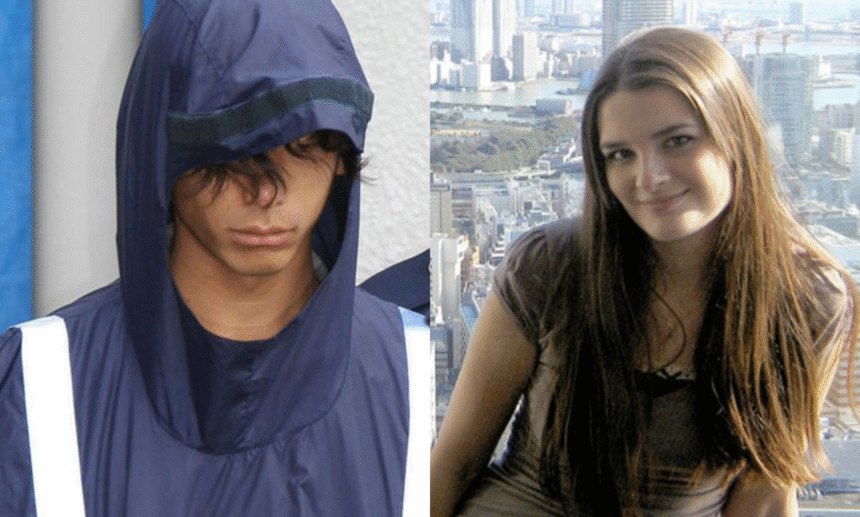
A young English teacher found buried in a bathtub filled with sand and flower seeds on a Tokyo apartment balcony. Her killer fled past nine police officers and vanished for over two years.
A Body in a Flower Pot
On the evening of Monday, March 26, 2007, Japanese police officers entered an apartment in Ichikawa, Chiba Prefecture, and encountered one of the most grotesque crime scenes in recent memory.
The naked body of 22-year-old Lindsay Hawker, a British English teacher, was discovered buried inside a detachable bathtub that had been dragged from the bathroom to the apartment’s balcony. A mixture of sand and soil filled the tub almost entirely, with only Lindsay’s right hand emerging above the surface.
Her wrists and ankles had been bound tightly with plastic ties, and scarves had been used to gag her mouth. Bruises were scattered across her upper body, indicating she had endured a prolonged and violent assault before her death.
The scene grew more disturbing upon closer examination. A chemical decomposing agent had been mixed into the sand and soil surrounding her body, intended to accelerate the breakdown of her remains. Flower seeds had been carefully planted on top of the mixture, arranged deliberately to disguise the bathtub as an ordinary flowerbed.
The seeds would have eventually germinated by feeding off Lindsay’s decomposing body beneath them. Officers also noted that all of Lindsay’s hair had been shaved completely from her head. Inside the apartment, several wigs were recovered, prompting immediate speculation about the suspect’s behavior and motives.
Lindsay’s personal belongings remained scattered throughout the room, confirming she had been inside the apartment before her death. The suspect, a 28-year-old unemployed man named Tatsuya Ichihashi, had fled the apartment only moments before officers entered.
He had charged past nine police officers stationed outside his door, escaping into the narrow hallways of the building. The officers, who lacked radio equipment to coordinate their response, failed to catch him.
They managed only to seize a rucksack he had been carrying. Within minutes, Ichihashi had disappeared into the Tokyo night, launching what would become one of Japan’s most extensive and prolonged manhunts.
The discovery of Lindsay’s body sent shockwaves through both Japan and the United Kingdom, uniting two nations in grief and outrage over the calculated brutality of the crime.
The Girl From Coventry
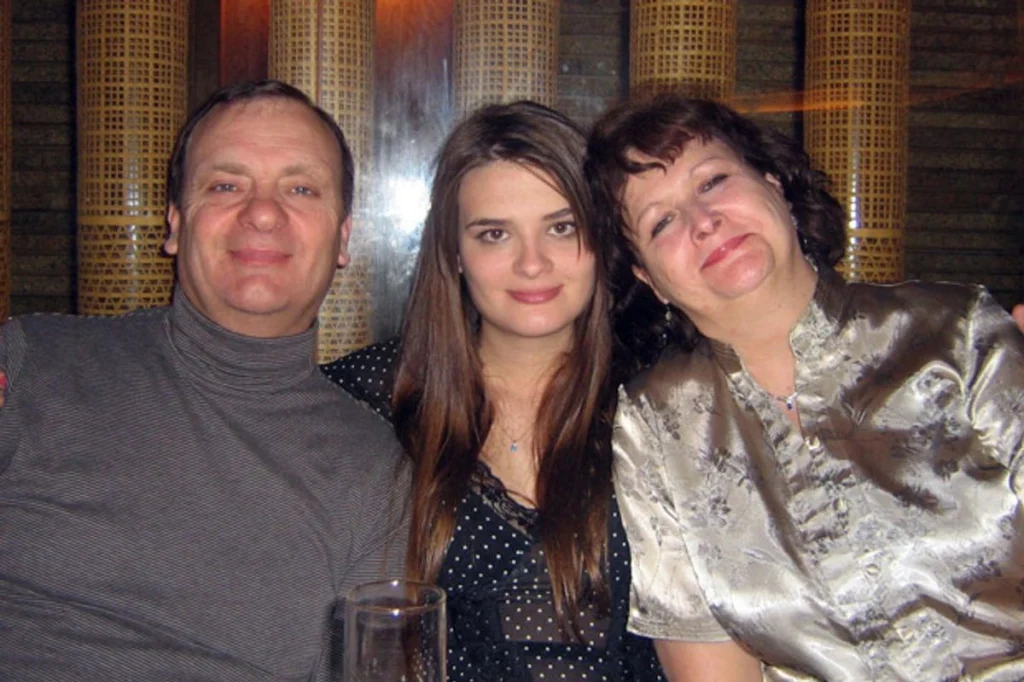
Lindsay Hawker was born on December 30, 1984, in Coventry, a city located in the English Midlands. She was raised by her father Bill and mother Julia alongside her two sisters, Louise and Lisa.
She attended King Henry VIII School before enrolling at the University of Leeds to study biology where she graduated in 2006 with first-class honours. Lindsay was well regarded among her peers, known for being bright, nurturing and socially engaged.
Before committing to a master’s degree, she decided to take a year abroad, combining travel with professional work to gain new experiences. In October 2006, she joined Nova, Japan’s largest private English-language school which recruited native speakers from across the world to teach in Tokyo and Osaka.
Lindsay was assigned to a branch in Koiwa, a district within the Edogawa ward of Tokyo. She chose to live further east in Chiba where rent was cheaper, sharing an apartment with two fellow English teachers who quickly became her close friends.
Lindsay adapted well to life in Tokyo and stayed in regular contact with her family and friends in England through phone calls, messages and Skype. By all accounts, she was enjoying her time in Japan.
She had a loving family, a wide circle of friends, and a boyfriend waiting for her back home. Six months into her stay, in March 2007, a chance encounter at a train station with a stranger would alter the course of her life permanently.
A man she had never met before approached her, claimed she was his English teacher and refused to leave her alone.
The Stranger at the Station
In March 2007, Lindsay finished work for the day and traveled to Chiba Station to collect her bicycle. As she was unlocking it, a man approached her from behind. He greeted her by saying, “You are my English teacher.”
Lindsay was confused. She did not recognize him and was certain he was not among her students at Nova. She declined to engage and mounted her bicycle, pedaling away. The man followed. His walking accelerated into jogging, then into a full run.
Through Chiba’s network of roads and intersecting walkways, he kept pace with her, repeatedly attempting conversation. He asked where she was from and where she had studied. Lindsay continued trying to shake him off but could not lose him.
She eventually reached her apartment and stopped her bike. The man caught up. His name was Tatsuya Ichihashi, and he proposed a straightforward arrangement. He asked Lindsay if she would be willing to give him private English lessons at a local cafe, offering to pay her by the hour.
Lindsay politely refused, explaining that her work schedule left her with little free time. Ichihashi appeared to accept this but then made another request. He said he was thirsty after chasing her through the streets and asked if she would allow him inside her apartment for a glass of water.
Lindsay hesitated but agreed, partly because her two roommates were home. Their presence provided a degree of safety and she reasoned that having them see his face could prove useful if the man ever became a problem.
Inside the apartment, Ichihashi raised his offer again, this time specifying a rate of 3,500 yen, approximately 32 dollars per hour. The arrangement would be strictly professional, conducted in a public coffee shop.
Lindsay reconsidered. The additional income would help supplement her Nova salary, and the terms seemed reasonable. She agreed to meet him for a first session in a few days.
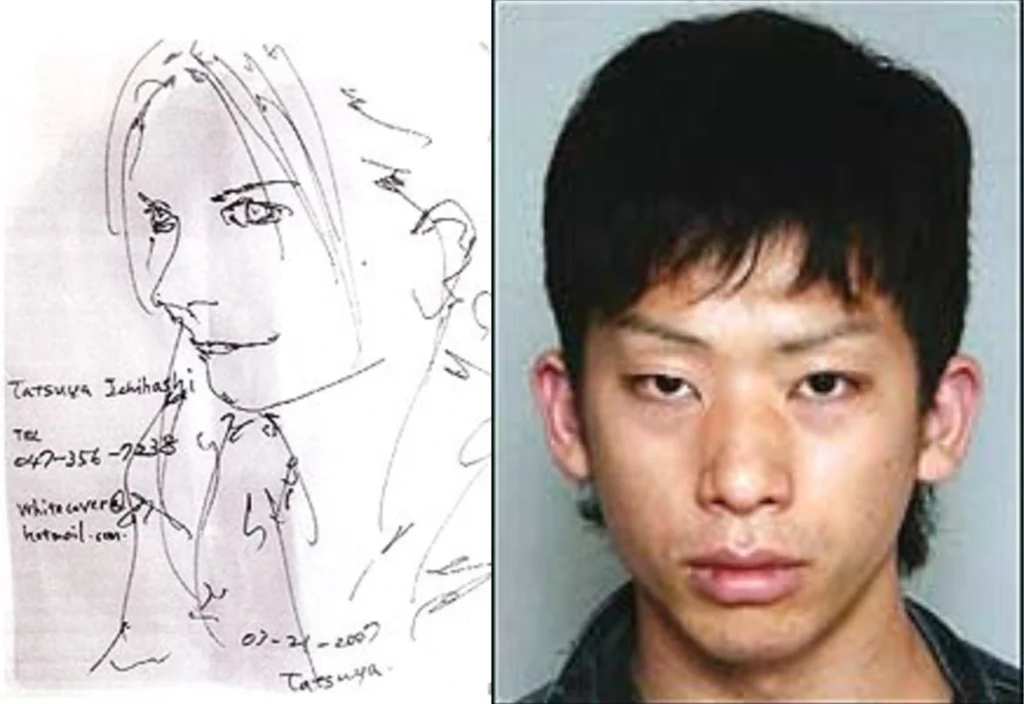
Before leaving, Ichihashi pulled out a pen, sketched a portrait of Lindsay on a piece of scrap paper, and wrote his name and phone number alongside it. He handed it to her, thanked her for the water, and left.
The Man Behind the Sketch
Tatsuya Ichihashi was born on January 5, 1979, in Gifu Prefecture, Japan. His family later relocated to Ichikawa in Chiba Prefecture, where he grew up in a comfortable, affluent household. His father worked as a medical doctor at a local hospital, and his mother practiced as a professional dentist.
Ichihashi initially intended to follow his father into medicine but he failed his entrance examinations and was denied the opportunity to advance in that field. He enrolled instead at Chiba University, where he graduated in 2005 with a degree from the Department of Horticulture.
Despite completing his education to a reasonable standard, Ichihashi made no attempt to seek employment after graduating. He survived entirely on a monthly allowance of 100,000 yen, provided by his parents. Those who knew him described him as a loner, reclusive in nature and rebellious in temperament.
He had no social circle to speak of and showed no interest in building a conventional life. His primary preoccupation was physical fitness. He attended a gym regularly and cycled distances exceeding 25 kilometers daily.
Ichihashi had no formal criminal record but his history was not entirely clean. He had been the subject of an allegation involving the assault and robbery of a woman on a public street.
The matter never reached a courtroom. It was alleged that his father intervened and settled the claim privately, paying the victim approximately one million yen. Because no formal charges were filed, Ichihashi’s official record remained unblemished.
Saturday, March 24, 2007
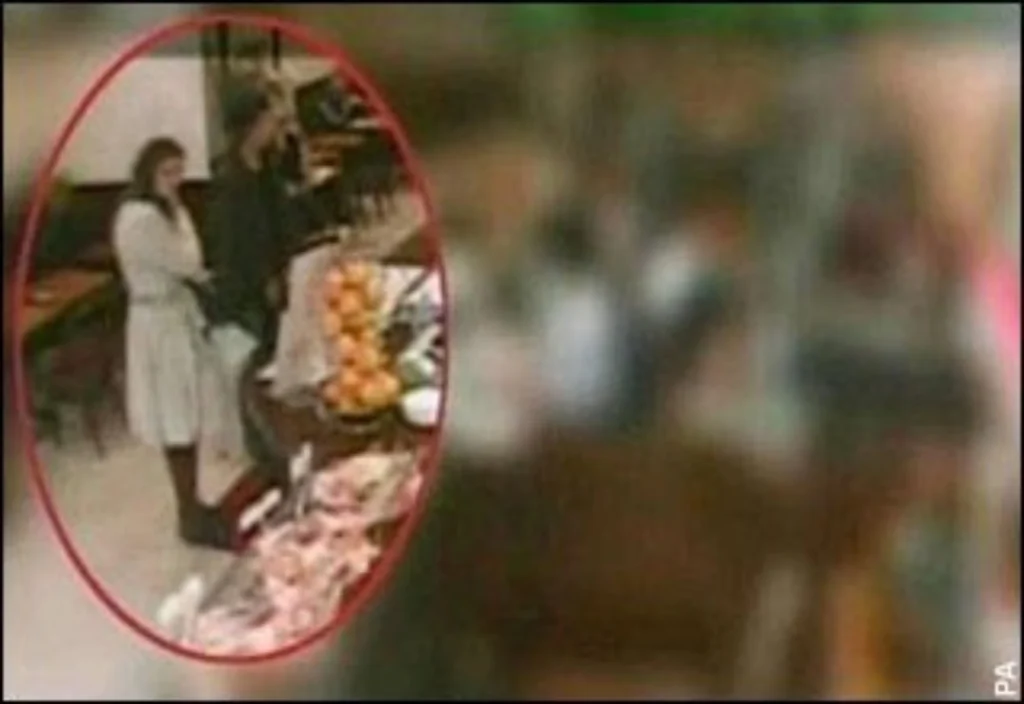
On Saturday, March 24, 2007, Lindsay met Tatsuya Ichihashi at a local coffee shop for their first scheduled English lesson. CCTV footage from the establishment captured the pair standing together in a queue.
Lindsay appeared relatively at ease, though she was observed taking clear steps backward each time Ichihashi moved closer to her. They sat down together and conversed for what appeared to be slightly over an hour. The session proceeded without visible incident.
When it ended, however, Ichihashi informed Lindsay that he had forgotten to bring money to pay her. He told her his apartment was only half a mile away and suggested she accompany him to collect her fee before continuing with her day. Lindsay agreed.
She had not brought her bicycle that day and had a work shift scheduled for later that afternoon, so the two took a taxi to Ichihashi’s apartment in Ichikawa. Upon arriving, Lindsay asked the taxi driver to wait for her, explaining she would only be a few minutes.
She followed Ichihashi inside to collect her payment. Several minutes passed. Lindsay did not return to the taxi. The driver, assuming she had changed her plans, eventually drove away. Lindsay never appeared at work that afternoon.
She did not return to her shared apartment that evening either. Her two roommates, already aware she had missed her shift, grew concerned as the night progressed. They contacted police later that evening to report her missing.
Saturday passed into Sunday, then into Monday. Lindsay missed a second consecutive day of work. Her school contacted her parents in Coventry to notify them. Her family and friends in England, already alarmed by her uncharacteristic silence on phone and social media, became increasingly distressed.
Japanese police only began treating the disappearance with serious urgency after Lindsay’s second missed workday, launching a formal investigation that commenced with interviews at her shared apartment in Chiba.
Nine Officers and an Empty Hallway
Lindsay’s roommates proved critical in directing the investigation immediately. They informed officers that Lindsay had arranged to meet an unfamiliar man for an English lesson on Saturday, shortly before she disappeared. They also produced the sketch Ichihashi had drawn of Lindsay during his first visit to the apartment which included his full name and phone number.
Police now had a suspect identified by name. At approximately 5:40 p.m. on Monday, two officers were dispatched to Ichihashi’s apartment. They knocked on his door but received no response. Neighbors in the building allowed the officers to look over the balcony partition and into Ichihashi’s living room.
The apartment was dark but officers could detect movement inside. They also observed something unusual. The apartment’s detachable bathtub had been moved from the bathroom onto the balcony. Suspecting that Lindsay might be held inside the apartment, the two officers called for reinforcements.
Seven additional officers arrived within the hour, bringing the total to nine. For approximately three hours, the officers positioned themselves outside the apartment and prepared to force entry. Then, without warning, Ichihashi opened his front door. He was carrying a rucksack and moved immediately.
In the brief moment of confusion that followed, Ichihashi charged directly past the officers. They managed to grab hold of his rucksack but could not restrain the man himself. Ichihashi sprinted through the building’s narrow and confusing hallways.
The nine officers, critically lacking any radio communication equipment to coordinate their pursuit, lost visual contact with him almost immediately. Within minutes, Tatsuya Ichihashi had vanished entirely into the streets of Tokyo.
The Longest Manhunt
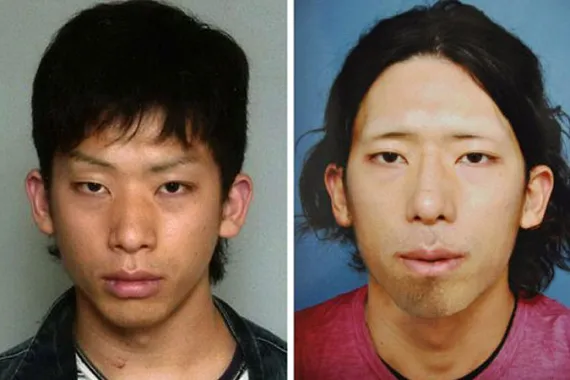
By the morning of March 27, 2007, Tatsuya Ichihashi was officially declared a wanted man across Japan. His photograph was distributed on wanted posters throughout Tokyo and broadcast on national news. Police conducted interviews and followed up on every reported sighting but for weeks, every single lead ended in nothing.
It later emerged that the photograph used on the original wanted poster was seven years out of date, rendering it nearly useless for identification purposes. Police even released digitally altered images showing Ichihashi wearing wigs but these too failed to produce results.
As weeks became months and months became years, Lindsay’s parents grew increasingly frustrated with the investigation. Bill and Julia Hawker traveled to Japan personally to raise public awareness. Bill Hawker went so far as to meet members of the Yakuza in a bar, presenting them with two bottles of whiskey and asking for their help in locating his daughter’s killer.
Media scrutiny of Japanese police intensified. Questions were raised about why it took a month to interview key witnesses, why the wanted poster used such an outdated photograph, and how the initial escape had been possible at all.
During his time as a fugitive, Ichihashi traveled the length of Japan, from Aomori in the far north of Honshu down to the remote southern island of Okinawa. He lived periodically in abandoned concrete bunkers on isolated islands.
For a sustained period through 2008 and 2009, he based himself in Osaka, sleeping in internet cafes and earning cash through construction work. He used his savings to fund plastic surgery aimed at altering his facial features.
Even before seeking professional surgical help, Ichihashi had already mutilated his own face. He cut off his moles with a blade, used scissors to remove a portion of his lower lip, and pushed a threaded needle through his nose to reshape its bridge.
By mid-2009, police raised the reward for information from one million to ten million yen and issued a public warning that Ichihashi had undergone plastic surgery. In October 2009, a surgeon in Nagoya contacted police, believing he had recently operated on the fugitive.
Ichihashi had agreed to before-and-after photographs of the procedure, which were released publicly. A construction colleague in Osaka recognized him. Ichihashi fled to Osaka’s ferry port on November 10, 2009, planning to escape to Okinawa.
A port worker identified him and alerted security. Officers confronted Ichihashi moments before he could board. He confirmed his identity plainly: “Yes, I am Tatsuya Ichihashi.” He was arrested, initially charged with abandoning a body and subsequently served warrants for rape and murder.
His trial began on July 4, 2011. He admitted to luring Lindsay into his apartment, raping her and strangling her because he feared her screams would bring police. On July 21, 2011, he was sentenced to life imprisonment.
“I did not intend to kill her, but I am responsible for her death. I am very sorry for what I did,”. Ichihashi further told the court, “I was the one who raped Lindsay. I was the one who put her through a scary experience and took her life.”
Lindsay’s family had requested the death penalty, but the court deemed it inappropriate given his lack of prior convictions. Before trial, Ichihashi published a book titled “Until I Was Arrested,” detailing his years on the run.
Over 100,000 copies sold. He offered all royalties to Lindsay’s family, who rejected them.

