
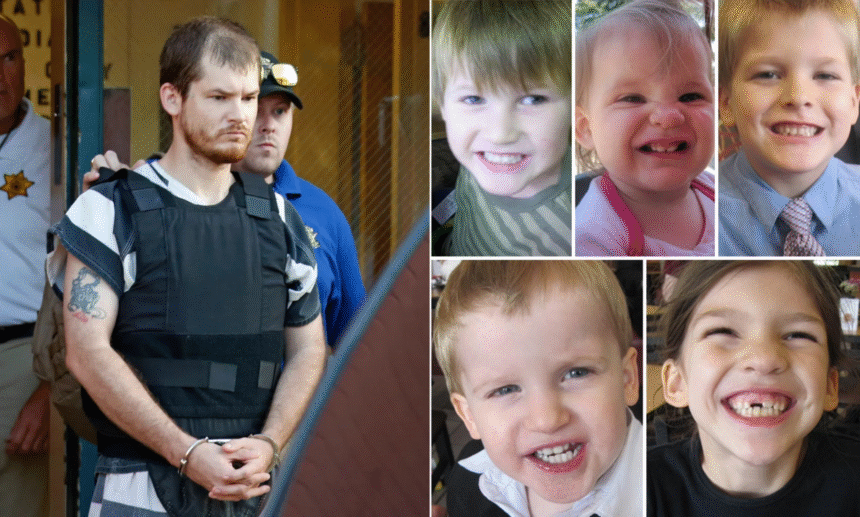
Timothy Jones Jr. was sentenced to death in 2019 for killing his five young children in South Carolina.
Timothy was born in 1981 in Mississippi. His family background was chaotic from the very beginning. His grandmother, Roberta, was repeatedly raped by her stepfather starting at age twelve.
Those assaults resulted in the birth of Timothy’s father, Timothy Jones Sr. Roberta was later forced to marry that same man before escaping at seventeen. Timothy Sr. grew up in that household for his first five years and later watched his mother behave violently toward her new husband.
Substance abuse was constant in that environment. Timothy Jr.’s mother, Cindy, had also been sexually abused by her own father as a child. She met Timothy Sr. at sixteen, and the two dropped out of school and got married. Timothy Jr. was born shortly after.
Cindy’s behavior after the birth raised serious concerns. She refused to comfort the baby when he cried, gave him ice-cold baths to quiet him, and fed him laxatives because she was worried about him gaining too much weight. She eventually took the baby and disappeared for several months.
Timothy Sr. eventually tracked them down. After that, Cindy was diagnosed with schizophrenia and placed in a psychiatric institution. Timothy Jr. was only two and a half years old, and he would not see his mother again for twenty years.
Timothy Sr. then raised his son alongside Roberta. Both had remarried, and the home involved ongoing abuse and instability. Violence was everywhere Timothy Jr. looked growing up. He started abusing drugs and alcohol as a teenager.
At fifteen, he was involved in a serious car accident when a cousin drove under the influence and struck a tree. Timothy spent two days in the hospital and was found to have suffered a traumatic brain injury.
After that, his personality changed significantly. He became depressed and paranoid, began hearing voices, and experienced hallucinations. His substance use also got worse following the accident.
He tried to join the navy, seeing it as a way forward, but was discharged after only six weeks for drug use. He then got involved in criminal activity, stealing cars and forging checks, and was sent to prison at nineteen.
As part of his sentence, he went through an intense boot camp program that involved extreme physical exercise.
After his release, Timothy made a genuine effort to change. He enrolled in college, earned a degree in computer engineering, joined a Pentecostal church, and found stable employment. He got a job at Intel that paid around eighty thousand dollars a year.
He also met a woman named Amber Kyzer. Within weeks of meeting her, he proposed. His family strongly objected, saying the relationship was moving far too fast, but he ignored them. They were married within six weeks of meeting.
The couple relocated from Mississippi to Lexington, South Carolina, and moved into a trailer. In the beginning, things seemed to be going well.
That did not last long. Timothy began imposing strict rules on Amber based on his religious beliefs. She was not allowed to wear makeup, cut her hair, or wear trousers. She had to quit her job, stay home, and cut off contact with friends and family.
He expected her to manage the household and raise the children, while he answered to none of those same standards himself. When she stepped out of line, he became physically violent. He spat on her, head-butted her hard enough to knock her unconscious, and threatened to kill her on more than one occasion.
On one particularly terrifying occasion, while Amber was in the passenger seat and the children were in the back seat, he deliberately steered the car into the lane of an oncoming eighteen-wheel truck before swerving back at the last second. He laughed the entire time.
During these years, the couple had five children together: Merah, Elias, Nahtahn, Gabriel, and Abigail. Reports about Timothy’s behavior began reaching the Department of Social Services in 2011, first triggered by a violent confrontation with a neighbor.
When caseworkers visited the home, they found it in terrible condition. The toilet did not work, cockroaches were present throughout, dangerous tools were left within reach of the children, and the home was covered in garbage. A safety plan was put in place. Nobody followed up on it.
In 2012, Amber began a relationship with a neighbor. When Timothy found out, he packed up the five children and left for Mississippi, blocking Amber from any contact with them.
He filed for divorce and sought full custody, describing Amber as someone who kept a messy home and made poor choices. Amber had no job, no money, and no support network. Timothy’s years of control had stripped all of that away from her.
She also believed, at least in part, that Timothy’s income might offer the children more stability than she could provide. She did not fight hard enough for custody, and in late 2013, Timothy was awarded full custody of all five children.
Amber received visitation on alternating weekends and certain holidays.
The family returned to the trailer in Lexington. Without Amber there, Timothy was responsible for the children entirely on his own. He began sending them to public school, since he could no longer require Amber to homeschool them.
He also relied on babysitters. The abuse that had previously been directed at Amber now turned toward the children. Timothy began punishing them through extreme exercise routines, forcing them to do hundreds of push-ups and squats and to stand on their tiptoes for hours at a time.
When he felt the punishment was not enough, he became physically violent. He dragged the children, whipped them, choked them, and threw them against walls. Food was withheld regularly.
The children were lucky to get one meal a day. When Timothy did bring food home, it was often a single fast food order shared among all five of them.
Teachers started noticing the signs at school. The children came in with bruises on their faces and arms. When asked, they openly said their father had hurt them.
Babysitters witnessed the abuse directly and fed the children in secret, because the children begged them not to tell Timothy, afraid he would take away food entirely as punishment. Reports kept coming in to the Department of Social Services.
On one visit, a caseworker saw bruising on the children with their own eyes and still closed the case. On another visit, Timothy told the caseworker directly that he did not want to send the children to school anymore because the teachers kept reporting him.
That statement was documented. Nothing was done about it either.
By August 2014, twelve reports had been filed about Timothy’s household. The final DSS visit took place just days before everything fell apart. The caseworker observed a cut above one of the children’s eyes, visible bruising on the children, and signs that the children were starving.
Timothy said the cut came from a doorknob. The caseworker’s report described him as overwhelmed but noted that the children appeared clean and appropriately dressed. The case was closed again.
On August 28, 2014, Timothy found his six-year-old son Nahtahn broke an electrical socket. By this point, all five children had expressed that they wanted to live with their mother.
Timothy had become consumed by paranoia and genuinely believed the children were working together against him. He interpreted Nahtahn’s actions near the socket as an intentional attempt to harm him.
As punishment, Timothy forced the six-year-old to perform continuous cycles of intense physical exercise for several hours. Nahtahn begged him to stop. Each time he slowed down, Timothy whipped him to keep him going.
Eventually, Nahtahn collapsed. Timothy carried him to his bedroom and left. When he returned hours later, Nahtahn was dead. He had died from severe dehydration and physical exhaustion.
After finding Nahtahn, Timothy’s first action was to search online for information about prison life. His concern was not his son. It was himself. He quickly concluded that if he were arrested, Amber would likely receive custody of the remaining four children. He decided that could not happen.
That evening and into the night, he went to each of his remaining four children and killed them. He strangled Merah, eight, and Elias, seven, with his hands. For Gabriel, two, and Abigail, one, he used a belt because his hands were too large for their small necks. The killings were spread across several hours.
After the murders, Timothy sent a message to the babysitter saying he and the children would be out of state for a few days. He searched online for campgrounds, methods of disposing of a body, and countries without extradition agreements.
He wrapped all five children’s bodies in plastic bags, loaded them into his vehicle, and drove toward Alabama. He stopped at a store and purchased saws, goggles, dust masks, acid, and a large plastic container, all captured on store surveillance footage.
He attempted to begin dismembering one of the bodies but stopped. In the end, he left all five children in plastic bags in a wooded area and kept driving. He stayed on the road for eight days while the babysitter, family members, and Amber all reported the children missing.
On September 6, 2014, police pulled Timothy over on suspicion of impaired driving. When officers checked his identification, they found he was wanted in South Carolina over a child welfare matter.
Searching the vehicle, they found no children but detected a strong smell of decomposition, along with blood, maggots, bleach, and children’s clothing. Timothy was arrested immediately.
During questioning, he admitted to the killings but claimed voices had told him to do it and that the children had been conspiring against him. He also insisted the murders were not planned.
Investigators saw these statements as deliberate preparation for a future insanity defense. Timothy then led officers to where he had left the bodies.
The case did not go to trial until April 2019. Timothy pleaded not guilty by reason of insanity, claiming undiagnosed schizophrenia had made him unable to distinguish right from wrong.
A forensic psychiatrist testified that he did not have schizophrenia, that he had been faking symptoms, and that he had fully understood what he was doing. The prosecution highlighted every calculated step he took after the murders as proof of that awareness.
The jury deliberated for six hours and found him guilty on all five counts. On June 13, 2019, Timothy Jones Jr. was sentenced to death.
Following the verdict, investigators reviewed the Department of Social Services’ handling of the case. The review found that caseworkers were undertrained, carried far too many cases, and worked within a broken system.
Amber filed a civil lawsuit against the department for its repeated failure to protect her children. There had been twelve chances to intervene. Not one of them was taken.



Recent Comments