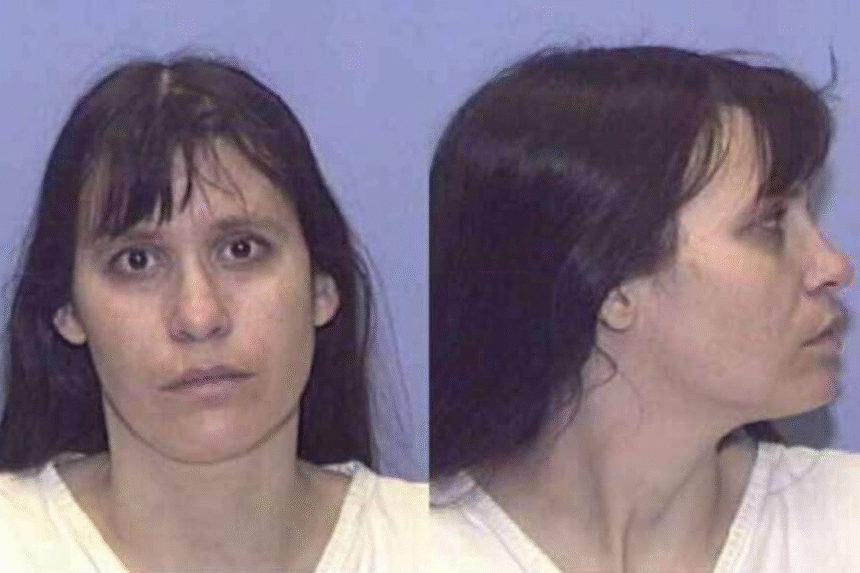
Andrea Yates, a former nurse from Houston, Texas, drowned her five children in their bathtub on June 20, 2001. She had a long, documented history of severe mental illness, including postpartum depression and postpartum psychosis, and had been under psychiatric care before the incident.
Growing Up
Andrea Pia Kennedy was born on July 3, 1964, in Houston, Texas. She was the youngest of five children. Her mother, Jutta Karin Koehler, was a German immigrant, and her father, Andrew Emmett Kennedy, came from an Irish immigrant family. Andrea grew up in a structured household where discipline and education were valued.
Even at a young age, Andrea struggled internally. During her teenage years, she developed bulimia and suffered from ongoing depression. At just 17 years old, she once told a friend that she was thinking about suicide. This moment later became an important detail when her mental health history was reviewed by doctors and courts.
Despite these struggles, Andrea excelled in school. She attended Milby High School in Houston and graduated in 1982 as the class valedictorian. She was captain of the swim team and an officer in the National Honor Society. Teachers described her as focused, disciplined and highly intelligent.
After high school, Andrea enrolled in a two-year pre-nursing program at the University of Houston. She later graduated from the University of Texas Health Science Center at Houston. Nursing required long hours and emotional control and Andrea appeared capable of handling both.
From 1986 until 1994, Andrea worked as a registered nurse at the University of Texas MD Anderson Cancer Center. She held the job for eight years and was viewed as responsible and reliable. During this time, she lived independently and showed no outward signs of severe psychosis.
Growing Family

In the summer of 1989, Andrea met Russell Yates at the Sunscape Apartments in Houston. Russell was a NASA engineer and a deeply devout evangelical Christian. The two began a relationship, moved in together, and married on April 17, 1993.
Religion played a major role in their marriage. Russell strongly believed in having a large family. According to NIH, The couple later announced that they would seek to have as many children as nature allowed. This belief shaped many of the decisions they made in the years that followed.
Their first child, Noah, was born in February 1994. Around the same time, Russell accepted a job in Florida. The family moved to Seminole and lived in a small trailer. Andrea was caring for a newborn while adjusting to a new place and lifestyle.
The family continued to grow. By the time their third child, Paul, was born, they had moved back to Houston. For a period, they lived in a GMC motor home. Eventually, they purchased a four-bedroom house in Friendswood, Texas.
From the outside, the Yates family appeared stable and devoted. Russell worked as an engineer, Andrea stayed home with the children and religion guided daily life. Internally, however, Andrea was struggling more with each pregnancy.
Breakdown After Fourth
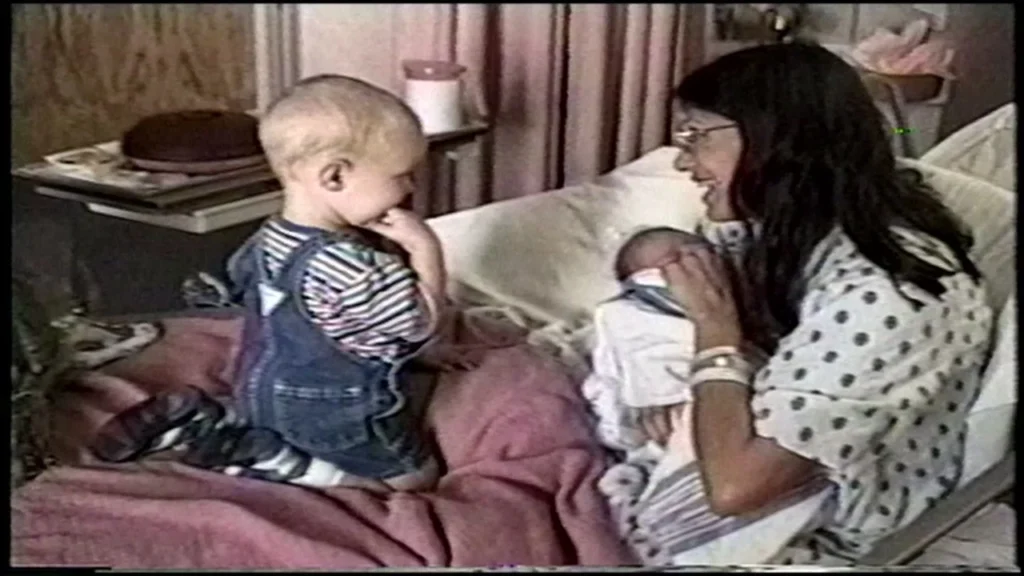
After the birth of her fourth child, Luke, Andrea’s mental health declined sharply. Her depression returned in a serious way. On June 16, 1999, Russell found her shaking and chewing her fingers. The next day, Andrea attempted suicide by overdosing on pills.
She was hospitalized and prescribed antidepressants. Shortly after being released, Andrea begged Russell to let her die while holding a knife to her neck. This led to another emergency hospitalization.
Doctors prescribed several medications, including Haldol, an antipsychotic drug. Andrea’s improvement after starting Haldol was immediate. Her thinking became clearer and her behavior stabilized. She was discharged with a prescription for the medication.
Concerned for her recovery, Russell moved the family into a smaller house. For a short time, Andrea appeared stable enough to function. That stability did not last.
In July 1999, Andrea suffered a severe nervous breakdown. She made two suicide attempts and was hospitalized twice during that summer. Doctors diagnosed her with postpartum psychosis, a rare but dangerous mental illness.
Andrea’s psychiatrist at the time, Dr. Eileen Starbranch, gave a clear and serious warning. She urged Andrea and Russell not to have any more children. She stated that another pregnancy would “guarantee future psychotic depression.” This warning was recorded in Andrea’s medical files.
Despite this warning, Andrea became pregnant with her fifth child only seven weeks after being discharged from Dr. Starbranch’s care. She stopped taking Haldol in March 2000 and gave birth to her daughter, Mary, eight months later.
Rapid Mental Decline
After Mary’s birth, Andrea Yates appeared to cope for a short period. That stability was fragile and depended heavily on ongoing treatment.
Everything worsened after the death of Andrea’s father on March 12, 2001. His death deeply affected her emotional state. Soon after, Andrea stopped taking medication entirely. She began mutilating herself, read the Bible obsessively and stopped feeding Mary. Her behavior became alarming and incapacitating.
Andrea’s condition declined to the point that she required immediate hospitalization. On April 1, 2001, she came under the care of psychiatrist Dr. Mohammed Saeed. She was treated and later released. Despite treatment, her mental state continued to worsen.
On May 3, 2001, Andrea entered a near-catatonic condition. That day, she filled the bathtub in the middle of the afternoon. She later confessed that she planned to drown her children that day but decided not to carry it out.
The following day, Andrea was hospitalized again after a scheduled doctor visit. Her psychiatrist believed she was suicidal and assumed the bathtub incident was an attempt to harm herself. She was released shortly after.
Medical experts later explained that oral Haldol takes four to six days after discontinuation to reach near-complete elimination from the body. By this time, Andrea had been without the medication for weeks.
The Murders Inside the Home
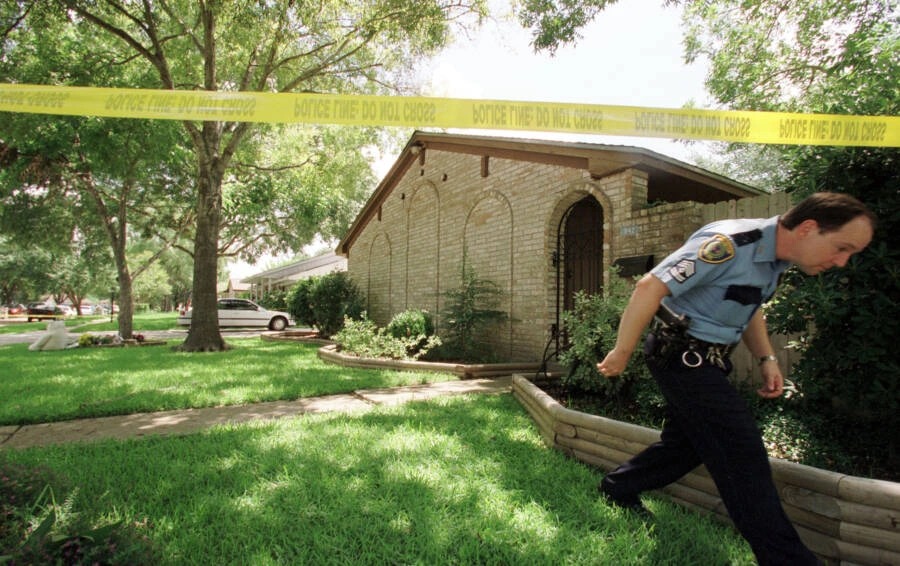
By June 2001, the Yates family was living in Clear Lake City, a suburb of Houston. Doctors had clearly instructed that Andrea should not be left alone with the children and required round-the-clock supervision.
Despite this, Russell began leaving Andrea alone for short periods. He believed that allowing her some independence would help her recover. His mother, Dora Yates, regularly assisted with supervision and was scheduled to arrive each morning.
On the morning of June 20, 2001, Russell left for work. Dora was expected to arrive about an hour later. During that hour, Andrea was alone with all five children.
Andrea filled the bathtub with water. She began with Paul, Luke and John, drowning them one at a time. After killing them, she laid their bodies carefully on her bed.
She then drowned Mary and left her floating in the bathtub.
Noah, the oldest child, entered the bathroom and asked what was wrong with Mary. He ran away but Andrea caught him and drowned him as well. She left him floating in the tub before placing his body on the bed and laying Mary in John’s arms.
After the killings, Andrea called the police. She repeatedly asked for an officer but refused to explain why. She then called Russell and told him to come home immediately, per The New York Post.
The First Trial
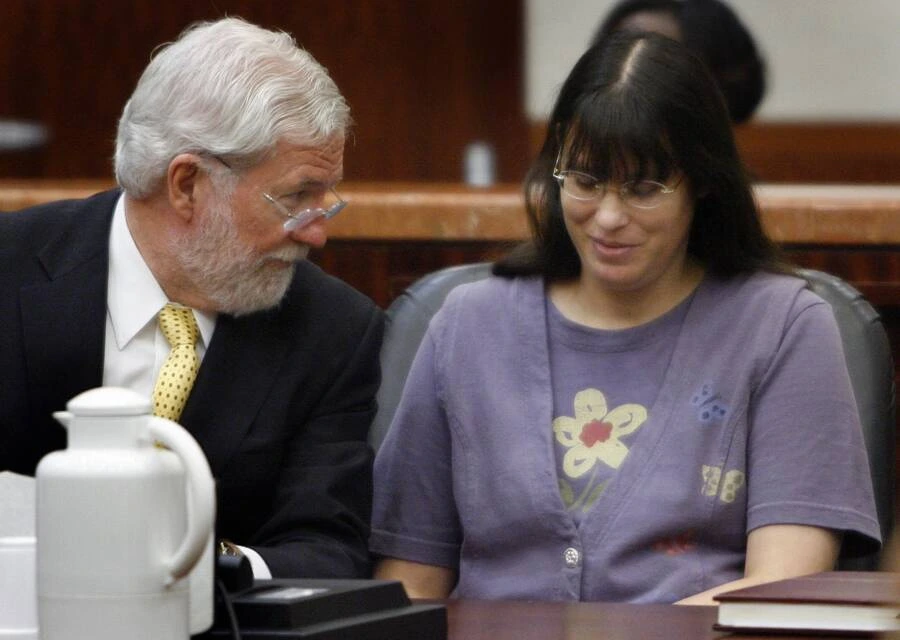
When police arrived at the house, Andrea calmly confessed to drowning her children. She later told psychiatrist Michael Welner that she waited for Russell to leave because she knew he would have prevented her from harming the children.
Investigators found the family dog locked in a cage. Russell told Welner that the dog had been free when he left for work. This led psychiatrists to believe Andrea locked the dog away to prevent interference while she carried out the killings.
Andrea explained that she believed her children were not righteous and that she was a bad mother. She believed they were doomed to suffer because of her failures. She later told her jail psychiatrist that killing them was necessary to save them from eternal punishment, describing her thoughts in terms of sin, hell and salvation.
Andrea was charged with capital murder. At her 2002 trial, Harris County District Attorney Chuck Rosenthal sought the death penalty. Although experts from both the prosecution and defense agreed that Andrea was severely mentally ill and psychotic, Texas law required proof that she could not tell right from wrong at the time of the crime.
The jury rejected the insanity defense and found Andrea guilty of capital murder. They refused the death penalty option. Andrea was sentenced to life in prison with the possibility of parole after forty years.
Life After Verdict
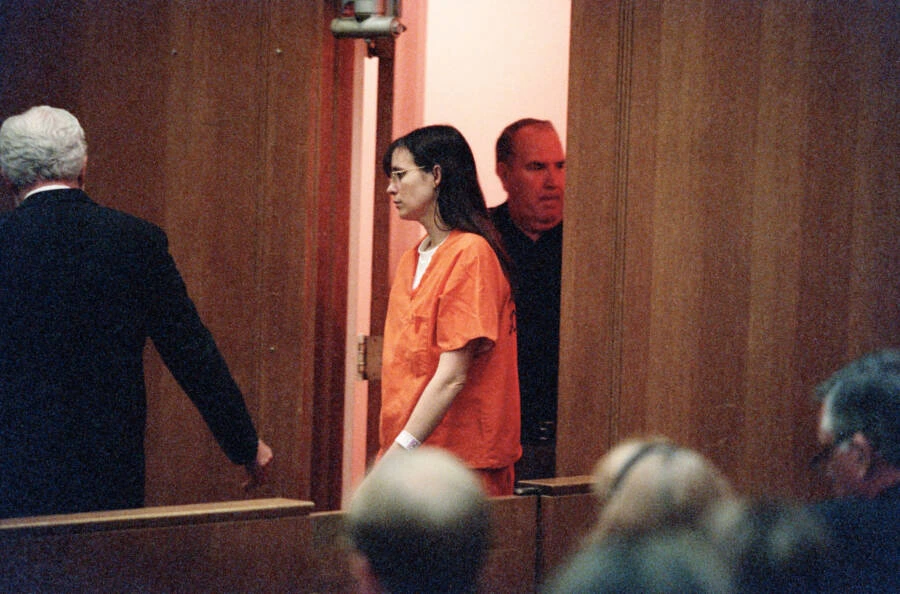
In January 2005, Andrea’s conviction was overturned by a Texas Court of Appeals. The decision was based on false testimony given by prosecution witness Dr. Park Dietz.
During the trial, Dietz claimed that an episode of Law & Order had aired shortly before the murders, featuring a woman who drowned her children and was found not guilty by reason of insanity.
Journalist Suzanne O’Malley, who was covering the trial and had previously worked as a writer for Law & Order, reported that no such episode existed. The appeals court ruled that the jury might have been influenced by this false testimony and ordered a new trial.
In 2006, Andrea again entered pleas of not guilty by reason of insanity. Her legal team rejected a plea offer for a 35-year sentence. She was released on bail under the condition that she be admitted to a mental health facility.
On July 26, 2006, after three days of deliberation, a Texas jury found Andrea not guilty by reason of insanity. She was committed to the North Texas State Hospital in Vernon, a high-security mental facility. While there, she shared a room with Dena Schlosser, another woman who had killed her child during a psychotic episode.
In January 2007, Andrea was transferred to Kerrville State Hospital, a lower-security mental health facility.
Russell Yates faced strong criticism for ignoring doctors’ instructions not to leave Andrea alone. Family members testified that he believed short periods of independence would help her recover.
Andrea’s brother claimed Russell once said depressed people needed a “kick in the pants.” Andrea’s mother expressed concern that Andrea was not stable enough to care for the children.
Russell blamed the medical community, medication changes and insurance limits involving Blue Cross Blue Shield and Magellan Health Services. He stated that Andrea should not have been discharged from the hospital in May 2001.
Religious influences were also examined. Media reports linked Andrea’s delusions to newsletters from itinerant preacher Michael Woroniecki. Both Woroniecki and Russell denied responsibility, stating the connection was exaggerated by the media.
In August 2004, Russell filed for divorce. It was finalized in March 2005. He remarried in March 2006 and had one son. That marriage ended in divorce in 2015.
Andrea remains committed to a state mental hospital where she continues to receive treatment.