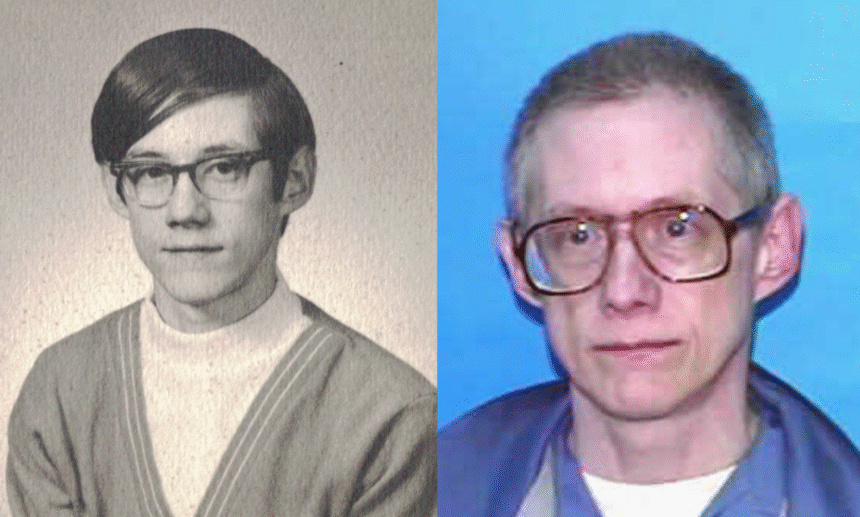
John Brennan Crutchley was a convicted kidnapper and rapist who later became known as the “Vampire Rapist.” Authorities suspected him in several unsolved killings across different states. His life moved from success in engineering to violent crime and prison.
Early Years
John Brennan Crutchley was born on October 1, 1946, in Clarksburg, West Virginia. He was the youngest of three children in a family that was financially comfortable. His parents were William “Bill” Crutchley Sr. and Mildred Burnside.
Before his birth, the family had suffered a loss. His older sister, Donna June Crutchley, died in 1945 during emergency surgery. Her death deeply affected his mother.
Crutchley later claimed that his mother had wanted another daughter. He said that for the first six years of his life, she dressed him in girls’ clothing. He also stated that he experienced harsh physical punishment at home.
According to his own account, he was beaten until he lost consciousness. These claims were part of his later descriptions of childhood.
As a boy, he kept to himself. He did not have many friends. Instead, he spent long hours in the basement of his family home, working with electronic devices. He learned how to repair radios and stereo systems. This skill allowed him to earn money while still young.
He graduated from Upper St. Clair High School in Pennsylvania. Later, he attended Defiance College in Ohio, earning a Bachelor of Science degree in Physics in 1970.
He also completed a Master of Engineering degree in Engineering Administration at George Washington University in Washington, D.C. In 1969, he married his first wife. At that time, he appeared to be building a stable future.
Career and Personal Changes
After college, Crutchley began working in engineering. He first worked at General Motors’ Central Foundry Division in Defiance, Ohio. There, he helped install a new plant security system.
Wanting to move forward in his field, he applied for a transfer to Delco Electronics in Kokomo, Indiana, where such systems were designed.
He worked for several years as an electrical systems engineer. During this time, his first marriage began to fall apart. By the time he left Kokomo, the relationship had nearly ended. His departure followed an internal investigation into missing materials at the plant.
In the mid-1970s, Crutchley moved to Fairfax County, Virginia, and remarried. He worked for high-technology firms in the Washington, D.C., area, including TRW, ICA, and Logicon Process Systems. His career placed him in positions of trust. He handled advanced systems and sensitive information.
In 1983, he relocated to Florida and began working at Harris Corporation in Palm Bay. The company was connected with naval contractors and NASA research facilities near Cape Canaveral.
When he was later arrested, authorities found that he possessed a large amount of classified material related to naval communications and weapon systems. Federal agencies considered opening an espionage case but did not move forward with one.
To neighbors and coworkers, he appeared to be a skilled engineer. There was little outward sign of what would soon come to light.
The Night on the Road
On the evening of November 22, 1985, a disturbing scene unfolded in Malabar, Florida. A young woman, later identified as 19-year-old Laura Murphy, was found crawling naked along the roadside. Her ankles and wrists were cuffed. Several trucks passed before a motorist stopped.
She pleaded with him not to take her back “to that house.” She asked him to remember the location. The driver took her home and called police and an ambulance.
Doctors determined that Murphy had lost between 40 and 45 percent of her blood. There were marks around her neck from a ligature. She had been hitchhiking the day before, on November 21.
According to her statement, Crutchley had offered to drive her to Melbourne, Florida. He said he needed to stop at his house first to get a notebook for work.
When they reached his driveway, he invited her inside. She refused. At that point, he placed a cord around her neck and choked her until she lost consciousness. He dragged her into the house.
Murphy later described waking up naked and restrained on a kitchen countertop. Her arms and legs were secured. Lights and a video camera were set up. Crutchley raped her. He inserted needles into her arm and wrist and withdrew blood.
He told her he was a vampire. Afterward, he placed her in a bathtub while still restrained. The assaults and blood extraction continued.
Escape and Arrest
The following morning, after another assault, Crutchley handcuffed Murphy and left her in the bathroom. He told her he would return and threatened that his brother would kill her if she tried to escape.
When he left, she forced her way through a bathroom window. Weak from blood loss, she crawled to the road. A medical expert later stated that without help, she would likely have died within twelve hours.
At first, Murphy was too traumatized to press charges. A rape counselor encouraged her to move forward, explaining that a conviction could prevent further harm to others.
Police obtained a search warrant. At 2:30 a.m., officers entered Crutchley’s home. His wife and child were out of state for Thanksgiving. Officers found a video camera with a partially erased tape. Murphy said it had recorded the assault and blood extraction.
Photographs taken during the first search showed a thick stack of credit cards, women’s necklaces, and locks of hair. These items were noted but not seized. In a later search, they were gone.
During a second search related to the case, officers found seventy-two index cards. On them were names of women and some men, along with comments about sexual encounters.
Some individuals contacted by police said that encounters had crossed into non-consensual restraint. Investigators also found explicit photographs of a woman tied and gagged, and images of Crutchley choking her.
Crutchley was arrested during the search.
Court and Sentence
In June 1986, Crutchley pleaded guilty to kidnapping and rape. In exchange, prosecutors dropped charges of grievous bodily harm related to the blood extraction and a drug possession charge.
During sentencing, the issue of blood drinking was discussed. Crutchley claimed that in this case, he had not successfully drunk the blood because it had coagulated. His wife told reporters that he was not guilty and described him as “a kinky sort of guy.” She also commented publicly about the attack, using words that drew criticism.
The judge reviewed testimony and evidence from the hearing. He chose to exceed state sentencing guidelines. Crutchley was sentenced to twenty-five years to life in prison, followed by fifty years of parole, , according to The Washington Post.
At the same time, investigators and experts began to look more closely at his past. FBI profiler Robert Ressler believed Crutchley fit the pattern of an organized serial killer. He urged a broader search for connections to unsolved cases.
Although no direct evidence tied him to other murders, his name began appearing in discussions of missing women across several states, including Virginia, Maryland, Ohio, Pennsylvania, Washington, D.C., and Florida.
Missing Women and Suspicions
Years before his 1985 arrest, several women had disappeared in areas where Crutchley lived or worked.
On January 28, 1978, Deborah Rita Fitzjohn, a 25-year-old secretary from Fairfax, Virginia, vanished. She had been dating Crutchley and was last seen at the trailer park where he lived. He told police she had visited him and left while he slept.
Her skeletal remains were found in October 1979. After his 1985 arrest, investigators discovered that he still had the business card of the lead detective from her case.
In March 1985, Patti Lou Volansky, 29, left her home in Mims, Florida, intending to hitchhike. She disappeared. Police later found her photo identification card in Crutchley’s workplace desk.
He admitted picking her up months earlier but said he told her to leave his car after she made demands. Her body has never been located.
Identification cards belonging to other women were also found in his possession. Nancy Kay Brown disappeared in Cocoa Beach in 1983. Her remains were later found in Canaveral Groves.
Cheryl Ann Windsor, 16, and Diana Lee Casey were found dead in 1984 on Merritt Island. Bone fragments discovered in Malabar in 1985 were identified as belonging to Kimberly Ann Walker and Jeanette Marcotte. Another woman, Lynn Kay Desantis, was found dead in Grant, Florida, in November 1985.
In 1995, Naval Criminal Investigative Service agents examined his access to Norfolk Naval Air Station during the murders of Pamela Anne Kimbrue and Carol Ann Molnar. Another man was later convicted in Kimbrue’s death. Molnar’s case remains unsolved.
In 2010, authorities released a reconstruction image of an unidentified woman found near Crutchley’s home in 1985.
No direct evidence linked these deaths to him, but suspicion remained.
Prison and Death
FBI profiler Robert Ressler once predicted that Crutchley might be released by 1998. Instead, he was freed even earlier. On August 8, 1996, after serving eleven years, he was released from Union Correctional Institution in Raiford for good behavior.
Communities in West Virginia and Florida did not want him to return. He was placed at the Orlando Probation and Restitution Center, a halfway house. Within a day, he tested positive for marijuana. He denied using it, claiming others had blown smoke in his face.
However, prosecutors later presented a confession in which he admitted smoking due to stress about release.
On January 31, 1997, he was sentenced to life imprisonment under the “three strikes” law. This counted as his third conviction, following the kidnapping and rape charges. In prison, he was placed in solitary confinement after officials found multiple body piercings that violated rules.
On March 30, 2002, he was found dead in his cell at Hardee Correctional Institute. A plastic bag was over his head. Authorities reported the cause of death as asphyxiation. Later statements from the Florida Department of Corrections described the death as autoerotic asphyxiation, the Orlando Sentinel reports.
Years later, media programs revisited the case. Interviews and archival footage showed Crutchley denying the label of “vampire,” saying it was only a name. Despite that, the case left a lasting mark. His confirmed conviction involved one survivor who escaped. Many other questions remain unanswered.