
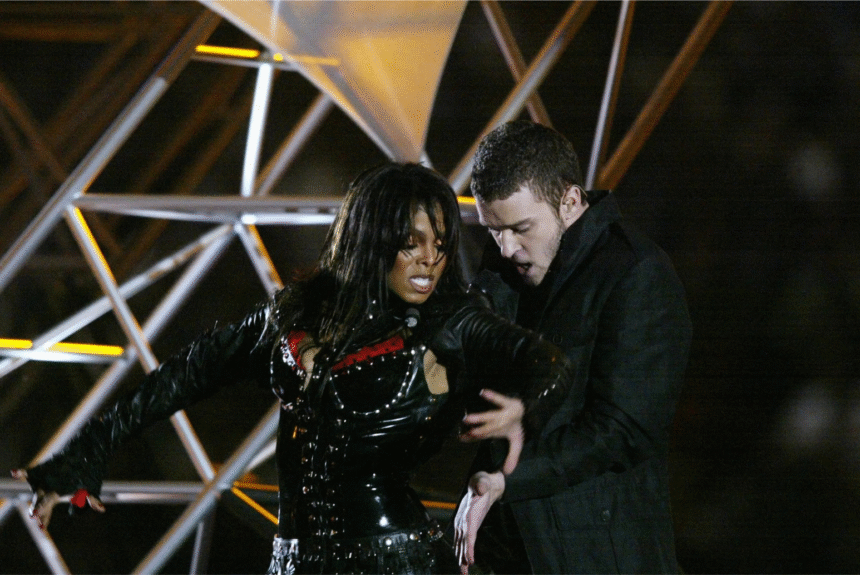
On February 1, 2004, during Super Bowl XXXVIII in Houston, Texas, a split-second moment during the halftime show turned into one of the biggest controversies in American TV history.
The NFL picked Janet Jackson as the headline performer for the halftime show in September 2003. Because 2004 was a presidential election year, MTV, which produced the show, built the theme around its “Choose or Lose” campaign.
The goal was to get younger people to register to vote. Everything seemed well-planned and straightforward heading into the big night.
Jackson and Justin Timberlake had known each other for years before sharing the Super Bowl stage. Timberlake attended Jackson’s Rhythm Nation Tour as a kid, and her performing style made a strong impression on him.
When Timberlake was part of the boy band *NSYNC, Jackson chose them as the opening act for several dates on her Velvet Rope World Tour. That opportunity helped introduce the then-unknown group to a massive worldwide audience.
Jackson even performed alongside them on multiple nights, including a live a cappella duet of Stevie Wonder’s “Overjoyed.” After the tour, the two stayed close friends.
Timberlake later asked Jackson to sing backing vocals on a track from his debut solo album, Justified. Their connection was real, and their chemistry on stage was expected to be a highlight of the show.
What nobody in the audience knew was that a major change to the show’s choreography was only communicated to Timberlake just 20 minutes before the live broadcast, after he had already flown into Houston. This was later confirmed by former Super Bowl director Beth McCarthy-Miller and producer Salli Frattini.
Jackson opened the halftime performance with a medley of hits, including “All for You,” “Rhythm Nation,” and a brief excerpt of “The Knowledge.” Timberlake then joined her onstage as a surprise guest to perform his song “Rock Your Body.”
The duet included several suggestive dance moves from both performers. As Timberlake sang the final lyric — “Gonna have you naked by the end of this song” — he pulled away part of Jackson’s costume.
The plan was to reveal a red lace bra underneath her rubber bustier. Instead, the garment tore away completely, exposing Jackson’s right breast, which was adorned with a sunburst-shaped nipple shield, for less than a second.
The CBS broadcast immediately cut to a wide shot of the stage, then to an aerial view of Reliant Stadium.
Jackson’s representative explained that the costume reveal had been decided after final rehearsals and that CBS, MTV, and the NFL had no knowledge of it beforehand. The exposure, they said, was an accident.
Celebrity stylist Wayne Scot Lukas told a different story years later, claiming the incident was planned by Timberlake. A 2018 USA Today report added weight to that claim, stating that Lukas had been seen purchasing a sunburst nipple shield the weekend before the Super Bowl and allegedly told the artist he bought it from to watch the halftime show for a surprise.
Timberlake’s first public comment after the show did not help calm things down. Speaking to Access Hollywood shortly after the performance, he said, “Hey man, we love giving you all something to talk about.”
He later released a written statement calling the exposure unintentional and using the phrase “wardrobe malfunction” to describe what happened. That phrase spread immediately. It was eventually added to Merriam-Webster’s Collegiate Dictionary.
The following week, at the Grammy Awards, Timberlake addressed the incident again, calling it completely regrettable and apologizing to anyone who was offended.
Both CBS and MTV issued public apologies after the broadcast, saying they had no prior knowledge that the performance would involve nudity. MTV’s CEO Tom Freston claimed in a Reuters interview that the exposure was a stunt orchestrated solely by Jackson.
Separately, an MTV representative confirmed that the costume tear was conceptualized by MTV staff but insisted nudity was never the intended result. CBS, under pressure, required Jackson to make a public apology.
In a video statement, she said the reveal was never meant to go as far as it did and apologized to the audience, MTV, CBS, and the NFL.
The reaction from officials was fast and harsh. NFL commissioner Paul Tagliabue, FCC chairman Michael Powell, and NFL executive vice president Joe Browne all publicly condemned the incident. Powell ordered an FCC investigation the very next day.
Nearly 540,000 complaints poured in, with the Parents Television Council claiming responsibility for around 65,000 of them. America Online, which had sponsored the halftime show, demanded a refund of the approximately $7.5 million it had paid. No other advertisers made similar demands.
On September 22, 2004, the FCC fined Viacom $550,000 — the maximum penalty of $27,500 applied across each of the 20 CBS-owned stations that aired the show. CBS challenged the fine, arguing the exposure was unplanned.
The case dragged through courts for years. In 2008, the Third Circuit Court of Appeals voided the fine, ruling the FCC’s enforcement was a major departure from its prior practice. The Supreme Court sent the case back for reconsideration in 2009.
In November 2011, the Third Circuit upheld its original decision, finding the broadcast legal under the FCC’s then-existing policy on fleeting moments of indecency and ruling it unfair to apply a stricter standard retroactively.
In June 2012, the Supreme Court declined the FCC’s appeal, ending the legal battle.
Beyond the courtroom, the incident set off a wave of stricter rules across the entire broadcasting industry. Congress moved to raise the maximum fine for indecency violations.
The House pushed for $500,000 per violation, the Senate settled on $275,000, and the two sides eventually agreed on $325,000 per violation through the Broadcast Decency Enforcement Act of 2005.
Networks also began using broadcast delays of up to five minutes for live events to allow editors to cut away from unexpected content.
Jackson paid the steepest personal price. Viacom CEO Les Moonves ordered her singles and music videos blacklisted across all Viacom properties, including CBS, MTV, and the Infinity Broadcasting radio group.
She had been scheduled to appear at the 46th Grammy Awards as a presenter for a Luther Vandross tribute, a role chosen because of her previous collaboration with him on the number-one hit “The Best Things in Life Are Free.” She was ultimately barred from attending. Timberlake was allowed to attend and perform.
Jackson had also been cast to portray Lena Horne in a biographical film being produced by ABC but was forced out of the project. A Mickey Mouse statue dressed in her iconic “Rhythm Nation” outfit, installed at Walt Disney World the year before to honor her legacy, was removed shortly after the controversy.
Her album Damita Jo, released in the months following the incident, suffered heavily from the blacklist. Radio stations refused to play her singles, and her videos were pulled from rotation.
Despite all that, the album was certified Platinum, sold over three million copies worldwide, and earned a Grammy nomination. Singles “Just a Little While” and “All Nite (Don’t Stop)” both reached number one on the Hot Dance Club Songs chart.
Timberlake faced almost no career consequences. People Magazine called him “the Teflon man” at the Grammy Awards. In a 2006 MTV interview, Timberlake himself acknowledged receiving only about 10 percent of the blame and stated that American society was harsher on women and unfairly harsh on ethnic people.
The incident’s cultural footprint was massive. Jackson became the most-searched person and term on the internet for both 2004 and 2005. The event broke the record for the most-searched moment in a single day and was later listed in the 2007 Guinness World Records under “Most Searched in Internet History.”
It also became the most-watched, recorded, and replayed moment in TiVo history, and reportedly prompted around 35,000 new TiVo subscribers to sign up.
YouTube co-founders Jawed Karim, Steve Chen, and Chad Hurley credited their frustration at not being able to find a video clip of the incident as a key reason behind creating the platform. Facebook launched three days after the incident.
The NFL cut all ties with MTV following the event. Beginning with Super Bowl XXXIX in 2005, the halftime show shifted toward classic rock artists seen as safer choices. Paul McCartney headlined that show and joked publicly beforehand about guaranteeing no wardrobe malfunctions.
In February 2021, after people got upset because of the documentary Framing Britney Spears, Justin Timberlake posted an apology on Instagram. He said he was sorry to both Britney Spears and Janet Jackson, and admitted that he had let them down. He also said he wanted to do better in the future.
Later that year, in November 2021, another documentary came out called Malfunction: The Dressing Down of Janet Jackson. It talked about what happened during the Super Bowl incident and showed how it affected Janet Jackson’s career and the way people saw her for a long time.



Recent Comments