
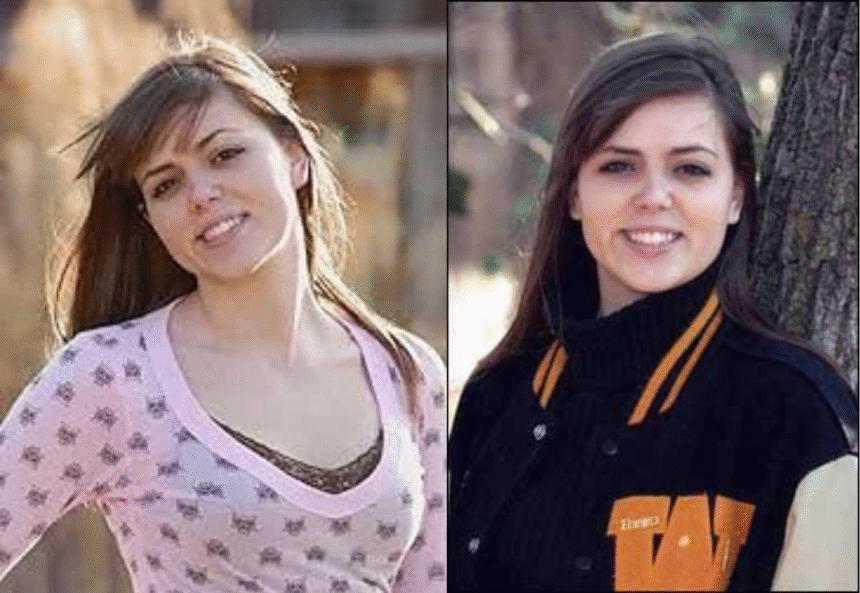
Kelsey Smith was 18 years old when she was abducted from a parking lot in Overland Park, Kansas, in June 2007. She had just graduated from high school nine days earlier.
Kelsey was born on May 3, 1989, in Charleston, South Carolina. She was the middle child of five. Her father, Greg, served in the Navy and later worked in law enforcement at a local community college. Her mother’s name was Missey.
When Kelsey was nine, the family moved to Overland Park, Kansas, roughly 20 to 25 minutes south of Kansas City. Greg was originally from the area. It was a quiet, residential community with a reputation for being safe and having strong public schools.
At Shawnee Mission West High School, she played clarinet in the marching band, sang in the choir, participated in theater, and ran track. She kept solid grades throughout. Friends and family described her as kind, funny, and easy to be around.
Her parents rarely had to worry about her. She was responsible, stayed out of trouble, and followed the rules her parents set. After graduating on May 24, 2007, she had plans to attend Kansas State University to study veterinary medicine.
She also intended to join the marching band there alongside one of her sisters. That summer was supposed to be her last one at home before starting that next chapter.
By June 2007, she had been dating her boyfriend John Biersmith for six months. Their families considered the relationship serious. John had planned to give her a promise ring on their six-month anniversary, which fell on Saturday, June 2, 2007.
That evening, the two had plans to attend a friend’s pool party and then go out to dinner. Before meeting up with John, Kelsey wanted to make a quick stop at a nearby Target to pick up a gift for him. She was putting together a scrapbook and needed a box, wrapping paper, and a few supplies.
She left home around 6:30 p.m. She briefly came back inside to grab a CD she had forgotten, said goodbye to her father, and left again. Her mother was driving back from a wedding in Iowa and was not home.
The two spoke by phone after Kelsey arrived at the store. Missey helped her locate what she needed while they talked, and they said goodbye before hanging up. Kelsey entered Target at 6:55 p.m., paid for her items at 7:05 p.m., and walked out at 7:09 p.m.
John arrived at the Smith home at around 7:30 p.m. Kelsey wasn’t back. Nobody panicked right away. But after 30 minutes passed without any contact, Greg and Kelsey’s sister Lindsey grew concerned.
The family had a rule where Kelsey was expected to check in when she was out moving between places. She always followed it. Greg began calling different police departments to find out if she had been in an accident or pulled over. Her sisters contacted local emergency rooms. Nothing turned up.
John and Lindsey drove to Target to look for her. They thought maybe her phone had died or something simple had gone wrong. Her car wasn’t there. They drove around nearby areas looking.
Greg’s parents, who lived close by, joined the search and ended up finding her car parked in the Macy’s lot on the opposite side of Oak Park Mall. Kelsey was not with it.
Greg told the family not to touch anything. He knew right away it could be a crime scene. He called 911. By 11:00 p.m., that parking lot had become the center of the investigation.
Officers examined the car and noticed a few things immediately. Something, possibly a piece of clothing, was hanging out of the trunk. The trunk was opened and found empty.
Inside the passenger area, they found her keys, her purse, and the items she had purchased at Target. Her phone was not there, and there were no visible signs of a struggle inside the vehicle.
Her purse was a Coach bag her parents had given her as a graduation gift just days before. Leaving it behind was out of character and made it clear to investigators that something serious had happened.
Greg and Missey were questioned that night and cleared quickly. John was also interviewed at length, with the same questions asked in different ways to test consistency. His answers didn’t change, and he had a solid alibi. He was eliminated as a suspect.
Missey started calling Verizon that same night. She believed Kelsey might still have her phone and that locating it could point them in the right direction. Verizon refused to release any location data, citing privacy concerns.
Multiple representatives gave the same answer. The Overland Park Police Department contacted Verizon as well and received the same response. A court order was required, and that wasn’t something that could be obtained quickly.
Verizon told Missey she could view call history through their website, but that wasn’t useful. What they needed was the phone’s physical location.
The next morning, the community got involved fast. Greg and Missey’s home became a coordination point. Volunteers showed up ready to help. Flyers were printed and distributed across the area. Grid searches were organized and carried out.
By Monday, over 400 people were actively searching. Greg used his law enforcement experience to help coordinate. He and Missey also gave media interviews to keep attention on the case.
By the time police began their own search, nearly every person they spoke to in the surrounding area had already heard about Kelsey.
On June 3, detectives went to Target to collect security footage. The store had over 40 cameras. A representative from Target’s national investigation center came in to assist.
Footage clearly showed Kelsey entering the store, moving through the aisles, checking out, and leaving. The parking lot footage was lower quality, partly due to the technology available in 2007 and partly because her car wasn’t parked close to any camera.
On the first viewing, investigators watched her load her items into the passenger side, walk to the driver’s side, get in, and drive away. Nothing appeared immediately alarming.
Macy’s footage was then reviewed. It showed that at 9:17 p.m., Kelsey’s car pulled into the Macy’s lot. The person driving it was not Kelsey. It was a man in a white shirt and dark shorts. He got out and walked away from the camera.
Investigators went back to the Target footage and this time projected it on a large screen with more people in the room to examine it carefully. A brief flash appeared at the top of the frame as Kelsey approached the driver’s side of her car. It was a person moving quickly, wearing a white shirt and dark shorts.
When the interior store footage was reviewed again with this in mind, investigators found the same man had followed Kelsey through multiple aisles without picking up a single item. He left the store ahead of her when she moved toward the checkout.
A camera near the exit caught a clear image of his face. Additional parking lot footage showed a man matching that description arriving in a dark blue Chevrolet just one minute after Kelsey had pulled in.
That same vehicle was recorded going around the back of the store and leaving the Target lot shortly after the man was seen walking away from Kelsey’s car at Macy’s. The image and vehicle description were released to the media. Over 2,000 tips came in.
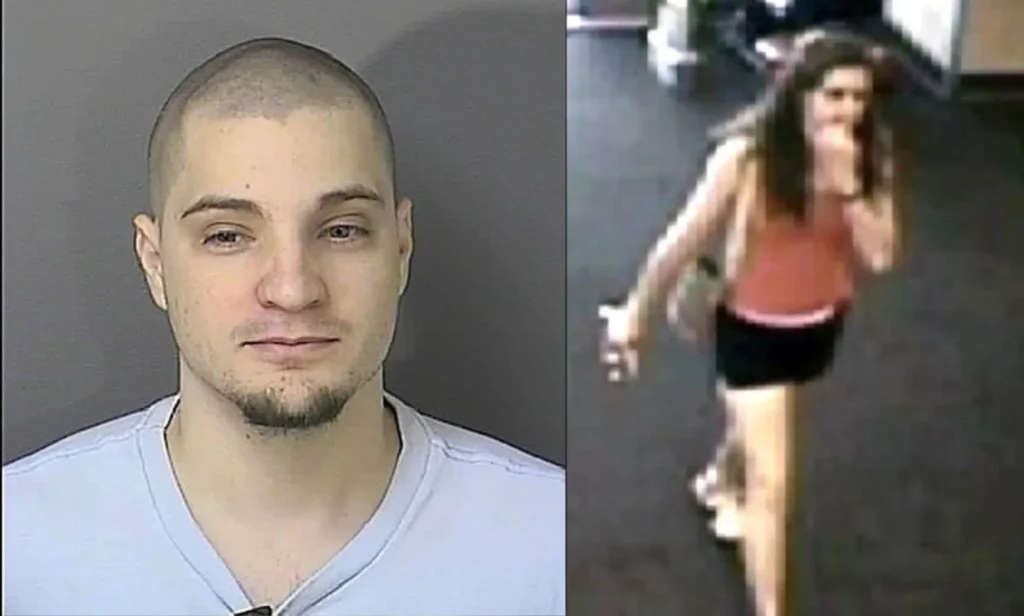
Three of them pointed to the same person, 26-year-old Edwin Hall, a local resident who matched the physical description and drove a dark blue Chevrolet.
A check of Kelsey’s computer confirmed she had no prior connection to him. Before officers could formally approach him, a lawyer contacted police saying Hall wanted to speak with investigators.
When officers arrived at his home, he was there with his wife and child, loading boxes into a truck. He was brought in for questioning.
During the interview, Hall acknowledged being in the Target footage but denied any involvement in Kelsey’s disappearance. He was dismissive throughout and at one point asked investigators what evidence they had found, which was not information they were going to share.
He even stated that he remembered noticing Kelsey in the store because he thought she had nice legs. He attributed cuts and scrapes on his hands to yard work. When investigators suggested he provide DNA and fingerprints to rule himself out, he agreed.
His wife also brought in the clothes he had worn that day. Everything was sent to the crime lab. Within hours, a thumbprint recovered from the seat belt buckle in Kelsey’s car matched his print.
Around the same time, the FBI stepped in and obtained Kelsey’s cell phone location data from Verizon, something law enforcement had been requesting for days. The data traced her phone along Highway 435 to a final location near Longview Lake in Missouri. A search of that area was launched immediately.
It took 45 minutes. Kelsey’s remains were found approximately 150 feet into a wooded area, partially covered with sticks and leaves. Her belt was around her neck. Her clothing was found nearby with bleach stains on it, indicating an attempt to destroy forensic evidence.
An autopsy confirmed she had been strangled and sexually assaulted. Defensive wounds on her hands indicated she had resisted.
Hall was arrested and charged with kidnapping, rape, sodomy, and capital murder. In 2008, he pleaded guilty to avoid the death penalty. As part of the plea, he provided a full confession. He admitted going to Target specifically to find a victim.
He followed Kelsey through the store, went to his car to get a BB gun designed to look like a real firearm, and used it to force her into her vehicle. He directed her to drive to Longview Lake. After committing the crimes, he drove her car to the Macy’s parking lot, left it, and returned to his own vehicle.
A total of 119 pieces of evidence connected him to the crime, including his DNA on the steering wheel, on the BB gun, and traces of Kelsey’s DNA on his clothing. He was sentenced to life in prison without the possibility of parole.
Less than five weeks after losing their daughter, Greg and Missey founded the Kelsey Smith Foundation on July 7, 2007. The foundation focuses on personal safety education and has held speaking engagements across the country.
Greg was later elected to the Kansas House of Representatives in 2010 and served in the Kansas Senate from 2013 to 2017.
In April 2009, Kansas passed the Kelsey Smith Act. The law requires cell phone providers to share a customer’s location with law enforcement without a warrant when there is credible reason to believe that person’s life is in danger.
Under the law, it is law enforcement, not the provider, that determines whether the situation qualifies.

Recent Comments