

In April 2020, Phoenix Netts was stabbed to death inside a women’s refuge in Birmingham. Her killer was a fellow resident named Gareeca Conita Gordon.
Phoenix Netts was born in the early 1990s in Croydon, South London. She was the only child of Mark and Saskia. Classmates remembered her as bright and articulate. She loved drama, performing, and horse riding.
By 18, she had enrolled at Canterbury Christ Church University in Kent, aiming to become a paramedic. She never finished. Between her first and second year, she left. Those close to her said depression, occasional drug use, and academic pressure played a role.
Despite this, her relationship with her parents remained strong throughout her life. She eventually settled in Birmingham, a city she grew fond of.
By late 2019, her circumstances had become unstable, and she moved into a women’s refuge in the Lozells area of West Birmingham. It was meant to be temporary. She planned to return to London and move back in with her parents as soon as she could.
Also living at that refuge was Gareeca Conita Gordon, a 28-year-old Jamaican national. She had moved to England at age seven to live with her aunt, and her mother followed later. She attended an all-girls secondary school in North London.
Her early years appeared ordinary, but her late teens took a damaging turn. She became involved with an older man who exploited her and forced her into sex work. It was an abusive relationship that caused lasting harm.
By adulthood, she had been diagnosed with a personality disorder. She struggled with a very low tolerance for frustration and intense difficulty handling rejection. These conditions were never properly treated.
By early 2020, she had left London and was staying at the same refuge in Birmingham where Phoenix lived.
The two women ended up in neighbouring rooms. Over time, they began speaking. Their connection was built more out of sharing the same space than any genuine closeness. By February 2020, that dynamic had already shifted into something troubling.
Phoenix began telling friends that something felt wrong. Gareeca had been repeatedly asking her for sex. Phoenix was clear every time that it was unwanted. She tried to stay calm and keep the peace, but the situation was genuinely frightening her.
On April 7, 2020, she sent a text to a friend that read: “There’s a girl here who keeps asking me to be sexual. I think I’m going to have to move back to London. It’s scaring me.”
On the night of April 11, Gareeca called the Samaritans while drunk and distressed. She spoke about wanting to have sex with another woman at the refuge. That same night, the United Kingdom entered a strict national lockdown due to the COVID-19 pandemic.
The lockdown changed Phoenix’s situation immediately and drastically. Her plan to return to London became legally impossible. Visitors were not permitted. Staff at the refuge were rotated on limited schedules, and support services were significantly reduced.
Phoenix was now confined to the same building as someone who had been frightening her, with no realistic way out. They shared the same kitchen, the same hallway, and the same bathroom. A place designed to provide safety had, for Phoenix, become the opposite.
Her messages during this period reflected growing anxiety. She continued telling friends she planned to leave as soon as restrictions were lifted, but her tone had clearly changed.
Meanwhile, Gareeca’s behaviour was worsening. Her fixation on Phoenix intensified, and her emotional state became increasingly unstable. With fewer staff present and no way for Phoenix to create distance from the situation, the tension inside the refuge continued to build with each passing day.
In the early hours of April 16, 2020, Phoenix was on the phone with a friend. She again expressed her intention to return home once lockdown ended. Shortly after that call, Gareeca entered Phoenix’s bedroom and stabbed her four times in the chest.
She then left, taking Phoenix’s mobile phone with her. Phoenix was left on the floor, mortally wounded, with no means of calling for help.
What followed over the next several hours was deeply disturbing. Other residents in the refuge heard unusual noises coming from Phoenix’s room. There was banging, scraping, and the faint sound of a woman’s voice.
Several of them later stated they heard Phoenix say the word “help.” No one intervened and no one called anyone. Medical evidence confirmed later that Phoenix could have survived for up to twelve hours after the attack had someone stepped in to help her in time.
While Phoenix remained in that room, Gareeca was using her stolen phone to conduct a series of searches. Between 10:04 p.m. and 3:07 p.m., she searched how to treat a punctured lung, what internal bleeding does to the body, and whether someone can survive a stab wound. She did not return to the room.
By the morning of April 17, Gareeca had shifted fully into concealment. She purchased a 45-pound circular saw through Gumtree, having it delivered directly to the refuge.
Before 11 a.m., she used it to dismember Phoenix’s body. She then cleared out the bedroom entirely. The mattress, bed frame, carpet, and underlay were all removed. The floor was scrubbed heavily with bleach.
She hired two men separately, both completely unaware of what had taken place, and paid them to carry rolled carpets and heavy black bags out of the building.
With the room cleared, Gareeca turned to Phoenix’s phone and social media accounts. She began sending messages to Phoenix’s friends, her housing support manager, and her parents, impersonating her.
The messages were precise. She matched Phoenix’s writing style, her abbreviations and her use of emojis. Those receiving the messages had no reason to question them.
Gareeca also downloaded a voice editing application and used existing recordings of Phoenix’s voice to produce audio messages, which she then sent to contacts. To everyone on the outside, Phoenix appeared to still be alive.
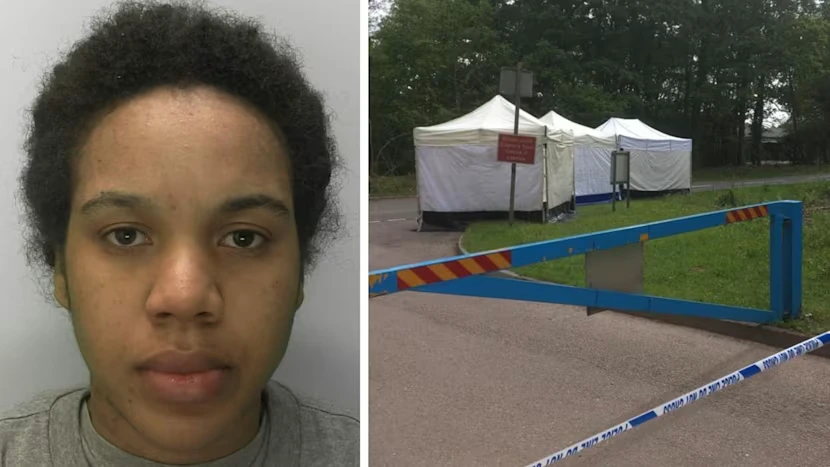
Phoenix’s remains were packed into two large suitcases. In the days that followed, surveillance cameras across Birmingham captured Gareeca’s movements without anyone realising what they were recording.
One clip showed her cycling through residential streets while transporting a heavy suitcase. Another recorded her at a police station, visibly agitated and holding her phone, claiming she needed to charge it and was waiting for a friend.
When officers asked for her identification, she became noticeably panicked and evasive.
The following day, a camera recorded her entering a Home Bargains store, where she bought cleaning products and a sleeping bag using cash, then left abruptly. She booked a taxi shortly after, but the driver abandoned her at a petrol station, sensing something was wrong.
Left stranded, Gareeca contacted the police and reported that the taxi driver had stolen her bag. When officers asked what the bag contained so they could assist, she immediately retracted the claim and said the driver had returned it. The matter was dropped.
Shortly after, she conducted further searches on Phoenix’s phone. These included how killers get caught, whether a body can burn to ashes using petrol, and what happens when a body is burned with petrol.
She then used Gumtree to hire a man named Mahesh Sorathiya, arranging for him to drive her from Birmingham to the outskirts of Coleford, near the Forest of Dean in Gloucestershire.
On May 12, 2020, Mahesh collected her and drove her to Stowfield Quarry. She asked him to stop at the entrance, said she needed to retrieve something, and told him to return for her later. She did not reappear.
As time passed and Gareeca failed to come back, Mahesh grew concerned and began driving circuits around the surrounding road looking for her. A local resident noticed his car repeatedly circling the area and contacted police.
Officers ran a check on his licence plate and found the vehicle was registered to an address in Wolverhampton, approximately 80 miles away. Under the lockdown regulations in effect, that distance of travel was not permitted without lawful reason.
Officers stopped him, questioned him briefly, and he told them he was waiting for a friend. He was issued a warning and directed to return home.
Less than an hour later, those same officers returned to the area. Something had not sat right with them. Near the entrance to Stowfield Quarry, they spotted the same vehicle, now parked with its engine off.
Standing beside it was a woman with two large suitcases. Body camera footage captured everything that followed. From the moment officers approached, she was agitated and attempted to block them from getting near the luggage.
As they moved closer, she became increasingly erratic, speaking over them and insisting she could explain. Officers informed her she was obstructing them and placed her under arrest.
When officers opened the first suitcase, they found human remains inside black bin bags. The second suitcase contained more. Both Gareeca and Mahesh were arrested at the scene.
During questioning, Gareeca’s responses were inconsistent and contradictory. She offered several different explanations, none of which aligned. Mahesh cooperated from the beginning.
Investigators quickly established that he had no knowledge of or involvement in the murder. He had responded to a job listing online and had no awareness of what he had been transporting.
Gareeca’s trial began in April 2021. Prosecutors presented the evidence in full. This included surveillance footage from multiple locations across Birmingham, forensic findings, mobile phone records, and every search conducted on Phoenix’s stolen device.
When investigators searched Gareeca’s room back at the refuge, they recovered a hacksaw that still had Phoenix’s blood on it. The evidence against her was extensive and direct.
Her defence team did not dispute the facts of the case. Instead, they focused on her personal history. They described the trauma she had experienced, her clinical diagnosis, and the years of abuse she had suffered after being forced into sex work as a teenager.
Her own mother submitted a written statement to the court describing her daughter as a ticking time bomb who had never received the mental health support she needed.
She made clear she did not view her daughter as an inherently bad person, but as someone who had been repeatedly failed by systems that should have intervened long before it came to this.
Phoenix’s parents each delivered victim impact statements during proceedings. Her father said the family’s anguish was indescribable and that their lives had been irreversibly changed. Her mother described herself as forever devastated and forever empty.
The judge described Gareeca as a very dangerous woman. She characterised the crime as callous, calculating, and evil. Gareeca was sentenced to life in prison with a minimum term of 23 years and six months.



Recent Comments