
Early on Halloween morning in 2019, police in Hays, Kansas, were called to a home where a 26-year-old woman, Kristen Trickle, had been shot.
The Morning of October 31, 2019

At 5:37 a.m. on October 31, 2019, the Hays Police Department dispatch center received a call from Colby Trickle about his wife, Kristen. The morning was cold, and snow covered the ground.
Sergeant Brandon Hauptman, the sergeant on duty, arrived at the couple’s home shortly afterward and found Colby waiting on the porch. Tears were coming down Colby’s face, and he was so choked up that he was difficult to understand.
Hauptman and the other officers announced themselves at the front door and went inside. Looking to his left, the sergeant saw Kristen lying in the bedroom. He noticed that her jaw was moving.
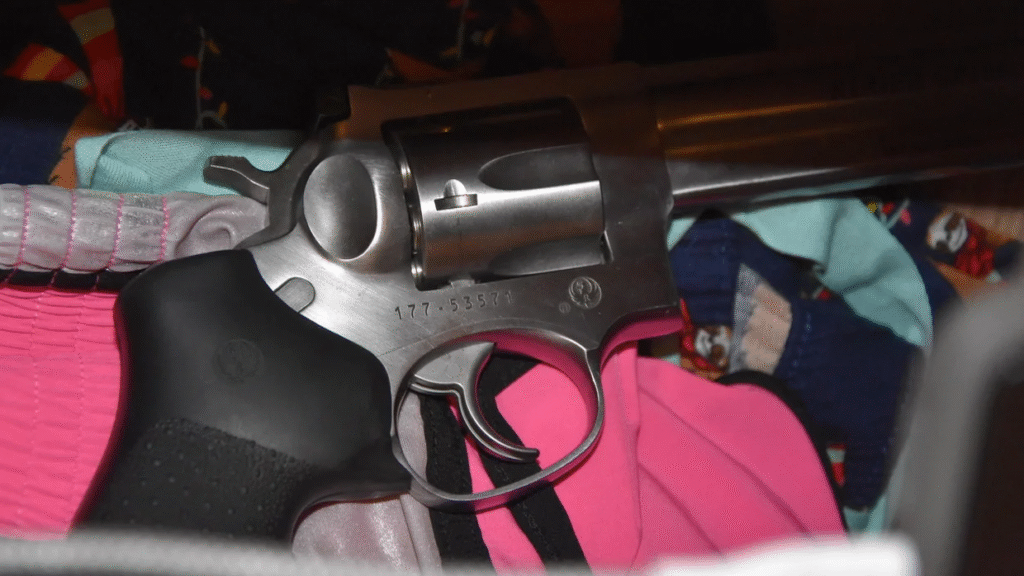
A large-caliber revolver rested across her abdomen, and she was wearing only underwear. The only injury Hauptman could see was an entrance wound beneath her chin.
Officers confirmed that she had a pulse. Hauptman moved the revolver away from her, carried her into the living room and began CPR.
While the effort continued, Colby remained on the porch and talked with other officers about video games, naming Counter-Strike, Call of Duty and Minecraft among the titles he enjoyed. Hauptman’s body camera recorded only audio that day, and it captured the conversation.
Responders could not save Kristen, and she died. Hauptman went outside and told Colby, who asked whether the officers were sure.
Hauptman then asked him to come to the police station to explain to investigators what had happened. Colby agreed, and officers provided him with shoes.
At the station, Colby described the night. He said Kristen had come home from her job in the garden center at Walmart and that the two had played video games. He went to bed before she did.
He woke to ringing in his ears and found Kristen lying beside him with a gunshot wound to the head. She was looking at him. He ran to his phone and called 911.
During the call, Colby said, he checked Kristen’s pulse and felt nothing. He then picked up the revolver, which had been lying by her neck, and pulled it back. For a moment he thought about taking his own life and held the gun to his head.
But he was still on the phone, dispatchers had told him help was on the way, and he believed responders might be able to save his wife. He set the revolver back on her stomach and ran outside. He described her death as a suicide.
While Colby was still at the station, Kristen’s aunt and uncle, Delynn and Brant Rice, learned she had died. Brant is a local pastor. When they heard how her death had been described, they told investigators that Kristen was the last person they would expect to take her own life.
They said she was a joyful person who did not run from problems, and that she would not have died without tying up loose ends with her family and arranging for the care of her two dogs.
Questions and a Ruling of Suicide

Colby spent more than 11 hours with investigators, who asked him repeatedly to recount the previous night. He said he and Kristen had not fought the day before.
He also described his work for the US military, saying he served in human intelligence and had been sent to the Middle East and Central America.
He said the assignments took him to interesting places. Detective JB Burkholder, who took part in the questioning, formed the impression of a decorated service member who loved his wife.
Asked about life insurance on Kristen, Colby said he had a military policy on himself but none on her. When investigators asked whether he had killed his wife, he answered no. He left the station that day.
At the house, the scene was being examined by Coroner Lyle Noordhoek. He concluded that the revolver had been held close to Kristen’s chin and parallel to her body when it was fired, which he said, in his experience, was not unusual in a self-inflicted shooting.
He looked for any evidence that someone else was involved, including signs of a struggle or defensive wounds, and found none. He also checked for evidence of past physical abuse, which typically appears as a series of progressive injuries over time, and saw nothing of the kind.
Burkholder, who had also responded to the home, said suicides occur several times a year in the area, but this one seemed different to him. A woman with a gunshot wound to the head was unusual in his experience.
When he arrived, a cell phone alarm was sounding. Kristen had set it to wake up and prepare for work, and Burkholder silenced it.
Candy had been set out in the kitchen, and Kristen and Colby had planned for Halloween to go on as normal, including trick-or-treating. Burkholder said people who are thinking about suicide are often not setting alarms for the next day.
The weapon troubled him most. It was a full-size .357 revolver, a large-caliber handgun about 11 to 12 inches long that can be hard to handle. He did not think it likely that a smaller woman could place it under her chin and fire it in a dark bedroom.
He also found it odd that Colby had put the revolver back on his wife’s body while a call for help was in progress. Hauptman, meanwhile, had been struck that Colby stayed on the porch chatting while officers worked to save her.
Kristen’s autopsy took place that day. Three days after her death, Noordhoek ruled the manner of death a suicide. He said he had made the decision on the information available to him, taking the husband’s statement at face value.
The ruling troubled Kristen’s relatives, whose doubts grew as they learned more. Kristen was afraid of guns, they said, and was very private and modest about her body, so learning that she had been nearly undressed shocked them.
The Rices also shared with authorities their concerns about Colby’s behavior over the years. Kristen and Colby had met at 18 at the church the Rices attended, where Colby played on the worship team.
For years afterward, the Rices said, they were bothered by what they described as controlling behavior. If Kristen did not answer a text or a phone call immediately, he became very frustrated, and he wanted her at his beck and call.
They told Kristen they had serious concerns about her husband. She was unhappy with them for it, and Brant believed Colby had convinced her that her family was against her. She pulled away from them somewhat.
Kristen later married Colby and moved almost 300 miles away to Kansas City. Life there was difficult. Colby enlisted in the Army Reserve and did odd jobs, Kristen worked at a veterinary clinic, and money was tight.
In early 2019, the couple returned to the Hays area, and Kristen began attending the Rices’ church again. Her relatives were thrilled.
Evidence on the Phone
On the day of the shooting, investigators obtained a warrant to search Colby’s cell phone. Two discoveries stood out to Burkholder. The first was a series of flirtatious Snapchat messages Colby had exchanged with another woman, which the detective described as sexual in nature.
The second was a screenshot, found by Detective Ridgeway, of a search made 10 days before Kristen’s death asking how much a spouse’s life insurance would pay.
Investigators learned that Kristen was covered by a life insurance policy provided through the military for service members and their families, and that Colby had looked up its payout amount. Burkholder said this contradicted what Colby had first told investigators.
On November 4, 2019, Colby returned for a second interview and agreed to speak without a lawyer. Investigators asked him about the insurance search.
He said he had never made it and suggested Kristen might have done it on his phone, noting that the couple had always given each other access to their money and accounts.
They also asked about the messages. Colby admitted the relationship had begun a few months before Kristen died, after he met the woman in a group chat while playing video games. He described it as strictly virtual and said he had never met her in person.
Asked whether Kristen had found out, he said he did not think so. Investigators had discovered that Colby was texting the woman within hours of Kristen’s death, while he was still at the police station. He had told her he was busy and could not talk, but wrote that he wished he could.
Burkholder tested the claim that Kristen had used the phone by obtaining surveillance video from the Walmart store where she worked. The footage showed that Kristen was at her job when the search was made and had no access to a phone.
The location of the revolver also raised questions. Colby had said Kristen kept the .357 on her side of the bed. At the scene, however, investigators saw multiple firearms on the side described as Colby’s.
Photographs of the couple’s bedroom on Colby’s phone, taken about a month before Kristen’s death, showed a large-framed revolver lying on the bed on the side Colby claimed as his. It was the only .357 found in the house, and Burkholder concluded it belonged to Colby.
Despite these findings, the case moved slowly. Assistant Ellis County Attorney Aaron Cunningham said the coroner’s ruling of suicide limited investigators’ ability to obtain search warrants, even though they still had leads to follow.
In the winter of 2020, Colby began collecting payouts from two life insurance policies on Kristen: $23,000 from Walmart and $100,000 from the US military. Around the same time, investigators learned more about his own service.
The military told them he was a Reserve officer who had never been deployed. He had no overseas deployments and, as an intelligence analyst, no experience speaking with informants.
Police still did not arrest him. Over the following year, Colby went on with his life, playing music at a restaurant in town and posting self-help videos on Facebook. Burkholder said running into him in public was very frustrating.
A Charge and a New Kind of Autopsy

In January 2021, Robert Anderson took office as the newly elected Ellis County attorney. Within days, Cunningham and Burkholder pulled him aside, told him they believed Kristen’s death was a homicide and asked for his help.
After reviewing the file, Anderson concluded the coroner had gotten it wrong. On July 14, 2021, he charged Colby with murder. Anderson said the insurance money certainly provided a motive and said the circumstances of Kristen’s death did not point to a woman planning suicide.
Officers arrested Colby after asking him to step out of his car, nearly two years after Kristen’s death. He did not appear surprised.
Detectives told him he was under arrest and to put his hands behind his back, and he complied. He told them he had not killed Kristen, adding, “I know many people don’t believe that and I respect that.”
Cassy Zeigler, one of Colby’s defense attorneys, said she did not believe he had shot his wife. She described him as a devoted Christian who cares about his spiritual life and said she saw in him no ability to plan such a crime.
Zeigler said Kristen had suffered from depression since childhood and had endured more pain than people acknowledged. The coroner also held to his finding, which gave the defense confidence going into trial.
He said he had the power to change it before trial but would not alter it to homicide on the strength of an accusation made before court proceedings.
To convince a jury that Kristen had not died by suicide, Anderson turned to a method never before used in a Kansas criminal case: a psychological autopsy. The method seeks to establish the state of mind of a person who has died.
He hired forensic psychologist Dr. Ashley Christiansen to examine Kristen’s state of mind before her death. Because Kristen could not be interviewed, Christiansen spoke with her family, friends and co-workers and reviewed her social media, diaries, journals and other materials.
The Trial, Verdict and Appeal
The trial began in September 2023. In his opening statement, Cunningham told jurors that Kristen had been murdered for the oldest reasons in the world. The case, he said, was as simple as ABC: an affair, a breakdown of control and cold hard cash.
Zeigler responded that the online relationship was a flirtation rather than an affair and that she saw no plan for a long-term, intimate one. She also denied that Colby had plotted to kill Kristen for cash.
On the insurance search, she said Colby did not remember making it and had been filling out paperwork for his own military life insurance around that time, so the timing might be a coincidence.
Jurors heard that Colby had collected more than $120,000 from the two policies and had spent all of it in about eight months. Burkholder testified about one payment of $1,942 to True Touch Dolls, a company that makes and sells life-size sex dolls.
Zeigler said Colby had trouble sleeping alone and had been open about the purchase, even discussing it with his mother.
Brant Rice testified that in the months before her death Kristen had become more assertive with her husband, and the family was proud of her for it. Prosecutors also introduced text messages from April 8, 2019.
Colby had written that Kristen seemed different and pushy about things. She replied that she was deciding to stick up for herself, just as he did, and was taking control of the situation. Cunningham said the exchange showed that Colby feared losing control over his wife.
The prosecution’s star witness was Christiansen. She testified that the information she gathered showed considerable hope in Kristen around the time of her death.
Kristen had spoken optimistically with relatives about her future, Christiansen said, and wanted to open her own business, either pet boarding or dog grooming.
Colby had told her in an interview for her report that Kristen knew about his online relationship. In her opinion, Kristen was at low risk for suicide when she died, and she said it was relatively less likely that the death was a suicide.
Zeigler argued the report should not have been admitted as evidence. Christiansen had never met Kristen, and her interviews and report came almost two years after the death.
Zeigler said memories change over time. She also said the phrase “relatively less likely” told her nothing, because no one can know the mind of a person who ends her life.
On September 22, 2023, Colby decided not to testify. Zeigler instead called his mother, who described Kristen as reserved, someone who rarely revealed her feelings and was hard to read.
Zeigler said this differed sharply from the family’s description of Kristen and argued that no one could know how Kristen truly felt. She suggested that learning of an emotional relationship online could have been the last straw.
In his final argument, Cunningham displayed the revolver and told jurors Kristen could not have fired it. The claim that she did, he said, did not add up, and the state would demonstrate why.
An autopsy photograph showed a small divot at the 3 o’clock position, which the coroner believed was the imprint of the gun’s sight.
Kristen was right-handed, and Cunningham said the natural way for a right-handed person to hold a gun to the head in a suicide would place the sight mark somewhere between the 9 o’clock and 6 o’clock positions. A mark at 3 o’clock, he said, would be very unnatural.
Using a similar gun, Cunningham showed how he believed Colby shot his wife as she slept beside him. He would have taken the revolver from the nightstand, rolled over, placed it just beneath her chin and pulled the trigger.
Cunningham said that was consistent with the sight mark and with a mark on her neck. Zeigler said the coroner’s continued position that the death was a suicide was significant, since the defense needed to show only reasonable doubt.
Kristen’s family feared that Colby might walk out a free man if even one of the 12 jurors had doubts. The jury deliberated for about two hours and 15 minutes.
It found Colby guilty of first-degree premeditated murder and of interference with law enforcement for falsely reporting information. Kristen’s family said they felt they could breathe again and that they had their lives back.
Afterward, Noordhoek said he planned to amend Kristen’s death certificate to read homicide. He acknowledged he had decided on suicide before speaking with anyone in her family or seeing the weapon, and he said police had not told him about the insurance research or the online relationship.
Details such as the size of the weapon, he said, would normally reach him through police and the pathologist, but they had not in this case. Had he known, he said, he would not have left the ruling as suicide. Investigators acknowledged they should have done a better job keeping him informed.
Colby returned to court for sentencing on November 20, 2023, about two months after the verdict. He said only that he could have been a better husband.
He said he could not apologize for something he did not do, but took partial blame for that morning and always wondered whether Kristen would still be here. The judge sentenced him to life in prison with no possibility of parole for 50 years.
Colby appealed to the Kansas Supreme Court, which heard oral argument on December 16, 2025.
He challenged the admission of the psychologist’s opinion and of the police recordings, the exclusion of a defense witness who would have described an unrelated suicide, and the evidence of the doll purchase. He also alleged judicial bias and prosecutorial misconduct in closing arguments.
On September 11, 2026, the court affirmed both convictions in a unanimous opinion written by Justice Caleb Stegall. It held that admitting the psychologist’s testimony was not an abuse of discretion, because it was framed around risk factors and left the final question to the jury.
The court added that most of the defense’s other objections to that testimony came too late, having not been raised at trial. It also found no error in excluding the defense witness or admitting the recordings, and no judicial bias.
The court did find fault with the prosecution. It cited a closing-argument reference to a gunshot residue report that was not in evidence, a remark that it was convenient for the defense to keep that evidence out, and flippant comments about Colby’s truthfulness.
It also assumed, without deciding, that the doll evidence was admitted in error, as the state conceded. The court concluded that none of these errors, alone or together, affected the outcome, and it described the evidence against Colby as significant.
Remembering Kristen Trickle

With Colby in prison, Kristen’s relatives say they are finally beginning to grieve. They think of her every day.
Kristen’s mother left her and her father when she was two years old. Her childhood was difficult, and at 17 she moved into the home of her aunt and uncle, Delynn and Brant Rice, and their three children. There, the family says, she thrived.
She loved the peace of the household and the sense of belonging to a family. The Rices say they knew her better than almost anyone, because they had watched her grow up. Their daughter, Chloe, regarded Kristen as an older sister. She remembers Kristen as always being there to make her smile and feel important.
Her relatives remember her smile above all. They say it is hard to find a photograph in which Kristen is not smiling. She had found her faith again, and those who spent time with her say they felt loved. They describe her as having a beautiful heart and a gentle spirit.
In her final months, Kristen had picked out a small house south of town for her planned business. A little barn behind it was to become the boarding area. Her family still drives past the house and calls it Kristen’s house. Chloe wrote a song in her memory.


Recent Comments