

Hiroyuki Sanpei was born in September 1988 in Koriyama City, in Fukushima Prefecture, one of the 47 prefectures into which Japan is divided. He was the eldest son of an engineer employed by a major company.
While Sanpei was still in kindergarten, his father was transferred to the United States, and the entire family relocated with him. Sanpei remained there until the sixth grade. In April 2001, the family returned to Japan, and he enrolled in a local junior high school.
Although he had spent much of his childhood abroad, he readjusted quickly. Friends recalled that he blended in without difficulty and soon made many acquaintances. For a time, at least until high school, he lived with his grandfather.
The family’s wealth gave him access to the best education money could buy. After finishing high school in Japan, he enrolled at a university in the United States, the country where he had spent his early years.
His mother was closely involved in his upbringing and was known for being dedicated and focused in raising her son, while his father was more withdrawn.
Neighbors remembered hearing unsettling noises from the household late at night, including the sound of objects being thrown. Over the years, Sanpei himself became violent toward members of his own family.
In his twenties, Sanpei married a woman who had attended the same high school as he had. At school the two had not been close, but they reconnected through social media once they were adults, began a relationship and eventually married.
His professional life appeared equally successful. His years in the United States had given him a strong command of English, an advantage that set him apart in Japan’s corporate world, and he was promoted ahead of his colleagues.
He earned a high salary and received praise for his work at an early age. To people who knew him only from the outside, he seemed to have a stable career, a kind wife and a secure future.
In December 2015, when he was 27, Sanpei assaulted a police officer in Hitachi City, in the northern part of Ibaraki Prefecture, which lies northeast of Tokyo. The officer suffered minor injuries.
Sanpei was arrested the following month. He denied the charge and faced no meaningful punishment. In November 2016, he bought a villa in Hitachiota City and moved in with his wife.
He would own the property for more than five years before police ever entered it. Neighbors saw the couple relaxing together on the wooden deck, drinking tea and enjoying the quiet surroundings. To anyone passing by, they appeared content, affectionate and at ease.
On January 17, 2017, barely two months after the move, Sanpei, then 28, was arrested for a second time. The allegation was that he had hugged a 26-year-old woman on the street without her consent and pushed her to the ground.
Her injuries took three weeks to heal. Eight days later, on January 25, he was arrested a third time, caught strangling a 32-year-old woman from behind, dragging her down and assaulting her.
Both women were strangers whom he had only just encountered on the street. Despite the seriousness of the two incidents, Sanpei avoided prosecution.
He and his father paid large settlements to the victims. In Japan, such payments are a recognized way of resolving cases with victims outside the courts.
Between six months and a year after moving into the villa, the couple told an elderly neighbor that they planned to relocate to Kawasaki, a city in Kanagawa Prefecture, and they soon left.
After that, only Sanpei came back to the property, once every month or two, to tend the garden and pull weeds. His wife stopped visiting altogether. When she discovered the arrests, she filed for divorce.
The payments had spared him legal consequences, but they could not save his marriage. In December 2017, Sanpei quit his company and moved to Kanagawa Prefecture, where he joined a major company in the region in a chief-level position.
He obtained the job by falsifying part of his career history and omitting any mention of his arrests. At the new workplace, he caused trouble for colleagues and gained a reputation for poor behavior.
An Online Following

While Sanpei was settling into his new job, Rina Arano had begun a very different career in Tokyo. By early 2019, she was already known in the world of soaplands, the Japanese bathhouses that offer private adult services in addition to bathing.
She worked at an establishment called New Ruby, where workers are ranked by their popularity with customers. She rose quickly through those rankings and eventually competed for the top position. She built a loyal following, and some clients returned to see her again and again.
Her life outside work developed alongside her career. She became a regular at host clubs, nightspots where women pay to drink and be entertained by male hosts.
Spending in such venues can be considerable, because patrons often pay for expensive bottles of alcohol in addition to the hosts’ company, and lavish orders are a way of showing devotion to a favorite host.
She was far more than an occasional customer, and some people described her as addicted to the clubs. Eventually, she left her family home and moved to Kabukicho, a dense neighborhood of bars, clubs and other nightlife venues in Shinjuku, one of Tokyo’s busiest districts.
The area is known as the city’s most notorious red-light district. There she lived with her boyfriend, who was said to be a host himself. Her spending was extravagant. It included champagne towers, in which glasses are stacked in a pyramid and filled with champagne, as well as costly gifts.
On some nights she spent about 700,000 yen, more than $5,000, in a single sitting. Around 2021, the couple broke up, and she moved back into her parents’ home. By then she had been working in the adult industry for roughly two years, and she did not leave it.
Between February 2021 and June 2022, Arano appeared in 82 adult videos, an average of nearly five per month, most of them released through FC2, an independent platform popular among Japan’s independent creators.
This sector operates quite differently from the mainstream studios, which are established companies with their own staff and distribution. The independent scene is made up largely of small operators.
Creators typically advertise on social media using the word “modeling” rather than stating that they produce adult content, so a performer’s account serves as both her advertisement and her direct line to potential clients.
Many of the photographers and producers are amateurs, and payment varies widely. Whether a model is willing to show her face can significantly affect what she earns, and some performers receive more than 200,000 yen, roughly $1,500, for a single shoot.
Arano was regarded as a popular model. She launched a fan club that brought in more than 1 million yen, about $7,400, per month, and her Twitter following grew rapidly.
Twitter lets users post public messages and exchange private ones, which made it a natural meeting point for creators and fans. Before the account was made private, its replies showed how many fans admired her.
The account also served as a way to find work. Arano promoted her content there and often replied to people who praised it, hoping to meet potential clients or collaborators for photo shoots and videos.
Sanpei came across the account and began sending her messages, presenting himself as a fan of her work. The two corresponded frequently, and around February or March 2022, they agreed to meet in person.
What was discussed at that first meeting has not been established. It may have concerned a filming project or a private transaction, and no evidence points either way.
Meeting at Mito Station
After weeks of further conversation online, Arano and Sanpei agreed to meet a second time. The purpose was to settle the terms of a contract before they began filming content together.
Independent performers often agree on payment and on whether the performer’s face will be shown before any filming begins. They arranged to meet at 10:00 a.m. on Sunday, June 5, 2022, at the north exit of JR Mito Station.
JR stands for Japan Railways, the country’s largest rail group. Mito is the capital of Ibaraki Prefecture, and its station is one of the main rail hubs in the region.
Arano, who was 23 and still lived with her parents, told them she was going out to meet an acquaintance. She described the outing as a casual get-together and said she would be home by evening.
She did not return that evening. Her parents waited through the day, then through another, and another. When three days had passed without any word from her, they began contacting friends, colleagues and anyone else who might have heard from her. No one had.
On Wednesday, June 8, her parents reported her missing to the police. The report formally notified the authorities that she had not come home and allowed them to begin looking for her.
Investigators set out to retrace her movements. They visited places she was known to frequent and reviewed surveillance cameras in the area she had mentioned to her family.
Footage from a camera near Mito Station showed her getting into a car with a man, and the timestamp matched the day she had left home. It was the last confirmed sighting of her, and it gave investigators their first concrete lead.
Officers traced the car’s registration to a villa in Hitachiota City. A registration record links a vehicle to an owner and an address, which allowed police to move from a camera recording to a specific location.
Residents of the area helped them identify its owner as Sanpei, a 33-year-old company employee. Neighbors said that he had recently been visiting the property more often than before.
The Search of the Villa

The investigation moved quickly once the owner of the villa was known. On Tuesday, June 14, six days after the missing-person report and nine days after Arano was last seen, officers took Sanpei into custody at the villa on suspicion of kidnapping and illegal confinement.
The property stood in an isolated rural area, surrounded by trees, with only a few homes nearby, most of them occupied by elderly residents. In his first round of questioning, Sanpei said that he knew Arano but denied any involvement in her disappearance.
The police divided into teams. Some searched the villa, while others examined his phone. This allowed the property and the owner’s electronic records to be examined at the same time.
Inside the house, they found no sign of Arano and nothing to indicate where she had gone. They did find a basement room with dim lighting and a bed to which a set of handcuffs was attached.
The mattress bore traces of an unidentified substance. On the phone, the digital forensics team, which specializes in recovering data from electronic devices, found dozens of explicit photographs and homemade videos of Arano, some showing her in sexually suggestive positions and others depicting sadomasochistic acts.
In the video clips, which were crude and amateur in quality, a handcuffed woman took part in bondage-related sexual acts with a man who appeared to be Sanpei. When investigators examined the woman’s face closely, they recognized Arano.
Police questioned Sanpei again and asked him directly where she was. He had no answer to that question, but he gave a fuller account of the meeting.
He acknowledged that he had met Arano outside Mito Station, that they had filmed videos together, and that the videos involved BDSM, a term for sexual practices built around bondage, domination and submission.
He maintained that everything had been consensual and said that, after filming, he had dropped her off at a nearby shop. According to Sanpei, that was all he knew.
Sanpei was held on that suspicion while the investigation continued. The police then widened their search around the villa, covering more ground and combing every trail and path through the surrounding forest. The search continued over the following days.
Developments in the Case
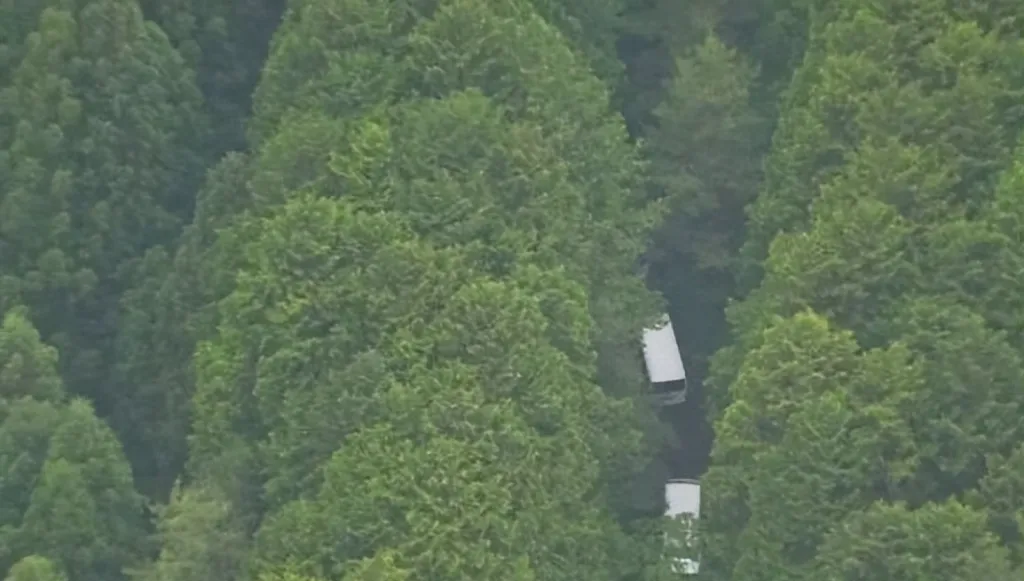
On the morning of Saturday, June 18, four days after Sanpei’s arrest and thirteen days after Arano was last seen, a cry rang out from the forest near the villa, where search teams were combing the area.
A man had come upon a body and, frightened, could only point with a trembling hand toward the spot. It was that of a woman, hanging from a tree without any clothing.
There were marks around her neck, and her skin had darkened and swollen as the body decomposed. The smell was so overwhelming that some officers became physically ill, and the scene was among the most distressing that some of them had ever encountered.
She carried no identification and no belongings. In an early statement, issued while the woman’s identity was still unknown, the Tokyo Metropolitan Police Department said the body showed no visible injury other than a wound on the neck, which was not a cut but a pressure mark of the kind left by strangulation.
The body was sent for an autopsy. The investigation, which had begun as a search for a missing person, had become an inquiry into a death.
The results were released on June 21, three days after the discovery. The examination found clear signs of abuse before death.
The left hyoid bone, a small U-shaped bone at the base of the tongue, was fractured and split, which indicated that it had been crushed with considerable force.
The cause of death was strangulation, most likely by hand. The forensic doctor estimated that the woman had been dead for about two weeks when she was found.
Because nothing identified her, investigators initially considered whether she had been connected to a separate case, and they released a description of her appearance in the hope that someone could help.
Fans of Arano came forward, saying that a distinctive mole on the woman’s face and the shape of her teeth matched those of a performer they recognized.
Among those who weighed in were users of an anonymous online forum known as 5chan, who connected the woman to a performer called Maritan. Her eyes looked different, which led some of them to conclude that she had undergone cosmetic surgery.
It was on that forum that her presence in independent adult videos was first recognized. Shortly afterward, the videos were deleted. When police contacted Arano’s family, who had filed the missing-person report earlier that month, the identification was confirmed.
On June 24, three days after the autopsy results, the Metropolitan Police Department rearrested Sanpei, this time on suspicion of abandoning a corpse, which is a distinct criminal offense under Japanese law.
Under Japanese procedure, a suspect already in custody can be arrested again on a separate suspicion, which gives investigators additional time to question him.
Despite the video files and physical traces found at the villa and the discovery of the body, Sanpei remained silent, repeated his earlier statements and refused to say anything more.
On September 9, eleven weeks later, he was rearrested on suspicion of murder, the most serious of the allegations against him.
At the Tokyo District Court on February 17, 2026, Sanpei denied the charges of murder and abandoning a corpse, saying everything was wrong, and he then stayed silent for the rest of the trial.
Prosecutors argued that he strangled Arano after filming sexual acts with her, while the defense said the filming was consensual and that no direct evidence linked him to her death. Prosecutors asked for 20 years in prison.
On March 10, presiding judge Masataka Nakagawa found no reasonable doubt that Sanpei had killed her and sentenced him to 20 years on both counts. Sanpei has appealed, so the conviction is not yet final, and no appellate ruling has been reported.
Remembering Rina
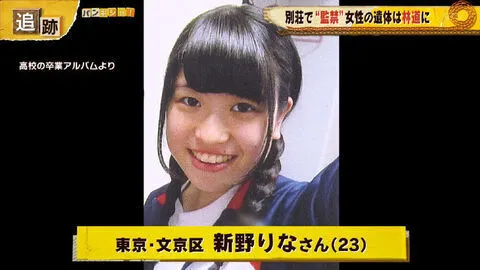
Rina Arano’s early life, which preceded all of these events, is recorded here in remembrance. Those who knew her as a child remember a gentle, determined girl.
She was born in 1999, the youngest of three sisters, in a household that many would have considered ideal and that neighbors described as warm and respectful.
Her father worked for a foreign pharmaceutical company and left early each morning in a sharp suit, always looking put together. Her mother was known in the neighborhood for her kind heart and her beauty.
She was tall and slim, with large eyes and a delicate face, and people often said she looked like someone out of a magazine. Her daughters inherited those features.
Rina’s older sister was seen as having a sweet, classic look and a constant smile, while Rina was praised for her porcelain-like complexion and gentle manner.
She grew up in downtown Tokyo. As a child she was somewhat shy, yet she made a point of smiling and greeting people. She was shorter than most of her classmates, which added to the doll-like impression others had of her.
Despite her quiet side, she was popular, and some classmates placed her at the top of the school’s social order. She was fun, friendly and confident. She held her own academically and athletically and was chosen to represent her school in a relay competition.
From an early age, she cared about her appearance. While most girls in elementary school gave little thought to such matters, she already kept a routine and spoke about skin care, lightening her skin and losing weight.
Classmates remembered, however, that she was driven by more than beauty standards. She had a vision for her future: she wanted to become a doctor. She studied hard and seemed sincere in her hope of helping others, saving lives and bringing smiles to people in need.
After elementary school, she entered Yamawaki Gakuen, a respected private girls’ school in Akasaka, a district of central Tokyo, whose students typically continued directly to university.
Photographs from that period show her in the standard school hairstyle of braided pigtails, neat and uniform, and it suited her well. After graduating, she took a different path from most of her classmates.
Rather than attending a university, she enrolled in a medical vocational school, which some say was a nursing program. She left it not long after she began. These are the memories that neighbors and classmates have kept of her.


Recent Comments