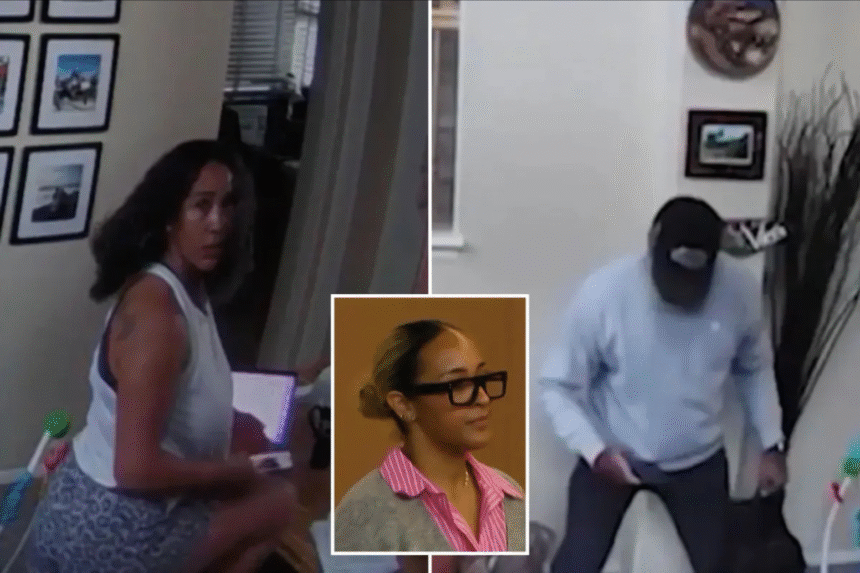
A San Diego woman admitted to secretly watching her ex-husband and his new family through their home security cameras for more than 700 hours, recording deeply private moments inside their residence.
Rayna Bell was previously married to Yantzy Villefranche. The couple lived together in the San Diego neighborhood of Rancho Peñasquitos. During their marriage, the household used Ring security cameras, and Bell had authorized access to the system at that time.
The couple’s marriage eventually ended, and their divorce was finalized in February 2023. After the split, Villefranche moved on with his life and began a relationship with Acacia Young.
Together, they started a new family. They welcomed a newborn and were raising three children in total, including Villefranche’s 10-year-old stepson.
Villefranche believed he had removed Bell from his Ring account during the divorce process. The cameras remained installed throughout the home because one of the children had begun sleepwalking.
The devices were placed both inside and outside the house, including in the children’s bedrooms, purely for safety purposes.
The couple had no reason to suspect anything was wrong. The cameras were meant to protect the family. For months, Villefranche and Young carried on with their daily lives, unaware that someone else was watching.
Young first grew suspicious in May when she noticed the camera’s blue light turning on at unusual times. The blue light indicates that someone is actively viewing or recording through the device. It would activate on its own even when nobody in the household had pressed record.
At first, she was unsure what to make of it. The couple grew increasingly uneasy but could not explain the activity. Then something far more alarming occurred.
Young heard a voice coming from one of the cameras. “It was his ex-wife’s voice,” she later recounted. The moment was deeply unsettling for the couple. Young immediately pulled down the cameras.
When they examined the Ring account, they discovered that Bell’s name was still attached to it. They also found that the Ring cameras had been connected to several Amazon Alexa devices registered in Bell’s name — devices the couple did not own.
Young said she found more than a dozen video clips that contained Bell’s voice. What the family uncovered next was far worse than they had imagined.
Villefranche filed a request for a domestic violence restraining order against Bell. The filing accused her of unlawfully accessing his private Ring camera system and linking his account to half a dozen Amazon Alexa devices registered to her.
The restraining order stated that Bell had viewed video footage for approximately 44,640 minutes — an average of 12 hours per day — over the span of two months. The cameras she accessed covered areas both inside and outside the home, including the children’s rooms.
The footage Bell live-viewed and recorded captured deeply personal and private moments.
These included Young breastfeeding their newborn, nudity and partially undressed footage of the children, and Villefranche’s 10-year-old stepson in what the filing described as vulnerable settings. The family considered the recordings deeply invasive and flagged them as possible child exploitation.
The spying extended beyond video. The restraining order also charged that Bell accessed and recorded confidential household conversations.
These included private discussions between Villefranche and Young regarding their finances, credit card numbers, banking details, Social Security information, medical records, medical health history, and other protected health and identity-related data.
The filing described Bell’s conduct as a serious invasion of privacy and potential identity theft.
“There’s no way to describe how violated you feel,” Young said. “It feels like someone touched me. It feels like I found somebody in my house, physically in my house. Like she had been in my house for months, and we had no idea.”
Villefranche sent a cease-and-desist letter to Bell along with the restraining order, which aimed to protect him, Young, and their three children. The family also reported the matter to local law enforcement. Investigators forwarded the case to the San Diego County District Attorney’s Office.
A spokesman for the District Attorney’s Office confirmed the arrest of Rayna Bell. The sheriff’s office said she was booked on three felony charges: unauthorized wiretapping, eavesdropping, and invasion of privacy by recording communications.
Villefranche and Young said they watched Bell being handcuffed on the morning of her arrest, shortly before their family court hearing was scheduled to begin. That hearing was supposed to determine whether their temporary restraining order against Bell would become permanent.
Bell was held on $15,000 bond and was scheduled to be arraigned the following week. Due to the arrest, the family court judge rescheduled the restraining order hearing to October.
At her arraignment, Bell pleaded not guilty to the three felony charges. She denied the allegations and referred to them in court paperwork as a “smear campaign.”
Multiple media outlets attempted to reach Bell for comment. They left voicemails, texted, emailed, and knocked on her door. When she did not answer, a letter was left on her doorstep. She did not return any of the attempts to contact her.
The offense Bell faced is classified as a “wobbler” under California law, meaning prosecutors may pursue it as either a felony or a misdemeanor depending on the circumstances. Had it been charged as a felony, Bell could have faced imprisonment in a state prison rather than a county jail.
As a misdemeanor, the statute carries a fine not exceeding $2,500 per violation, up to one year in county jail, or both. California’s two-party consent rule, codified under Penal Code § 632, requires that all parties to a confidential communication consent before any recording takes place.
After months of legal proceedings, the case reached a resolution. Bell pleaded guilty to a reduced misdemeanor charge of eavesdropping using an electronic device. The plea deal required her to pay restitution to the victims in an amount to be determined at a later hearing.
She was also ordered to serve one day in custody, with credit for time already served, along with one year of probation. A judge signed off on the negotiated sentence.
Young said the guilty plea brought relief to the family. “Relieved, absolutely relieved, because we’ve been trying to convince everyone, you know, of the truth and now we no longer have to do that. She admitted it herself,” Young said.
The family struggled to regain a sense of privacy and security in the months following the discovery. They ultimately chose to move into another home and replace their Ring cameras entirely. The very devices they had installed for safety had become a source of fear.
“We tried so hard to try to restore the peace, the security, the privacy. Once you are robbed of that, it’s almost impossible to try to restore that in your home,” Young said.
She added that the experience continues to affect the family long after the cameras were removed. “You’re always going to feel like they can do it again,” Young said. “Or if they had the opportunity, they would do it again.”
Bell did not respond to any media requests for comment following her guilty plea. Villefranche plans to take legal action against her in civil court, seeking further accountability for the invasion that disrupted his family’s daily life.