
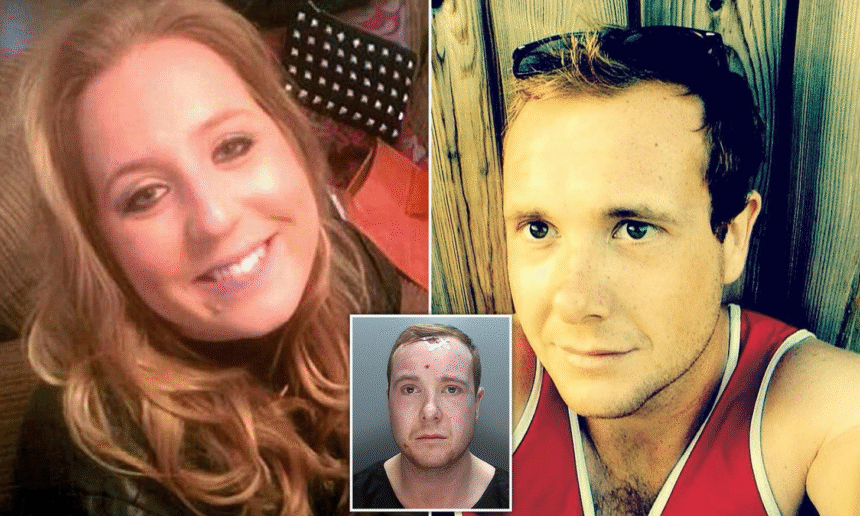
On Christmas Eve 2015, 23-year-old history teacher Katie Locke was murdered at a Hertfordshire hotel by a man she had met online just weeks earlier.
A Dangerous Man Hidden in Plain Sight
Carl Langdell’s history of violent behaviour stretched back years before he ever encountered Katie Locke. In 2009, he received a police caution for assaulting a former girlfriend.
By 2013, he had been classified as a risk to himself. He had been diagnosed with emotionally unstable personality disorder with narcissistic and antisocial traits — a profile that would grow far more alarming in the year leading up to the murder.
In early 2015, Langdell was living in Bristol with the family of his then-girlfriend, while his own family remained in Hertfordshire. On 20 March 2015, Avon and Somerset Constabulary received a call from the local Intensive Support Team reporting that Langdell had made a threatening phone call to a community psychiatric nurse.
During that call, he stated he wanted to cut the throat of his girlfriend’s sister, strip her, and sexually abuse her body. The nurse considered the threat credible. Upon learning that his comments had been passed to police, Langdell made a second call to the same team, this time threatening to slit the nurse’s throat.
He then phoned Avon and Somerset Constabulary from outside his girlfriend’s address and threatened to kill someone. Officers detained him under the Mental Health Act.
A formal mental health assessment was conducted that same day. In a detailed letter sent four days later to his GP in Hertfordshire, it was recorded that Langdell told the assessing doctor he experienced sexual gratification from thoughts of killing people, that he had harboured such thoughts since the age of 16, and that these thoughts were intensifying.
The doctor assessed him as presenting a high risk to others. However, this letter was not shared with any Hertfordshire public bodies and was seen by only one consultant at the Hertfordshire Partnership University NHS Foundation Trust.
Langdell was subsequently arrested, remanded into custody at Bristol Prison, and later appeared at Bristol Crown Court on 15 April 2015, where he pleaded guilty to two counts of making threats to kill. Sentencing was adjourned.
He was granted bail on the condition that he wear an electronic tag and reside at his parents’ home in Hertfordshire. Critically, Avon and Somerset Constabulary failed to inform Hertfordshire Constabulary that he had been bailed to their area.
Warnings Ignored, Opportunities Missed
Once in Hertfordshire, Langdell came under the care of local NHS mental health services. Staff at Hertfordshire Partnership University NHS Foundation Trust did not request any records from Avon and Wiltshire Mental Health Partnership NHS Trust and made no contact with clinicians there, despite being aware that threats had previously been made.
Reports emerged of Langdell starting fires at a hospital and of alleged sexual contact with a vulnerable female patient who lacked capacity.
Despite documented plans to refer these matters through safeguarding processes, the investigation that followed focused on the victim’s circumstances and entirely overlooked the risk Langdell himself continued to pose to women.
On 10 August 2015, it was recommended that Langdell be detained under the Mental Health Act. He was subsequently moved to an all-male ward to protect vulnerable female patients.
On 17 September 2015, he shouted at a staff nurse: “When I leave or I am discharged, I will kill someone. Document that. I will kill someone when I leave. You must document that.” Hospital staff reported the threat to Hertfordshire Police, but it was not formally recorded as a crime.
Officers arrived at the ward five days later — by which time Langdell had already been discharged. They then failed to interview him at his home address.
On 20 September 2015, he was discharged from the psychiatric hospital. On 2 December 2015, Langdell appeared at Bristol Crown Court for sentencing on the two threats to kill charges.
He received a nine-month prison sentence, suspended for two years, along with a twelve-month mental health treatment requirement and a rehabilitation activity requirement of up to fifteen days.
The inquest later found that a fully informed picture of Langdell had not been placed before the sentencing judge, meaning the court was unaware of the full extent of his documented risk.
On 11 December 2015, Langdell visited his GP and attempted to pressure her into prescribing two months’ worth of medication. She declined and issued only a one-month supply due to his history of suicidal behaviour.
The GP had the discharge report from March 2015 and the discharge summary from the community mental health team, but had no communication with the justice system and was unaware of his recent suspended sentence.
The Night That Changed Everything
Around two weeks after his sentencing, Langdell connected with Katie Locke through the dating website Plenty of Fish. He presented himself as an accomplished young man.
His LinkedIn profile claimed he had graduated from law school and founded his own law firm. He also maintained a blog titled “Ordinary Decent Human,” which addressed humanitarian issues.
Katie had no knowledge of his suspended sentence, his documented threats against women, or his long history with mental health and criminal justice services.
The two arranged to meet on the evening of 23 December 2015. They had drinks at a bar in Shoreditch, East London. Katie kept her friends informed, sharing a photo of Langdell and details of her plans.
She sent a message during the evening to say the date was going well. However, Langdell drank heavily and became severely intoxicated. Out of apparent concern for his condition, Katie arranged for them both to travel to the Theobalds Park Hotel in Cheshunt, Hertfordshire.
She paid £65 for the taxi and an additional £80 cleanup fee after Langdell was violently sick during the journey. They arrived at the hotel at 3:30 a.m. on 24 December. The hotel receptionist later noted that as the two walked down the corridor, Katie was supporting Langdell because he was unsteady on his feet.
On Christmas Eve morning, when Katie failed to arrive at a friend’s home where she was meant to housesit, concern grew quickly. Her parents had not known she was on a date.
Her friends attempted to reach her by phone repeatedly, with no answer, until eventually someone picked up. It was not Katie on the line. A man was heard making slow, drawn-out breaths and whispering her name.
Because Katie had shared a photograph of Langdell beforehand, her friends were able to find him on social media and message him on Facebook. He responded claiming she had left by taxi hours earlier and that her phone battery had died before she departed.
He said he had tried calling her and assumed she would be home by now. Katie’s father drove to Langdell’s parents’ address in Hertfordshire. His mother said he had taken the dog for a walk and rang him to ask what was happening. When he answered, Langdell told his mother: “I am a monster. I put her in the ground.”
Katie’s father immediately called the police. Langdell was located and arrested at Lee Valley Park. He confessed to an officer where he had left Katie’s body. Police moved quickly to the hotel grounds, and it was there, in undergrowth near a skip on the hotel property, that they discovered her body.
The Crime and Its Aftermath
A post-mortem examination confirmed that Katie died as a result of compression to the neck. The pathologist described the assault as forceful and prolonged, accompanied by serious sexual violence.
When police examined Langdell’s phone, they recovered photographs that had been deleted — images of Katie’s body. He later accepted that he had taken those photographs.
At the time of the murder, Langdell had alcohol, diazepam, cocaine, and antidepressants in his system. During police interviews, he declined to answer questions.
His defence team later claimed that Katie had consented to a sexual act involving restraint, and that Langdell had not intended to kill her. Langdell told his mother he had “gone too far” and reportedly stated to police: “She didn’t even put up a fight.
I expected her to hit out or something.” The prosecution described his attempt to avoid detection in the immediate aftermath: he called reception to request a late checkout, placed a do-not-disturb sign on the door, wrapped Katie’s body in a duvet, placed it in a laundry cart, and wheeled it outside before leaving her near the skip.
He then returned to the room, slept, ate breakfast, and checked out. All of the room’s bedding and towels were gone when staff entered, and the window lock had been broken.
He was charged with Katie’s murder on Christmas Day, 25 December 2015. While on remand at HMP Bedford, his violent conduct continued. He launched a sustained physical attack on a prison officer who had refused to open a cell for him to smoke in.
The officer later described how Langdell struck him in the face, smashing his eye socket, threw him against a wall, and then began strangling him.
The Sentencing and Institutional Failures
In June 2016, Carl Langdell pleaded guilty to the murder of Katie Locke and was sentenced to life imprisonment at St Albans Crown Court, with a minimum term of 26 years.
Judge Andrew Bright QC stated that the sexual abuse of her body after death “increased the depravity of the murder,” adding: “I am firmly of the view that you pose a very great danger to women and young girls with whom you come into contact in the future.”
The judge noted that Langdell had himself described his own character and actions as those of a monster and a psychopath and concluded that, once the minimum term was served, the question of whether he would ever be safely released would require careful psychiatric assessment.
Katie’s mother, Jennifer, addressed the court, saying nothing could have prepared her for seeing Langdell. Her father looked at him directly and said: “On the internet, you said you were an ordinary, decent person. You are ordinary, but you are not a decent person. Katie’s loss is huge for me.”
The family’s earlier statement released after news of the murder broke captured the collective weight of their grief: “There was not a bad bone in Katie’s body. Katie worked hard and loved her job as a teacher. We now feel like our future has been stolen from us.”
In a letter, Langdell himself wrote: “No apology I give and no sentence I receive, not even my death, could make up for what I have mindlessly taken.”
The inquest into Katie’s death, conducted by Assistant Coroner Alison McCormick at Hatfield Coroners Court, examined the failures of the public agencies involved in Langdell’s case.
McCormick ruled that “mistakes were made” and concluded: “It is clear none of the organisations managing Mr. Langdell knew what each other knew about him. There was very little information sharing and no joined-up thinking or management.”
The inquest found that five separate organisations — Avon and Somerset Police, Hertfordshire Police, mental health services in both Bristol and Hertfordshire, and the National Probation Service — had all been in contact with Langdell in the nine months before the murder, yet none had a complete picture.
It was also revealed that at the time of the murder, Langdell had been in contact with up to twenty women through dating platforms, none of whom were warned.
An independent review commissioned by NHS England found that there had been “systemic missed opportunities,” including a critical lack of information sharing between agencies.
NHS England regional medical director Dr David Levy acknowledged there had been “a gap at the heart of care planning and risk assessment” that prevented organisations from working together.
However, the review concluded that it was not possible to determine, with the level of certainty required to act, whether Langdell belonged to the three percent of people who follow through on violent threats or the ninety-seven percent who do not.
On 11 February 2021, Carl Langdell was found with a self-inflicted wound to his neck in his single-occupancy cell at Wakefield Maximum Security Prison. He went into cardiac arrest and was pronounced dead at 1:47 a.m.
Remembering Katie Locke
Katie Locke grew up the youngest of three daughters and was raised in a household where kindness was modelled and practiced from an early age.
Her father once recalled that when she was small, she came home from nursery and, when asked about playtime, explained that she had not gone out because she had been too busy helping the other children put their shoes on. That impulse to care for others stayed with her throughout her life.
She participated in the Brownies and the Girl Guides as a teenager, became a qualified kayak instructor, and volunteered at the 2012 London Olympics. She had also spent time working with underprivileged children in the United States.
She studied history and politics at the University of Southampton before teaching those same subjects at Cardinal Pole Catholic School in Hackney, East London. Colleagues and students described her as beautiful, vibrant, and deeply committed to her work.
Those who knew her used the words self-confident, fearless, energetic, reliable, and kind. She was someone who loved being part of a team and who always saw things through. As her father made clear on the day of sentencing, what was taken from their family went far beyond one person — it was a future.


Recent Comments