
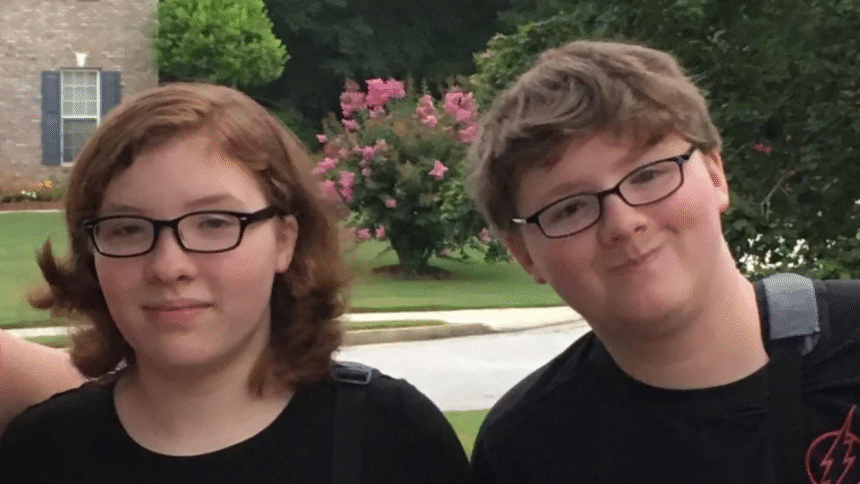
On September 29, 2021, a quiet household in Harris County, Texas, was shaken by an event that would lead to a criminal trial more than three years later.
The Elliott Household
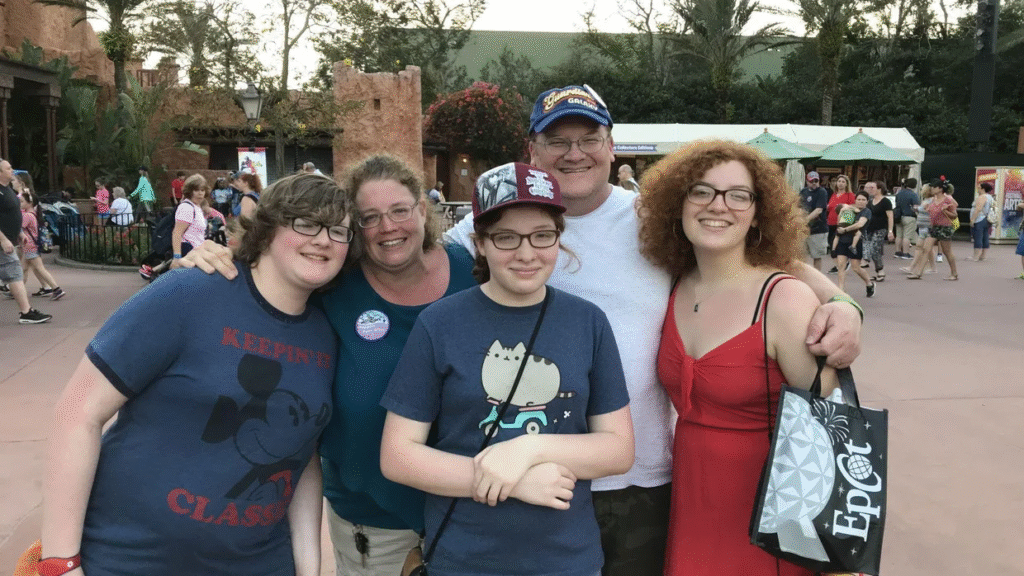
In the autumn of 2021, Michael and Kathy Elliott lived in the Houston area with their twin children, Benjamin and Meghan, who were both 17. Their eldest child, Elizabeth, had already left home for college.
Kathy worked as a senior manager with the Girl Scouts of America, and Michael was a stay-at-home father. The family loved camping and had built a large collection of knives and outdoor gear.
The twins were looking ahead to the next stage of their lives. Each had recently toured a different university, and Benjamin, who was interested in mechanical engineering, was preparing for college entrance exams. The Elliotts say the twins seemed happy in the weeks before that night.
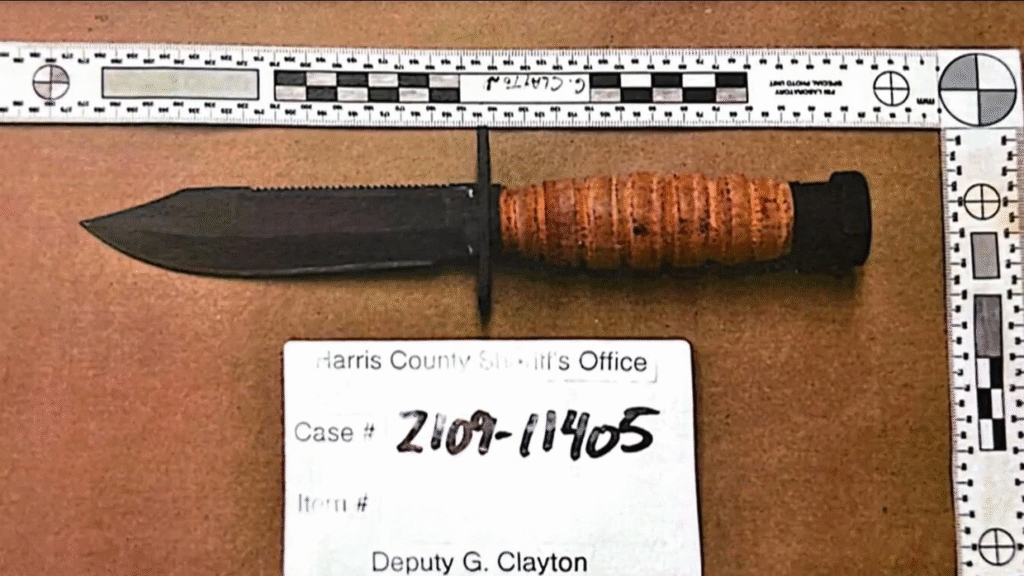
On the evening of September 28, Michael and Benjamin spent several hours together playing video games, including a title called Survive the Nights. In the game, Benjamin noticed a military-style knife that his father said looked like one he owned.
Michael offered to give it to him, went to find it, and handed it over. It was an Air Force survival knife, and Benjamin was fascinated by it. The family then went to bed.
A Call to 911
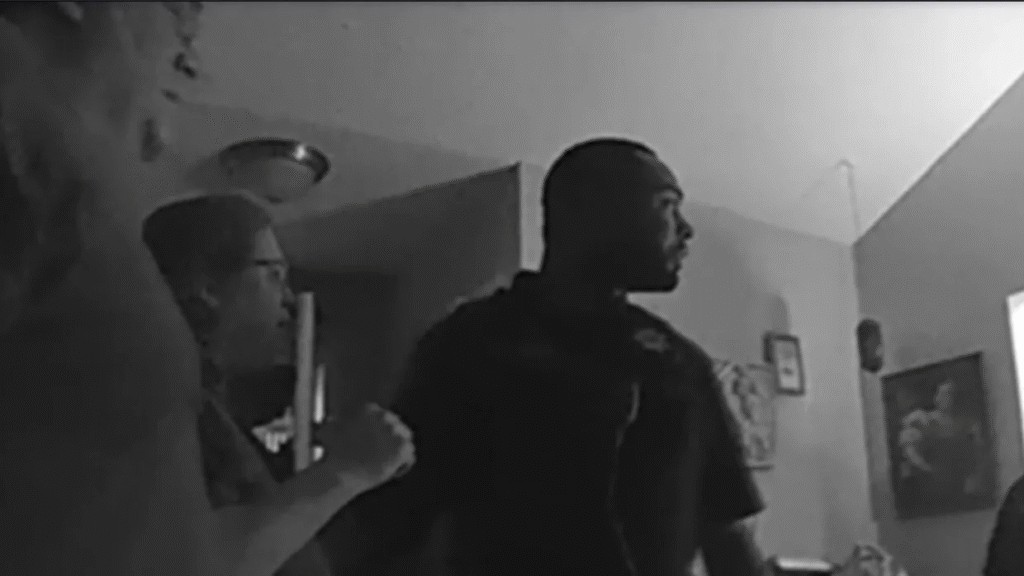
At 4:41 a.m., a Harris County 911 dispatcher answered a call and asked for the location of the emergency. The caller, a teenage boy, said he had just killed his sister. He gave his name as Benjamin Elliott.
Asked what had happened, he said he had thought it was a dream, that he had taken his knife and stabbed her, and that he did not want her to die. He told the dispatcher that his sister was 17, that they were twins, and that she was awake but barely alive.
The dispatcher asked whether anyone else was in the house. Benjamin said his parents were there but asleep, and he was told to wake them.
Shortly afterward, the dispatcher instructed him to begin CPR. He counted aloud as he pressed on his sister’s chest, and he was told to keep going until help arrived.
Michael Elliott heard his son’s voice on the call and cried out as he hurried to Meghan’s bedroom. There he found his daughter ashen and unresponsive.
Kathy, still unsure of what was happening, heard her husband’s shout from elsewhere in the house, and then heard him say that police had arrived.
When paramedics arrived, they took over CPR, and Benjamin was asked to step out of the room. His father recalled that he seemed shocked and kept saying it had been a dream.
Michael said he could not believe what he was seeing, because it did not fit the son he knew. In the rain outside, an officer searched Benjamin and placed him in the back seat of a patrol car.
According to his parents, Benjamin sat there in handcuffs for three hours while police, treating the home as the scene of an apparent homicide, secured the property.
The Elliotts asked to see Meghan, and even asked to be shown a photograph, but they were refused. No one would tell them how she was. Feeling cut off, they called a longtime friend who was also an attorney, and he went to gather information.
Questions at the Sheriff’s Office
Later that morning, Benjamin was brought to an interrogation room at the Harris County Sheriff’s Office, where Detective Freder Muñoz questioned him.
He had no lawyer with him. The detective began by asking whether he had ever had a nightmare so realistic that everything felt real and yet slightly wrong.
Benjamin said he had stabbed his sister once with the knife, but he remembered very little. Asked what he recalled after going to sleep, he said the next thing he knew was the sensation of stabbing something.
He found himself in her room with the light on, panicking, and he used a pillow in an attempt to stop the bleeding. He then ran to his own room, unplugged his phone, and called 911.
He said he thought he had fallen asleep sometime between 2:30 and 3:30 that morning. Phone records showed he had been browsing the internet before that, with activity stopping at 4:17 a.m. Benjamin gave the detective his passcode and permission to search the device.
The detective also asked about his home life and his sister. Benjamin described his relationship with Meghan as good and said he would do anything for her. He reported no rivalry and no recent fights.
He said he had never been diagnosed with a mental illness, that there were no problems at home, and that he was looking forward to college. He added that Meghan had struggled with severe depression for a time.
Throughout the questioning, Benjamin asked several times whether his sister was all right. Each time, the detective gave a reassuring answer, saying she was okay and was being checked by paramedics.
Authorities describe this as a standard technique for keeping a suspect talking, and investigators wanted him to keep speaking about his feelings toward his sister.
After about two hours, at 11 a.m., the detective told Benjamin that Meghan had not survived. By then, the family’s attorney friend had already given the news to Michael and Kathy.
Investigators now had Benjamin’s statement and the bloody knife. An autopsy then revealed something that contradicted his account: Meghan had two stab wounds, not one.
Benjamin was charged with the murder of his twin sister. He spent several days on suicide watch before being released on bail.
A Search for Answers
Michael and Kathy were waiting when Benjamin was released. Kathy recalled that he stood on the sidewalk and seemed not to notice her at first, and then appeared surprised to see her. In the car, he answered their questions in single words.
Michael eventually pulled over, walked around to Benjamin’s door, took his son’s face in his hands, and told him they loved him. Benjamin hugged his parents.
The Elliotts knew they could not return to their home and had already moved in with Kathy’s mother. Benjamin worried that he might do something else and wanted everyone around him to be safe.
For the first two nights, his parents took turns sleeping in a chair in front of his door, and they later installed an alarm on it.
His attorneys had asked them not to discuss the night of the stabbing with him, so the question they most wanted to ask, why it had happened, went unspoken.
The question weighed heavily on Kathy because her father had suffered from schizophrenia, and she feared her son might have the same illness.
Benjamin’s lawyers, Wes Rucker and Cary Hart, shared the concern and arranged for a psychiatrist to evaluate him.
Rucker fully expected to be told that Benjamin had schizophrenia or severe bipolar disorder. Instead, the psychiatrist called to say that he was fine.
The lawyers began to consider a different explanation. Benjamin had told police the stabbing felt like a dream, and they came to suspect that he had been sleepwalking. Neither lawyer had handled a case like it.
They knew, however, that defendants had won acquittals with similar claims. In 1987, Kenneth Parks of Canada drove 14 miles to his mother-in-law’s home and killed her, and a jury accepted his claim that he had been asleep throughout.
In 2010, a North Carolina jury found Joseph Mitchell not guilty after he attacked his own children in his sleep.
The lawyers turned to Dr. Jerald Simmons, a neurologist who specializes in sleep disorders. Simmons was skeptical at first and questioned whether he wanted to take part.
He agreed to study whether Benjamin could experience a parasomnia, which is abnormal behavior during sleep, such as sleepwalking.
The lawyers told Simmons that Benjamin had a history of sleepwalking. When he was about 10, his older sister, Elizabeth, found him sleepwalking outside her bedroom door.
At a sleepover around the same time, friends found him asleep on a couch eating a donut. When they woke him, he seemed confused and surprised. Simmons also learned that sleepwalking ran in the family, a factor that raises the likelihood of such behavior.
Kathy’s uncle had sleepwalked as a teenager and once wandered into the garage among the tools, and an aunt had once left her house in her sleep.
Simmons conducted two sleep studies in his laboratory, six weeks apart. Benjamin was connected to machines that tracked nearly everything his body did while he slept. He did not sleepwalk during either session.
Simmons did find that Benjamin had obstructive sleep apnea, a condition in which the airway becomes partly blocked during sleep.
The struggle to breathe, he explained, can act as a trigger for sleepwalking, particularly during deep sleep, the stage in which it typically occurs.
Simmons also noted how quickly Benjamin reached that stage. In the study, it took only 11 minutes from the time the lights were turned off.
That mattered because Benjamin’s phone had been idle for 24 minutes before the 911 call. Simmons concluded that Benjamin could have been sleepwalking during that window.
Simmons said there was no question that Benjamin had killed his sister, since he was the one holding the knife. But he believed the act was part of a parasomnia, carried out involuntarily and with no motive.
The findings surprised Benjamin’s parents, who had never imagined that such a thing could happen. Kathy and Michael found the idea frightening, since it suggested that anyone with a sleep problem could be at risk.
They hoped that prosecutors, once they learned of the conclusions, might drop the case. Michael has said he believes the tragedy would not have happened had he not given his son the knife.
The Road to Trial
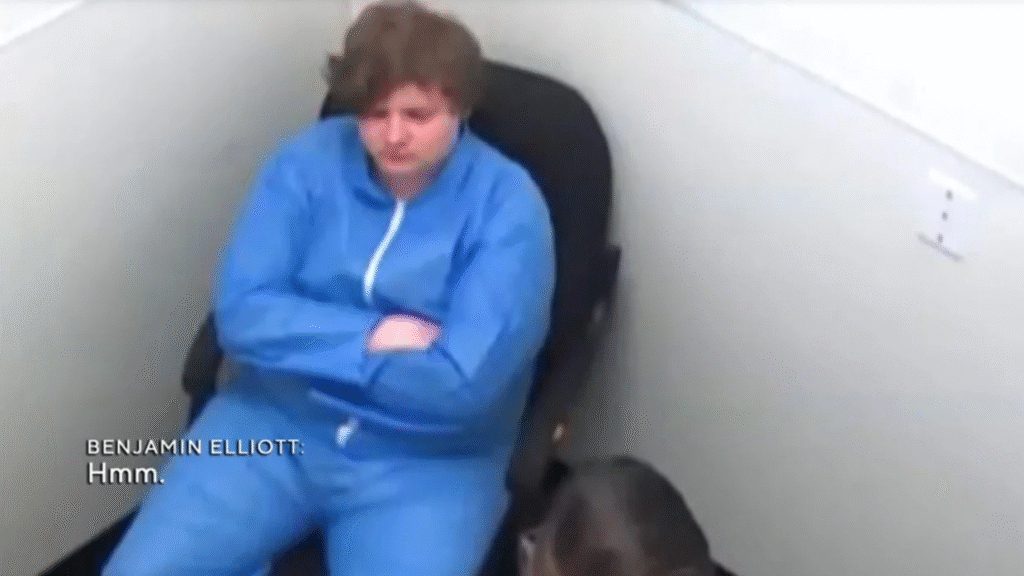
That hope faded in April 2023, a year and a half after Meghan’s death, when a grand jury indicted Benjamin, who was now 19, on a charge of first-degree murder. The prosecution was led by Megan Long and Maroun Koutani.
Long had won a conviction in 2019 against a man who claimed he was sleepwalking when he shot and killed his wife.
Long said she is a sleepwalker herself, as are her children, yet she disputed the Elliotts’ claim of a family history, because neither of Benjamin’s parents had ever sleepwalked. Family history, she noted, carries the most weight among close relatives such as parents.
The prosecution retained its own sleep consultant, psychologist Dr. Mark Pressman, who concluded that Benjamin had not been sleepwalking.
He said sleepwalkers become aggressive only when someone physically interferes with them, and that their response is a defensive reflex. He added that Benjamin would have had to take the knife out of its sheath, a complicated and conscious action.
He also found it unusual that Benjamin could describe the feeling of the knife entering his sister’s neck, because sleepwalkers do not normally keep such memories. Pressman reached these conclusions without speaking to Benjamin.
Simmons disagreed. He said Benjamin had simply told police what he could remember. Had he been inventing an alibi, it would have been easier to claim he remembered nothing at all.
Prosecutors acknowledged they could find no motive. No witness had seen trouble between the twins, and Benjamin’s lawyers said investigators had made almost no effort to learn about the family.
Long asked whether there was no motive because Benjamin had been sleepwalking, or because no one was willing to come forward.
She and Koutani still believed they could persuade a jury that his actions were intentional, and they regarded the missing motive as their biggest obstacle. They therefore made sure that prospective jurors were open to the possibility that the reason might never be known.
Before the trial, prosecutors offered Benjamin a plea deal of 30 years in prison. He declined it. His parents have said the family, having lost a daughter, now faced the possibility of losing a son.
The trial began on February 18, 2025. Benjamin’s lawyers acknowledged that colleagues thought it unlikely a jury would accept the idea of a sleepwalking killing, but they hoped to convince jurors that it was the only explanation.
In his opening remarks, Koutani told jurors that although there was no motive, the state had its killer. Prosecutors replayed the 911 call and said Benjamin was whispering.
They argued that he did not shout for his parents because he did not want them to share the reality he now faced. They also played the interrogation video and pointed to his calm demeanor, including his reaction when told that Meghan had died.
They argued that his responses showed he was not in shock and understood the consequences of his actions.
They noted that when asked where his phone was, he answered that it was at the crime scene, a phrase they thought unusual for a 17-year-old describing his own house.
They also read his remark about Meghan’s depression as a sign that the family was not as untroubled as it appeared.
Witnesses described Meghan’s injuries. One wound was four inches deep and had severed her carotid artery and jugular vein. The medical examiner testified that she would have died within minutes.
Prosecutors said paramedics found no breathing and no heartbeat, and they argued that Meghan was already dead when the call was placed.
They also said that if the knife had been pulled from her neck, blood would have sprayed on the walls, yet none was found.
In their view, the blood-soaked pillow had been used to muffle her screams rather than to help her. Michael Elliott was asked to identify his daughter’s body from an autopsy photograph.
When the prosecution rested, Hart and Rucker took over for the defense. They told the jury that sleepwalking was a real condition and not a ruse, and they called the suggestion of family problems ridiculous.
Benjamin, they said, knew what would happen to him if he killed his sister, and he had nothing to gain and everything to lose. They pointed to the 911 call as evidence of a young man pleading for his sister’s life.
Drue Whittecar, a family friend, testified that she never saw Benjamin change from the gentle teenager she knew. Childhood friend Anand Singh appeared by video to describe the sleepover and the confusion on Benjamin’s face.
Benjamin’s great-aunt, Martha Knight-Oakley, a psychologist, described her own history of sleepwalking, including a night when she came to in the bushes holding her dog. Simmons testified for four hours about the sleep studies.
Pressman then returned on rebuttal and repeated that Benjamin had not been sleepwalking, saying he had come out of the state far faster than any sleepwalker could. Benjamin did not testify.
In closing arguments, prosecutors described a deliberate killing. The defense answered that a person trying to hide a crime would not call 911 or beg for help, and urged jurors not to convict a 17-year-old over his appearance or his answers to interrogation questions.
Long spoke last. She said she understood a parent’s wish to protect a child, but she suggested that the Elliotts had been shielding Benjamin from the start, beginning with the call to their attorney friend.
She said no one could know what happened behind closed doors in the family home. Then she told jurors to look around the courtroom, which held many people there for Benjamin and not one for Meghan.
The judge allowed the prosecution to continue. Long urged the jury to be Meghan’s hero, and said Benjamin had shown no remorse.
After four days of testimony, the jury began deliberating. The first vote was seven to five. Several jurors had direct experience with sleepwalking.
One had been a sleepwalker, and so had one of that juror’s children, while another had a grandfather who sleepwalked. Even so, they were deeply conflicted and were troubled by Benjamin’s interview with the detective, particularly his apparent lack of remorse.
After about four hours, they returned a unanimous verdict: guilty of murder, as charged. Benjamin said he was stunned by the verdict.
Benjamin and his parents had little time to absorb the verdict, because the sentencing hearing took place the next day.
Prosecutors said that Benjamin was the one who went into his sister’s room that night and ended her life, and they asked for 40 years in prison.
A member of the jury asked the judge for leniency out of concern for Benjamin’s family. Judge Danilo Lacayo said he wanted a sentence he could live with, and he sentenced Benjamin to 15 years.
In an interview at the county jail, Benjamin, then 21, called the outcome a miscarriage of justice. He denied that he had whispered during the 911 call, saying he was panicked and simply does not yell.
He said there was no forensic evidence that he had used the pillow to silence his sister. He explained that his talk of college and exams during the interrogation was an attempt to steer his mind away from what had happened, and that he shut down when he learned she had died.
He said he once blamed himself because he had held the knife, but no longer believed it was his fault.
Asked whether he was the person prosecutors described, one who crept into his sister’s room and murdered her, he answered that he was not and that he tried to be honest and genuine. He said he would like to think of himself as a good person.
Benjamin and his parents were appalled by the closing remarks. The Elliotts said the prosecutors had waited until a moment when no reply was possible to hint at wrongdoing in the family, and that no evidence supported it. Benjamin said everyone in the courtroom had been there for Meghan.
Benjamin is appealing his conviction and will be eligible for parole in 2032, when he will be 28.
In Memory of Meghan
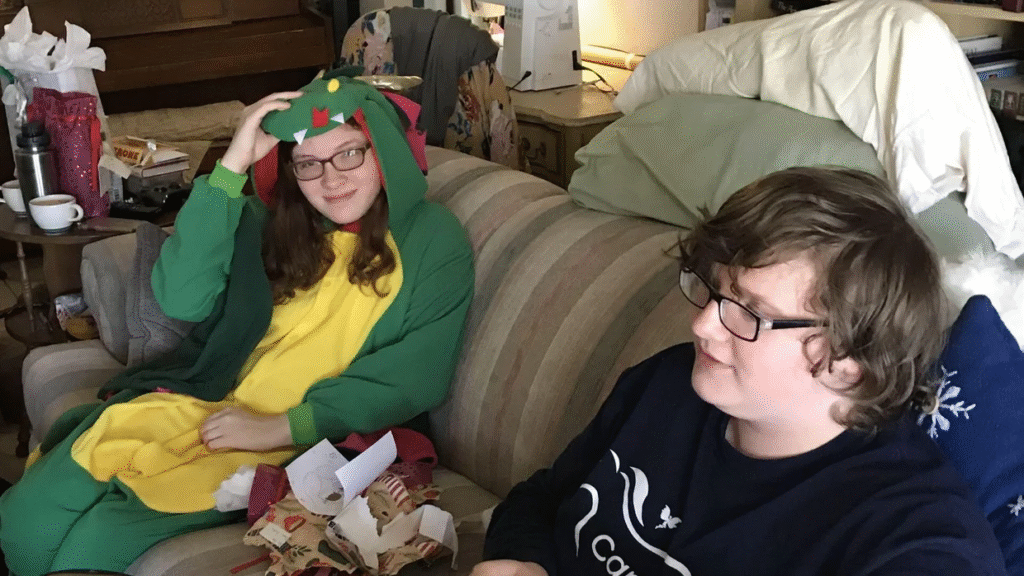
Meghan Elliott died at 17. Her family and the Whittecars had been close friends since 2005, and those who knew her remember her as a sensitive young woman who wrote poetry and loved to draw. She had been diagnosed with autism as a teenager.
Drue Whittecar recalled how much Meghan adored her brother. When she felt uncomfortable in a social setting, she would quietly walk over and stand next to him.
Whittecar, herself an engineer, described Benjamin as soft-spoken, smart, funny, and a little nerdy, with a strong focus on engineering. She said he took pride in looking after his sister and enjoyed being her protector.
In her final months, Meghan had begun to come out of her shell. She was finding her voice, had made friends online, and ran a YouTube channel where she shared her artwork.
Benjamin has spoken of how deeply he misses her. He acknowledged that it is very hard to know she is gone because of what happened that night.
He said they did everything together, and he remembers her as an artist with a creative mind who found beauty everywhere she looked.


Recent Comments