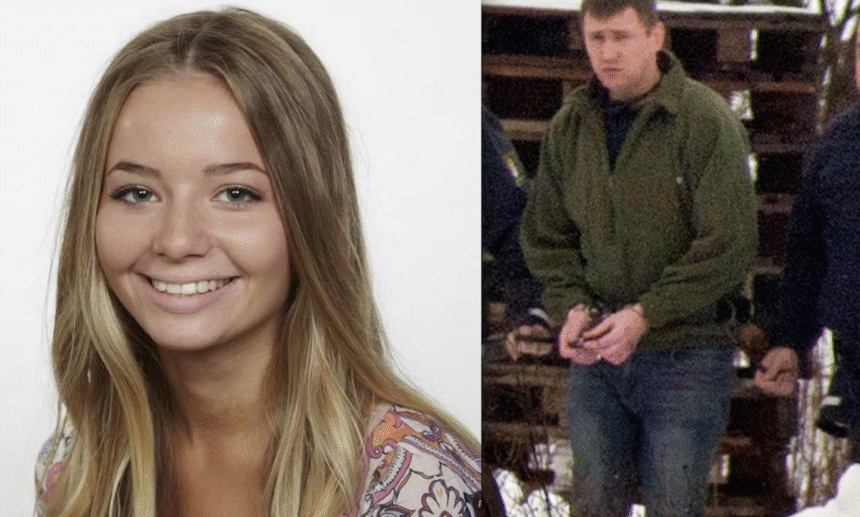
Lisa Holm was seventeen years old when she disappeared from a rural café in Blumberg, Sweden, on June 7th, 2015. What followed became one of the largest search operations in Swedish history.
Lisa grew up in Skövde, a quiet town in western Sweden. She was known for being reliable, warm, and mature for her age. Friends called her the “glad girl,” meaning she was always upbeat and curious.
She loved horses, baking, and had dreams of studying architecture one day. In the summer of 2015, she got her first job working weekend shifts at a countryside café near Kinnekulle hill, which sat between two lakes close to the small village of Blumberg.
Her parents had been driving her to and from work every weekend. As a reward for her hard work, they bought her a moped so she could commute on her own. June 7th was supposed to be her very first time riding home alone.
That Sunday evening, her colleagues said she seemed happy and relaxed as they closed up the café together. At around 6:23 p.m., Lisa texted her father to let him know she was almost done and would be heading home soon.
The route home was one she already knew well. It passed through forests and farmland and was considered completely safe. When the café closed, her two colleagues left through the front to catch a bus. Lisa went around to the back to get her moped. That was the last time anyone saw her alive.
By 8:00 p.m., her father had not heard anything more from her. He got in his car and drove to the café. When he arrived, he found her moped parked at the back exactly where she had left it.
The keys were still in the ignition. Her bag was sitting beside the bike. Her helmet, though, was missing. The café was dark and locked up, and when he called out her name, there was no answer. He called the police at 9:47 p.m.
Within hours, the search had already grown into something massive. Neighbours, friends, and volunteers came from all around. Officers, military personnel, helicopters, and teams on horseback and ATVs all joined in.
They swept fields, ditches, barns, and roadsides. The first search covered a radius of just three hundred metres around the café, and teams worked that area carefully to make sure nothing was missed.
Even so, they found almost nothing at first. There were no signs of a struggle, no footprints, and no obvious clues.
The first real lead came from police dogs. They picked up Lisa’s scent inside an old abandoned barn located directly across the road from the café. Officers went inside and found the place cluttered with old equipment, stacked wood, and dust.
Among all of that, they found a single black glove that was later confirmed to be hers. It was not much, but it was a starting point.
Through the night and into the following morning, the operation kept growing. Makeshift command posts went up, maps were covered in notes, and radio updates ran non-stop. The community of Blumberg refused to give up.
Hundreds of people who barely knew Lisa showed up anyway, because disappearances like this simply did not happen in their village.
On June 10th, the organisation Missing People joined the search, bringing trained staff and specialised equipment. By that point, the search radius had expanded significantly, and teams were now covering a much wider stretch of countryside.
Two days later, on June 12th, real evidence started appearing. Along a dirt road about a kilometre from the café, searchers found a pink phone case and broken pieces of a mobile phone, both confirmed to be Lisa’s.
A torn receipt and a train ticket with her name printed on it were found close by. Around the same time, a friend of Lisa’s father went back to the abandoned barn across from the café after noticing the police tape had been removed.
Inside, he spotted a pair of pearl earrings on the dusty floor. Lisa’s family confirmed they were hers. The next morning, her identification card and house keys turned up near a road heading south of the café.
Taken separately, the items looked scattered and random. But when investigators marked each location on a map, a clear direction emerged. Everything pointed toward a farm roughly one mile from the café, known as Martorp Farm.
And when search teams reached the edges of that property, they found Lisa’s jacket and white moped helmet hidden in tall grass near one of the sheds.
Earlier that same day, something had already raised concern at the farm. As volunteers began sweeping the surrounding land, two of the farm’s residents came out and approached them.
A man and a woman told the teams that police had already searched the area and that there was no point continuing. The man was visibly tense and told them that if they did not leave, he would call the police himself. The volunteers held their ground and called the police instead.
Officers arrived quickly. With suspicions now firmly raised, they began searching every building on the property.
Martorp Farm was modest in size but expansive enough, with a main building, two old barns, several sheds scattered along a rural road, and patches of wooded land. As daylight faded, officers moved through all of it carefully.
The breakthrough came at one of the small white sheds at the back of the property. The long grass leading up to its door had been recently trampled, which stood out because the shed appeared to have been out of use for some time.
Officers forced the door open. Inside, the smell of decomposition hit them immediately. The shed had two rooms. Officers opened each locker in the second room one by one.
In one of them, they found Lisa’s body. She had been partially undressed. Grey duct tape had been placed over her mouth, and a knotted rope was tied around her neck.
The farm was sealed off immediately. Forensic teams in protective suits worked through the night collecting fibres, fingerprints, DNA, and footprint impressions from every part of the property.
When news reached the volunteers who had spent days searching, many broke down completely. Several of the officers present also required psychological support in the weeks that followed.
The three residents of Martorp Farm were arrested the following morning for questioning. They were Nerijus Bilevičius, a thirty-five-year-old Lithuanian national, his wife Irina, and his younger brother. Bilevičius was the same man who had confronted the volunteers earlier that day.
What investigators found during the search of the property built an overwhelming case. Inside one of the farm’s barns, there was a room that had previously been used for storing cow’s milk. Detectives came to refer to it as the milking room.
Inside that room, rope fragments were found that matched the rope tied around Lisa’s neck. DNA belonging to Bilevičius was recovered from the room itself, from the rope, and from multiple areas on Lisa’s clothing.
His blood was found on her jacket, which indicated she had fought back during the attack. DNA collected from beneath her fingernails further confirmed that direct physical contact had taken place. A large quantity of human faeces found just outside the milking room was tested and confirmed to belong to Bilevičius.
Investigators also went back to the abandoned barn across from the café, the same one where Lisa’s glove and earrings had been found. One of the rooms inside offered a direct view of the café.
When officers examined the walls under ultraviolet light, they found multiple biological stains, all confirmed to contain Bilevičius’s DNA. It became clear that he had used that location on more than one occasion to watch women at the café.
His phone records contradicted the alibi he gave police. He claimed he had been in his room sleeping or speaking with his mother at the time of Lisa’s disappearance. The records showed that his phone call to his mother was made after Lisa had already vanished.
Multiple witnesses also reported seeing his car near the café at around 7:00 p.m. that evening. Surveillance footage from a nearby petrol station captured him later that night.
His own brother later told investigators that Bilevičius had asked him to provide a false alibi. He warned his brother that police would blame them simply because they were immigrants. Both the brother and Irina were cleared of any involvement.
Investigators were also able to piece together a likely sequence of events from the evidence. Weeks before Lisa’s disappearance, Bilevičius had approached another woman near the café and asked her for directions to a nearby town, claiming he did not understand Swedish.
When he asked her to get into his car, she felt uncomfortable and walked away. It is believed he used a similar approach with Lisa, possibly asking her to enter his vehicle to help enter a location into his GPS.
Once inside, she was overpowered and abducted. The forensic evidence at the milking room confirmed that a violent struggle took place there. Lisa fought back hard. Bilevičius ultimately restrained her using rope and duct tape before strangling her.
After her death, he moved her body to the shed and placed her inside a locker. Her belongings were left along the road in different directions, likely in an attempt to make the trail harder to follow.
Bilevičius’s trial began in autumn 2015 and drew enormous public attention. The courtroom was described as extremely tense. Lisa’s parents sat only metres away from him throughout the proceedings.
He showed no visible emotion during the entire trial and avoided making eye contact with her family. His defence argued that he had been framed and suggested that others on the farm may have been responsible.
The claim was not supported by any evidence and was dismissed. On November 17th, 2015, the court found Nerijus Bilevičius guilty of murder and sentenced him to life in prison.
In early 2017, he applied to be transferred to Lithuania to serve his sentence there. The application was approved. Once in Lithuania, he applied to have his sentence reduced under Lithuanian law.
That application was also approved, and his sentence was changed to fifteen years. The decision caused significant public outrage. Following legal and public pressure, his sentence was eventually reinstated to life imprisonment.
While in a Lithuanian prison, Bilevičienė was repeatedly targeted by other inmates. He was moved in and out of protective arrangements on multiple occasions. He was eventually stabbed to death in his cell.
Lisa’s funeral was held on July 7th, 2015. More than one hundred and thirty people filled the church, with hundreds more standing outside listening through loudspeakers. Friends described her as kind, creative, and full of ambition.
A cherry blossom tree was planted near the café in her memory. The Missing People organisation, which had played a significant role in the search, gained widespread national recognition as a direct result of the case. Over nine hundred volunteers had joined the search for Lisa across those five days.
Moral Hazard in Insurance Systems and How Financial Protection Can Change Behavior and Raise Costs
Insurance is supposed to be a seatbelt for your finances. You pay a steady premium, and the insurer steps in when life takes a hard turn. The twist is that the very protection that makes insurance humane can also nudge people to act differently once they feel covered.
Economists call that moral hazard, but it’s really about everyday behavior: risk feels cheaper when someone else shares the bill. In health, cars, homes, even bank deposits, those small shifts add up to big costs.
To keep it simple, moral hazard shows up after a policy is in force. It’s different from adverse selection, which is the “I know I’m risky, so I’m buying insurance” problem. Moral hazard is “Now that I’m insured, I might take fewer precautions, or I might use more of the service.” Sometimes it’s innocent.
If your health plan covers therapy, you might finally go, and that’s a good thing. Sometimes it’s wasteful, like booking an ambulance ride because the copay is the same as a taxi. And sometimes it’s straight up fraud, staged crashes, padded repair bills, fake disability claims, which is a crime, not just a nudge in incentives. Insurers and regulators treat these as separate issues, even though they can blur.
On a winter night in Chicago, a student, let’s call him Malik, woke up with a fever and a sore throat. He checked his campus health app and saw the urgent care was closed. The emergency room was open, and his insurance card promised a $0 visit fee. He went.
Three hours later he left with a bill he never saw, a negative strep test, and advice to drink fluids. Malik wasn’t trying to game the system; he just didn’t feel the price signal. That’s the setup. The RAND Health Insurance Experiment, one of the biggest real world studies on this, found that when people faced more cost sharing, they used roughly 20–30% less care, with little difference in overall health for the average person (RAND Corporation).
The hard part is separating “less waste” from “less needed care,” especially for low income patients.
Car insurance has its own version. If repairs are fully covered, a driver may park in riskier spots, delay fixing bald tires, or drive a little faster. Researchers have linked generous coverage to higher claim rates, although proving the driver’s mindset is tricky.
Insurers respond with tools that work: deductibles that make you pay the first, say, $500 or $1,000; no claim discounts that reward clean years; and premium increases after at fault accidents. Some companies now offer telematics, where your phone or a plug in device tracks braking and mileage.
Safer drivers get lower prices, and riskier drivers see the cost immediately. Critics call it creepy. Supporters call it feedback. Either way, it’s an attempt to turn “someone else pays” back into “I pay if I’m reckless,” without cancelling the whole purpose of insurance.
Home and disaster coverage show moral hazard on a bigger scale, because choices are made years before a storm hits. If flood insurance is cheap and easy, people are more willing to build in floodplains, and they may rebuild in the same place after a loss.
The U.S. National Flood Insurance Program has wrestled with this for decades: premiums often did not fully reflect risk, and repeat loss properties became a public argument (FEMA). After Hurricane Harvey in 2017, tens of billions of dollars in damage were reported, and many homeowners learned the hard way that they were uninsured for floods.
That story points both ways: some people were underprotected, while others in high risk zones had coverage that made rebuilding seem normal. Stronger building codes, elevation requirements, and pricing closer to risk are meant to reduce the “we’ll just rebuild again” cycle.
Moral hazard also plays out in income protection. Workers’ compensation, disability insurance, and unemployment benefits are lifesavers when you’re genuinely hurt or laid off. Yet any system that replaces income can tempt longer time away from work, especially if the checks arrive automatically and the job is painful.
Studies find that more generous benefits are linked to longer average claim durations, even after accounting for injury severity (OECD). This doesn’t mean most claimants are faking. It means the line between “not ready” and “could probably return with light duty” is fuzzy, and incentives lean one way. Many programs push back with medical reviews, return to work plans, and partial benefits that let someone work part time without losing everything.
Courts have also backed insurers’ right to investigate suspicious claims, as long as they follow privacy and bad faith limits set by state law.
A claims adjuster mentioned a body shop that treated insurance like a blank check. A dented bumper became a “full rear end overhaul.” A headlight that could be buffed was billed as brand new. Most customers didn’t notice, because the insurer paid and the customer only paid the deductible.
This is moral hazard sliding into fraud, and it’s why insurers send investigators, audit shops, and share data with law enforcement. The FBI has estimated that insurance fraud, not counting health insurance, costs the U.S. public tens of billions of dollars each year, often cited in the $40–$80 billion range (FBI).
Many states have specific insurance fraud statutes, and courts routinely uphold convictions for staged crashes and fake theft reports. The point isn’t that everyone cheats; it’s that a system with shared costs needs visible consequences for the few who do.
Sometimes the risky behavior isn’t yours or mine; it’s an institution’s. Deposit insurance means bank customers don’t have to judge a bank’s safety the way they might judge a used car. In the U.S., the FDIC promises deposits up to a set limit, which prevents panic runs and keeps the payment system stable (FDIC).
The tradeoff is that banks may feel freer to chase higher returns, because depositors won’t punish them by pulling out money. After the 2008 financial crisis, policymakers argued over whether bailouts and emergency backstops created a “heads I win, tails taxpayers lose” attitude.
Laws like the Dodd Frank Act tried to reduce that by raising capital requirements, adding stress tests, and creating resolution plans for failing banks. It’s not perfect, but it’s an example of moral hazard in a suit and tie, not in a waiting room.
Good insurance design tries to keep the promise of protection while limiting the “free ride” feeling. Cost sharing is the most obvious lever: copays, deductibles, and out of pocket maximums. Under the Affordable Care Act, many preventive services are covered with no patient charge, because skipping vaccines or screenings can cost far more later (HHS).
That’s a reminder that not all “extra use” is bad; sometimes coverage fixes underuse. The trick is aiming the friction at low value spending. Some employers use tiered drug formularies so a generic might cost $10 while a brand name alternative costs $40. Some health plans require a quick approval step for expensive imaging, which can prevent duplicative scans but can also slow care when the system is clumsy.
In property coverage, insurers offer discounts for smoke detectors, storm shutters, or smart water sensors because prevention is cheaper than a claim. In auto, usage based pricing rewards cautious driving without punishing the person who simply has bad luck once.
Law matters here because moral hazard can run both directions. Insured people may take more risk, but insurers can also be tempted to deny or delay claims once premiums are collected. Insurance law answers with duties of good faith and fair dealing, and with penalties when a company unreasonably refuses to pay.
The older idea of “utmost good faith” traces back to an eighteenth century English decision, Carter v. Boehm, which stressed honest disclosure in insurance contracts. Today, disclosure rules are balanced with consumer protections, because most people aren’t experts at reading fine print. Regulators require clear policy language, set minimum coverages for things like auto liability, and sometimes review rate increases.
These guardrails don’t remove moral hazard; they manage it. When done well, they also keep the debate honest: the problem isn’t “people are immoral,” it’s that any shared risk system needs checks on both sides.
In the end, moral hazard is less a lecture about ethics and more a report about incentives. Incentives are quiet, but they matter. When a cost is hidden, behavior shifts, and millions of small choices can push premiums up for everyone. Still, the answer can’t be to make insurance so stingy that people avoid doctors, ignore leaks, or drive uninsured.
The best fixes are usually boring: moderate deductibles, targeted free preventive care, fraud units that prosecute, and pricing that reflects risk without crushing people who are poor or sick. Climate change is tightening property markets, and data tracking is reshaping auto coverage.