
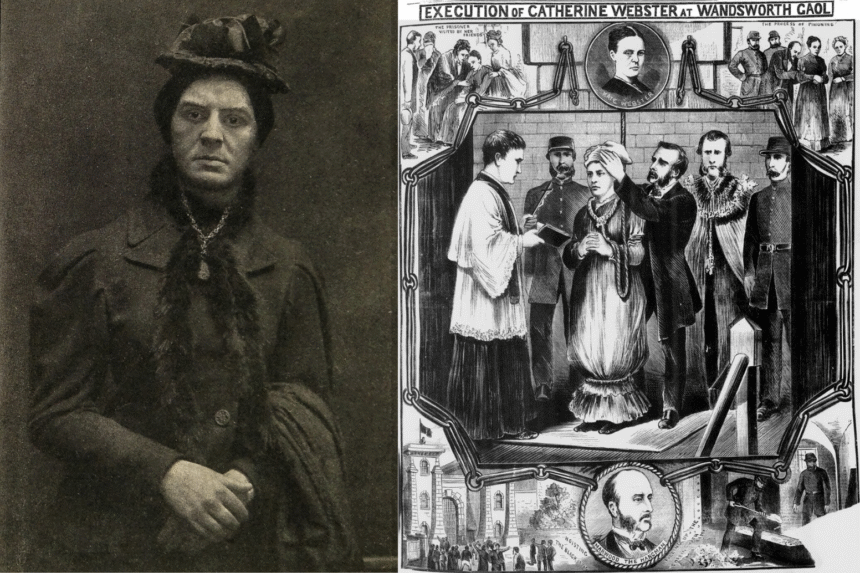
Kate Webster murdered her employer Julia Martha Thomas in Richmond, London, on 2 March 1879. The case shocked people across Britain and Ireland and became one of the most talked-about crimes of the Victorian period.
Kate Webster was born Kate Lawler around 1849 in Killanne, County Wexford, Ireland. From a very young age, she was in trouble with the law. She was imprisoned for theft in Wexford in December 1864, when she was only about 15 years old.
A few years later, she moved to England in 1867, and by February 1868, she had been sentenced to four years of penal servitude for committing larceny in Liverpool.
After her release in January 1872, she moved to Rose Gardens in Hammersmith, West London, where she became friendly with a family called the Porters. In April 1874, she gave birth to a son in Kingston upon Thames.
The identity of the father was never fully established, as she named different men at different times.
Webster moved around West London constantly, using several different names, including Webb, Gibbs, Gibbons, and Lawler. She never stayed in one place for long.
In May 1875, while she was living in Teddington, she was convicted of 36 counts of larceny and sentenced to eighteen months at Wandsworth Prison. Shortly after getting out, she was arrested again for theft and received another twelve months in February 1877.
While she was locked up, her young son was looked after by a friend named Sarah Crease, who worked as a charwoman in Richmond.
Julia Martha Thomas, meanwhile, had been living alone at 2 Mayfield Cottages in Park Road, Richmond, since 1873, following the death of her second husband. She had previously worked as a schoolteacher and was in her mid-fifties.
Her doctor described her as a small, well-dressed woman. Neighbours considered her eccentric. She travelled often and would sometimes disappear for weeks without telling anyone where she was going.
She dressed carefully and wore jewellery, giving the impression of being wealthier than she actually was. Employing a live-in servant was as much about maintaining her social image as it was about practical help.
However, she had a reputation for being a difficult employer, and keeping staff was a constant problem for her.
In January 1879, Crease fell ill and Webster stepped in temporarily to work for a Miss Loder, who was a close friend of Thomas. Loder was aware that Thomas was looking for a new servant and recommended Webster based on her short period of work.
When Thomas met Webster, she hired her on the spot without checking her background or references. Webster began working at Mayfield Cottages on 29 January 1879.
The working relationship fell apart quickly. Thomas was unhappy with the quality of Webster’s work and made that clear on a regular basis. Webster grew deeply resentful.
She later described how Thomas would go over her cleaning after she had finished and point out areas she supposedly missed, which Webster found deeply irritating.
The tension grew to the point where Thomas tried to arrange for friends to stay with her because she felt uncomfortable being alone with Webster in the house. By late February, Thomas had made her decision.
Her final diary entry read: “Gave Katherine warning to leave.” Webster was told her employment would end on 28 February.
Webster managed to persuade Thomas to let her stay for three more days. Sunday, 2 March, was Webster’s half-day off, and she was expected back in the afternoon to help Thomas get ready for the evening service at the local Presbyterian church.
Instead, Webster visited a local alehouse and came home late. Thomas left for church delayed and arrived there visibly upset. She told a fellow churchgoer that Webster had “flown into a terrible passion” when criticised for being late. Thomas left the service early and returned home around 9 pm.
When Thomas got home, the two women argued again. According to Webster’s own later account, the argument turned violent. She threw Thomas from the top of the stairs to the ground floor. Thomas fell heavily.
To stop her from screaming, Webster grabbed her by the throat, and Thomas was choked to death. The neighbours next door heard a single thump, similar to a chair falling over, but thought nothing of it and did not investigate.
Once Thomas was dead, Webster acted quickly to get rid of the body. She used a razor, a meat saw, and a carving knife to dismember the corpse. She then boiled the remains in the household’s laundry copper and burned as much as she could in the hearth.
The neighbours noticed an unpleasant smell but were not immediately alarmed. It was common for households to begin their washing early on Monday mornings, so the activity at the house did not seem unusual from the outside.
Over the next couple of days, Webster continued to present a normal front to tradesmen who came to the house. She packed the dismembered remains into two containers: a black Gladstone bag and a corded wooden bonnet-box.
Thomas’s head and one foot could not be fitted inside. Webster buried the head beneath the stables of the nearby Hole in the Wall pub and left the foot on a rubbish heap in Twickenham.
On 4 March, Webster travelled to Hammersmith dressed in Thomas’s clothes. She visited the Porter family, whom she had not seen in six years, and introduced herself as “Mrs. Thomas.”
She told them she had married since they last met, had a child, been widowed, and inherited a house in Richmond.
She invited Porter and his son Robert to a pub in Barnes, and along the way, she disposed of the Gladstone bag, believed to have been dropped into the River Thames while the Porters were inside the pub. It was never recovered.
Webster then asked Robert Porter to help her carry a heavy box from Mayfield Cottages. As they crossed Richmond Bridge that evening, she dropped the box into the Thames. Robert did not suspect anything.
The following morning, a coal porter named Henry Wheatley spotted the box washed up near Barnes Railway Bridge shortly before seven in the morning. He opened it and found body parts wrapped in brown paper.
The remains were examined by a doctor and identified as those of a woman, though her head and one foot were missing. A foot and ankle found separately in Twickenham around the same time were later confirmed to belong to the same body.
An inquest held on 10 and 11 March returned an open verdict, and the unidentified remains were buried in Barnes Cemetery on 19 March. The press named the unresolved case the “Barnes Mystery.”
While the investigation remained at a standstill, Webster continued living at Mayfield Cottages under Thomas’s identity. She wore her clothes, managed the household, and dealt with tradesmen as though she were the property’s rightful owner. On 9 March, she struck a deal with John Church, a publican from Hammersmith, to sell Thomas’s furniture for £68, with an £18 advance payment. Church planned to use the furniture for his pub, the Rising Sun.
By 18 March, when the removal cart arrived to collect the furniture, the neighbours had grown deeply suspicious. Thomas had not been seen for nearly two weeks.
Miss Ives, Thomas’s landlady who lived next door, asked the removal men who had authorised the collection. When they pointed to Webster, the suspicion became impossible to ignore.
Webster fled immediately, catching a train to Liverpool and then travelling by sea to her family in Enniscorthy, County Wexford.
Church, going through the items in the delivery van, found a letter addressed to the real Thomas. The police were called in and searched Mayfield Cottages.
They found bloodstains, burned finger-bones in the hearth, fatty deposits around the copper, and a letter from Webster containing her address in Ireland. A warrant was immediately issued for her arrest.
Scotland Yard detectives established that Webster had left for Ireland aboard a coal steamer. The Royal Irish Constabulary in Wexford recognised Webster from a previous arrest and traced her to her uncle’s farm at Killanne. She was arrested there on 29 March and brought back to London via Holyhead.
Webster went on trial at the Central Criminal Court, the Old Bailey, on 2 July 1879. The case drew intense public attention. The prosecution was led by the Solicitor General, Sir Hardinge Giffard, reflecting just how seriously the case was being taken.
Webster was defended by barrister Warner Sleigh, and Mr. Justice Denman presided over the proceedings. Before the trial began, Webster had tried to implicate both John Church and the elder Porter in the murder. Both men had solid alibis and were cleared.
At trial, Webster pleaded not guilty. Her defence argued that the evidence against her was circumstantial and pointed to her devotion to her son as a sign of her character. The prosecution called witnesses over six days.
One of the most damaging came from a bonnetmaker named Maria Durden, who told the court that Webster had visited her a week before the murder and mentioned plans to sell property in Birmingham that an aunt had left her.
The jury saw this as clear evidence of premeditation. After deliberating for about one hour and fifteen minutes, they found Webster guilty.
Immediately after the verdict, just before the judge was about to pass sentence, Webster claimed to be pregnant in what appeared to be a last-minute attempt to avoid the death penalty. An old legal procedure was used in response.
A jury of matrons, made up of women who were present in the courtroom, was assembled alongside a surgeon to examine whether Webster was pregnant. The examination lasted only a couple of minutes.
The jury of matrons concluded she was not with child, and Mr. Justice Denman sentenced her to death.
An appeal was submitted to the Home Secretary, R. A. Cross, but it was formally rejected. The official response stated that no sufficient grounds had been found to advise the Crown to interfere with the sentence.
In the days before her execution, Webster made two statements. In the first, she claimed that a man named Strong, whom she identified as the possible father of her child, had taken part in the murder and had pushed her toward a life of crime.
On the night of 28 July, she withdrew this statement entirely and made a second one, taking full responsibility for the murder and clearing Church, Porter, and Strong of any involvement.
On 29 July 1879, Webster was hanged at Wandsworth Prison at 9 am. The hangman, William Marwood, used his newly developed long drop method, which caused instantaneous death.
Webster was buried in an unmarked grave within the prison grounds. A crowd gathered outside cheered when the black flag was raised above the prison walls, confirming the sentence had been carried out.
Thomas’s skull, missing since 1879, was finally found in October 2010 during excavation work at the rear of the former Hole in the Wall pub, which Sir David Attenborough had purchased in 2009 to be redeveloped.
Scientific analysis at the University of Edinburgh dated the skull to between 1650 and 1880. The skull had fracture marks consistent with being thrown down stairs, and low collagen levels consistent with being boiled.
In July 2011, the coroner formally concluded that the skull belonged to Thomas. The open verdict recorded in 1879 was replaced with a verdict of unlawful killing, with the cause of death given as asphyxiation and a head injury, closing one of Victorian Britain’s longest-running criminal mysteries after more than 130 years.



Recent Comments