

Alexander “Alex” Woodworth was 24 years old when his body was discovered on a muddy farm road in Dunn County, Wisconsin, on March 23, 2018.
The Search Begins
On the afternoon of March 22, 2018, an elderly dairy farmer named Don Sipple was preparing for dinner when his doorbell rang urgently.
When he answered, he found a young woman standing on his porch barefoot, covered in mud, with torn clothing and blood around her mouth. She told him she had been attacked in the woods and asked to be taken to the hospital. Sipple brought her inside and called 911 immediately.
The young woman was Ezra McCandless, age 20. When first responders arrived and asked basic questions, she was largely unresponsive, unable to provide her own name. She repeatedly requested that someone contact a man named Jason Mengel.
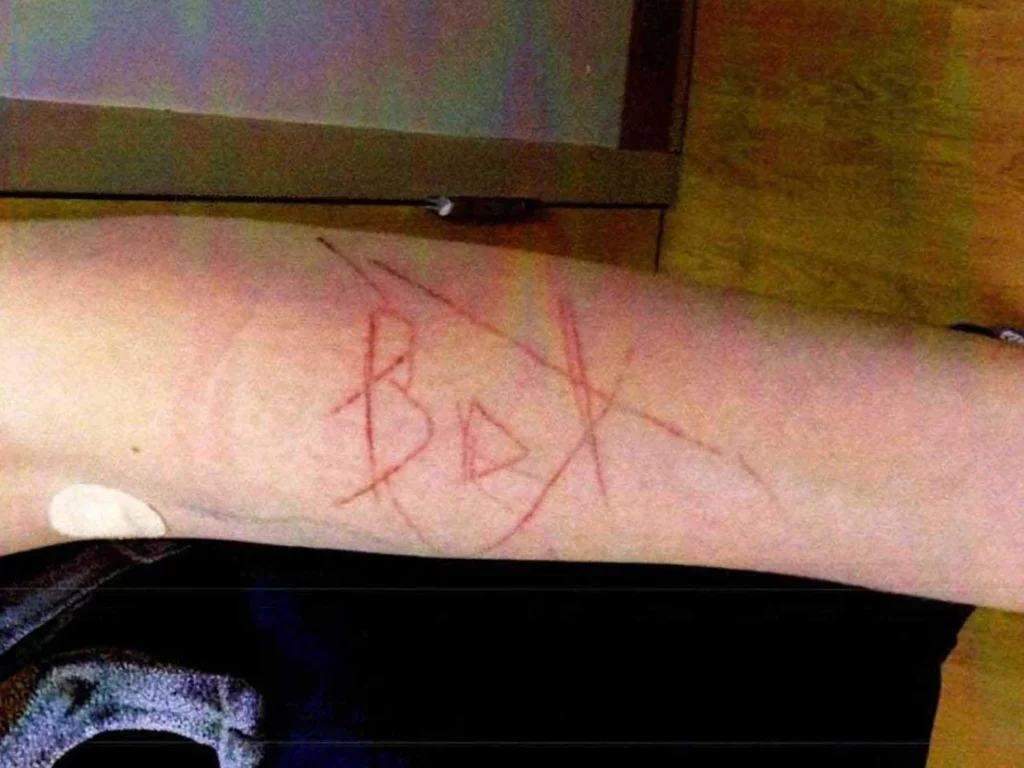
Paramedics noted scratches on her body, though no significant lacerations were found. The most notable injury was the word “boy” carved into her forearm. She was transported to the Mayo Clinic in Eau Claire, Wisconsin.
As medical staff treated her, McCandless gradually began to recall details. She gave her birth name, Monica Kay, and eventually named Alex Woodworth as the person who had harmed her.
Law enforcement began searching for Woodworth immediately, first checking Owen Park, then his residence. His roommate had not seen him, and none of his friends or family had heard from him.
A search for him spread quickly through his community, with people posting missing person flyers throughout the Eau Claire area. His family, deeply confused, worried he and McCandless may have been in some kind of accident.
The Discovery

The following morning, March 23, officers returned to Sipple’s farm near Spring Brook to retrace the night’s events. While one officer spoke with Sipple inside, an investigator drove slowly along the road outside, where he noticed footprints pressed into the mud.
He followed them down an isolated farm road and found McCandless’s car, its doors open, surrounded by scattered belongings. Half hanging from the rear driver’s side door was the body of Alex Woodworth.
The Wisconsin State Crime Lab was called in to collect evidence. The Dunn County Medical Examiner pronounced Woodworth dead at the scene. An autopsy would later reveal that he had been stabbed 16 times, with wounds to his head, torso, and genitals.
His throat had been slit three times. Several of the wounds were inflicted after death. The investigation quickly made clear that Woodworth was not a perpetrator but the victim of an extraordinarily brutal killing.
The case involved two counties — Woodworth lived in Eau Claire County while McCandless was found in Dunn County — but both departments worked cooperatively from the start, sharing information and resources without conflict.
The task of informing Woodworth’s family fell to his uncle, Dale Hall, who had been the family’s point of contact during the search. Hall had to deliver the news to his in-laws, a moment he later described as one of the most devastating of his life.
Unraveling the Timeline
Detective Ryan Prock, who had prior professional experience with everyone involved in the case, was assigned to lead the investigation. He interviewed McCandless at the Mayo Clinic’s behavioral health facility on March 24.
During the first half of the interview, she described wandering through the woods after being attacked and having almost no memory of the events. She claimed not to know her own name but remembered Jason Mengel’s contact information clearly.
Partway through the interview, Prock informed her that her car had been located — and that Woodworth’s body had been found there. At that point, McCandless’s account shifted dramatically.
She began describing a violent confrontation in the back seat of her car, claiming that Woodworth had grabbed her, cut her clothing with a knife, and that she had fought back in self-defense, eventually seizing the weapon and stabbing him repeatedly.
Investigators found significant problems with this account. The first stab wound on Woodworth’s body was to the back of his head, and he had no defensive wounds, suggesting he had no opportunity to react to an initial attack.
The amount of blood inside the car was inconsistent with multiple stabbings occurring there.
Additionally, the word “boy” carved into McCandless’s left forearm appeared too neatly written to have been carved by someone else from the position she described — particularly given that Woodworth was right-handed and would have been seated to her left.
When Prock pointed this out directly during the interview, McCandless admitted that she had carved the word herself, saying she did not know why she had done it.
Woodworth’s cell phone was found broken into pieces along the roadside, in soft mud that would not have been enough to shatter it.
His father’s kitchen knife — later confirmed as the murder weapon — had gone missing from the home where McCandless had been staying.
The Relationship Between McCandless and Woodworth

The connection between Ezra McCandless and Alex Woodworth had begun roughly a year earlier, in 2017. McCandless met Woodworth at a local bar in Eau Claire called The Joint, where she approached him while he was writing and struck up a conversation.
At the time, she was in a relationship with Jason Mengel, a 33-year-old Army Reserve medic.
Mengel and Woodworth were already friends, and McCandless eventually became part of the social circle that gathered regularly at a coffee shop called Racy D’Lenes Coffee Lounge, where Woodworth worked as a barista.
In October 2017, McCandless discovered she was pregnant. After choosing not to continue the pregnancy — an appointment that fell on her 20th birthday — the strain on her relationship with Mengel deepened.
Mengel began withdrawing emotionally, and McCandless increasingly sought support from Woodworth. What began as friendship developed into a romantic involvement, and Woodworth told friends that he was falling in love.
The situation became more complicated in early 2018, when Mengel left for a multi-week military field training and asked his close friend John Hansen to check on McCandless in his absence.
During that period, McCandless and Hansen became sexually involved. When Mengel returned and discovered text messages between them on her phone, McCandless told him that Hansen had sexually assaulted her.
An official investigation was opened and assigned to Detective Prock. However, after Hansen willingly turned over his text messages with McCandless — which told a different story — and after Woodworth told investigators that McCandless had privately admitted the encounter was consensual, the case was closed with no charges filed.
The fallout spread through their social circle. Rumors circulated. When Mengel confronted both Hansen and Woodworth publicly, Woodworth admitted to his affair with McCandless, causing further fractures in the group.
McCandless found herself increasingly isolated. Around this time, someone wrote her phone number on a bathroom stall at Racy D’Lenes with an obscene message, which she took very hard.
Her mother subsequently asked her to leave the family home, and she moved in with her father, Joshane Karlen, in Stanley, Wisconsin. She also secured employment with the Stanley Boyd School District.
The Day of the Murder

On March 22, 2018, McCandless made an unannounced trip to Eau Claire. She arrived at Racy D’Lenes, where she encountered Mengel, who was there with a friend named Max. She told Mengel she had come to return a few personal items to Woodworth.
She separately told Max that she was in town to deliver therapy letters to various people — a different explanation from the one she gave Mengel. She drove Max to his home for a previously discussed art exchange, then dropped him back at the coffee shop.
Mengel, sensing something was wrong, rode his bicycle to Woodworth’s residence. When he arrived, he saw McCandless’s car parked outside with the engine running and the driver’s door open.
He paced the area for roughly 45 minutes, drawing the attention of a neighbor who called police. Before officers arrived, Mengel entered the house and found McCandless and Woodworth together, acting as though everything was fine, though their behavior struck him as unusual.
Police arrived, assessed the scene, and found no reason to intervene. Mengel left. Officers departed. McCandless and Woodworth got into her car and drove away. It was the last time anyone other than McCandless would see Woodworth alive.
Trial, Verdict, and Sentencing

Ezra McCandless was arrested two weeks after the murder and charged with first-degree intentional homicide. She entered a plea of not guilty. A competency evaluation was ordered by the court and she was found fit to stand trial.
In October 2018, her attorneys filed to change her plea to not guilty by reason of mental disease or defect, but by February 2019, that plea was withdrawn and she returned to a not guilty position, announcing her intention to testify at trial.
The trial began on October 15, 2019. The prosecution argued that McCandless had deliberately led Woodworth to an isolated location with the intention of killing him, intending to frame the attack as self-defense to repair her reputation and potentially restore her relationship with Mengel.
The defense countered that McCandless had acted in self-defense during a violent confrontation.
McCandless took the stand and gave an account that differed in several ways from what she had told Detective Prock during the initial interview.
She described Woodworth driving to the isolated road, the car becoming stuck in mud, and Woodworth attacking her in the back seat. She testified that she had kneed him in the groin, taken the knife, and stabbed him in response.
She said she had carved “boy” into her own arm afterward, though she could not explain why. During her testimony, several details were inconsistent with the physical evidence, including the amount of blood found inside the vehicle and the absence of defensive wounds on Woodworth’s body.
A forensic pathologist testified that because none of the stab wounds struck the heart, spine, or major arteries, Woodworth would likely have retained motor function for a period after the attack, meaning he did not die immediately.
After three weeks of testimony, 50 witnesses, and more than 500 pieces of evidence, the jury deliberated for just three hours before returning a guilty verdict on the charge of first-degree intentional homicide.
At the sentencing hearing in February 2020, Woodworth’s family, friends, and colleagues delivered victim impact statements describing the depth of their loss.
McCandless was sentenced to life in prison, with the possibility of parole after 50 years, making her earliest eligible release date 2070. Her subsequent appeal was denied.
Who Alexander Woodworth Was

Alexander Woodworth was born on January 1, 1994, in St. Croix Falls, Wisconsin, to John and Kimberly Woodworth. He grew up in Iola, Wisconsin, the oldest of four children.
He was known among his siblings as a devoted older brother — his sister Sarah once credited him with helping her earn the highest score on the English portion of her ACT, after he spent hours tutoring her and creating custom worksheets to support her learning.
Woodworth graduated high school in 2012 and went on to attend the University of Wisconsin–Eau Claire, where he earned a bachelor’s degree in philosophy with a minor in biology.
Fellow students described him as intellectually impressive but equally warm and approachable. One friend joined Woodworth’s philosophy book club specifically because he wanted to know him better.
Another described him as “a super intellectual, very sensitive person” who seemed to know everything.
Outside of academics, Woodworth was known for his gentleness toward all living things. His father once noted that Woodworth “loved the unlovely,” a phrase meaning he paid attention to the things others overlooked.
He would never kill insects or spiders found inside the home, instead carefully relocating them outdoors.
After graduating, Woodworth remained in Eau Claire while applying to graduate schools, with the goal of eventually becoming a philosophy professor at the University of Oregon.
He tutored on campus, worked as a substitute teacher, and held a position as a barista at Racy D’Lenes, where customers and coworkers alike appreciated his warm and open presence. He was known as the barista who listened to unusual music and read philosophy between customers.
A card received by his family after his death came from a man whose son had once confided in Woodworth that he was considering ending his life. Woodworth had listened, spoken with him, and helped him find mental health resources.
His father read the card and reflected on the impact his son had made in just 24 years — and what his life might have continued to mean to others.
Alexander Woodworth was 24 years old.



Recent Comments