
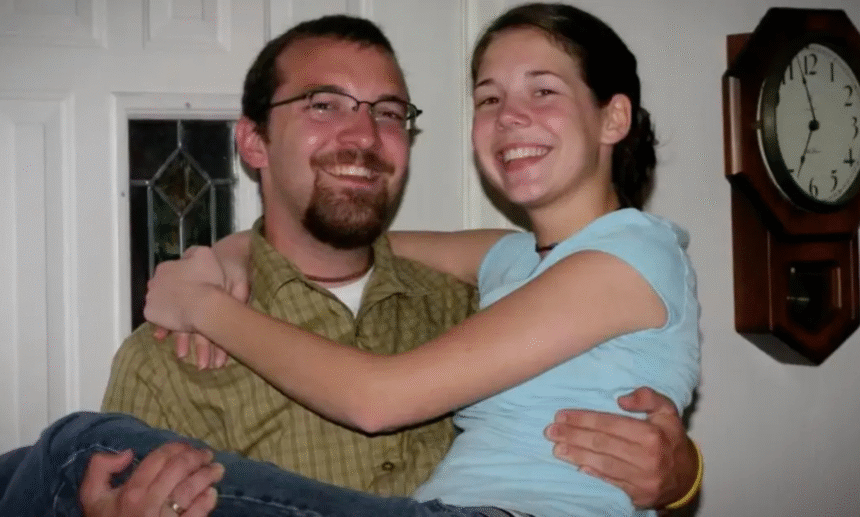
Heidi Firkus was 25 years old when she was shot and killed inside her own home in St. Paul, Minnesota, on April 25, 2010. Her husband, Nick Firkus, told police an intruder broke in and caused the shooting. It took more than eleven years before charges were filed.
Heidi Marie Erickson was born on December 14, 1984, in Roseville, Minnesota. She grew up in Falcon Heights with her parents, Linda and John, and her two older brothers, Peter and Joel.
She was active growing up, played basketball and tennis, and also had a creative side. She liked drawing and painting, and as she got older, she was known for handmaking cards and gifts for the people she cared about.
Friends described her as outgoing, warm, and someone who made others feel genuinely valued. Her faith was a major part of her life. She was a longtime member of the Calvary Church in Minnesota, and she eventually moved from being a youth group member to leading the group herself.
That church is also where she met Nick Firkus. He was two years older, and the two met when she was a freshman and he was a junior in high school. They got married in 2005, when Heidi was 20 and Nick was 22.
People who knew them considered them a strong couple. Other couples even went to them for relationship advice. By their mid-twenties, Nick was working in his family’s carpet cleaning business and Heidi had a job at a services company.
In 2007, they bought their first home together in St. Paul. From the outside, things looked stable and good for them. But behind that image, serious financial problems had been building for some time, and Heidi appeared to have no idea.
On the morning of April 25, 2010, Nick woke Heidi up just before 6:30 a.m. and told her someone was trying to break into their home. He said he had gotten up around 6:00 a.m. to get some water and, while lying back down, heard someone rattling the front doorknob and pushing against the door.
He went to the closet, grabbed his loaded shotgun, and woke Heidi. He told her to put her shoes on and head toward the garage so they could get in the car and leave.
As the two went downstairs, Heidi called 911 to report the break-in. Thirty-eight seconds into that call, a gunshot was heard clearly on the recording, and the call went silent.
Sixty-five seconds after that, Nick placed a second 911 call. He was frantic and told the dispatcher that both he and his wife had been shot. When police and paramedics arrived, they found Heidi on the floor near the kitchen entryway.
She had been shot in the back and was already dead. Nick had a gunshot wound to his left thigh, but the bullet had only grazed him. He was taken to Regions Hospital and treated for his injury.
The neighborhood where the Firkuses lived was considered safe. There had been minor incidents like car break-ins over the years, but nothing violent had ever happened there before.
A man named Brendan, who was house-sitting next door, said he heard someone shout something like “You shot her, you shot me, please, please, no.” through an open window that morning. Investigators took note of it, but it was far from enough to build a clear picture of what had actually happened inside that house.
That same evening, Nick came to the police department on crutches and sat down for a two-hour recorded interview with Sergeant Gray. He gave a more detailed account of what he said happened.
He claimed that as the two of them came downstairs, Heidi was walking in front of him and paused at a console table near the front door to grab her wallet. At that exact moment, he said the intruder forced his way inside, grabbed the barrel of the shotgun, and a struggle broke out.
He said his finger slipped during the struggle, the gun went off, and Heidi was hit in the back as she tried to run. A second discharge, he said, is what grazed his thigh.
Investigators found serious problems with that account almost immediately. Sending an unarmed person ahead while the armed person followed made no sense. Stopping to grab a wallet during what was supposed to be a terrifying home invasion made even less sense.
When police examined the entryway, nothing had been knocked over. The console table was completely undisturbed, despite Nick’s claim that a violent struggle had happened right in front of it. There was also no meaningful damage to the front door.
Nick had said the intruder burst through it, but the door showed no signs of being forced open. Officers later tested whether someone lying in the upstairs bedroom could hear a person rattling the front doorknob from the floor below. They could not hear it at all.
During the interview, Sergeant Gray eventually informed Nick that Heidi had not survived. Nick leaned back and said, “I figured that.” He had not asked about her condition once during the hour and a half of questioning before that moment.
His overall demeanor throughout the interview was calm and flat, which stood out sharply given what he was claiming to have just experienced.
Investigators also noted that Nick disclosed during the interview that the family had been planning to move out the very next day because of foreclosure. He said neither he nor Heidi had told anyone about their financial situation because they were embarrassed.
But when officers looked around the house, nothing supported that claim. All the furniture was in place, clothes were still in the closets, and the refrigerator was full.
There were a few boxes in the dining room, but nothing close to what someone would expect to see if an entire household was being packed up overnight. Heidi had also been planning to go to work the following day, which made it even harder to believe she knew they were being evicted.
Nick had not paid the mortgage since September 2008. Foreclosure proceedings had started in April 2009. Heidi’s name was not on any of the foreclosure documents, and she had not attended the eviction hearing that took place in March 2010.
The day after Heidi was killed, Nick sat down with both sets of parents and told them about the financial situation for the first time. When Heidi’s father said he felt confident police would find the intruder, Nick replied that they would never find him.
Within days of the murder, Nick hired a lawyer who advised him to stop cooperating with investigators. He followed that advice completely.
He refused to work with the police department’s sketch artist and instead commissioned his own private artist to draw a composite image of the supposed intruder. His legal team then brought that image to the police themselves. When it was released publicly, no useful tips came in, at least not right away.
Nick was not charged. The case did not move forward. He moved out of the St. Paul house two months after Heidi’s death and began spending time with a woman named Rachel Sanchez, who was the sister of one of Heidi’s close friends.
Rachel had recently moved to the St. Paul area after ending her own marriage. The two started dating, and within a year Nick proposed. They married shortly after and went on to have three children together.
Just as he had in his marriage to Heidi, Nick took full control of the household finances. He told Rachel that all his previous debts had been paid off. Because his credit was too poor to secure a loan, his parents took one out in their own name and put a house under their ownership.
Nick was responsible for paying the property taxes and providing his parents with rent money each month. He was not doing either.
Rachel’s suspicions grew after she received a call from a collections agency. She searched the house and found correspondence from the agency hidden in his sock drawer.
The discovery shook her. She realized that if he had been lying about the finances throughout their marriage, then his claims about hiding the finances from Heidi were likely also false. And if that was false, then his entire account of what happened the morning Heidi was killed came into question.
Rachel confronted him and recorded the conversation. During that exchange, she began expressing her concerns about his dishonesty, and Nick interrupted her by stating the exact conclusion she had been building toward — that he could be capable of murder.
She confirmed that was what she feared. He did not respond with any real explanation and the conversation ended there. She later approached his parents with her concerns but found their responses unconvincing. In 2018, Rachel filed for divorce.
In 2019, Detective Nichole Sipes was assigned to take a fresh look at the case. She brought in the FBI and together they went through everything again in detail. They built a full financial timeline and examined years of digital records.
In the twenty-two months during which mortgage payments had lapsed, there was not a single message between Heidi and Nick about debt, foreclosure, or financial trouble.
Phone records did show that in the weeks before her death, Heidi had started receiving emails directly from creditors, and each time she received one, she immediately called Nick.
One of her friends told investigators that just one day before Heidi was killed, Heidi had mentioned that Nick told her they had been victims of identity theft and that more than two hundred thousand dollars had been stolen from them.
The FBI also conducted a digital reconstruction of the shooting. It determined that the shotgun had been fired from shoulder height, not from chest level as would be consistent with a struggle over the weapon.
The reconstruction also confirmed that the entryway space was too small for the kind of violent physical confrontation Nick described without anything nearby being disturbed.
A review of Heidi’s 911 call found no background noise that would suggest a second person was present or that any kind of struggle was taking place. No foreign DNA was recovered from the scene either.
Around the same time, investigators revisited a tip that had come in five years after the murder. Someone had identified the man in Nick’s composite sketch as a St. Paul resident named Michael Pye, who had a documented history of breaking into homes in the early morning hours while people were still inside.
The timing seemed significant until it was confirmed that Pye had been in jail when Heidi was killed. He could not have been there. Pye spoke with investigators and acknowledged his past criminal record but stated clearly that he had never harmed anyone.
The evidence strongly suggested that Nick had deliberately described Pye’s appearance when commissioning the sketch, as Pye had received notable news coverage in the St. Paul area during the winter before Heidi’s death.
On May 19, 2021, Nick Firkus was arrested by a SWAT team. He was initially charged with second-degree murder, and those charges were later upgraded to include first-degree murder. He posted bond and remained free until his trial began in January 2023.
The court ruled before trial that Rachel could not testify, which meant jurors would not hear the recorded confrontation or anything about the financial deception within their second marriage.
Despite that, the prosecution presented a strong case. During closing arguments, they staged a timed demonstration showing that Nick would have had enough time to shoot Heidi, graze himself, and dial 911 within the sixty-five seconds between the two calls, with time left over.
The defense pointed to tool marks on the door frame as evidence of an attempted break-in, but a licensed locksmith testified that no intruder would have worked on that part of the door while leaving the deadbolt completely undamaged.
The defense also argued that Heidi must have known about the foreclosure because financial mail from the bank was found inside the home. The prosecution countered that Nick had handled all household finances throughout the marriage, which made it entirely plausible that Heidi had no real knowledge of the situation.
After five hours of deliberation, the jury returned a guilty verdict. Two months later, the judge sentenced Nick Firkus to life in prison without the possibility of parole.
He maintained his innocence at sentencing and pursued an appeal backed by members of his family, which the Minnesota Supreme Court ultimately rejected, officially upholding his conviction. Heidi’s family expressed relief that the case had finally been resolved, more than thirteen years after her death.


Recent Comments