
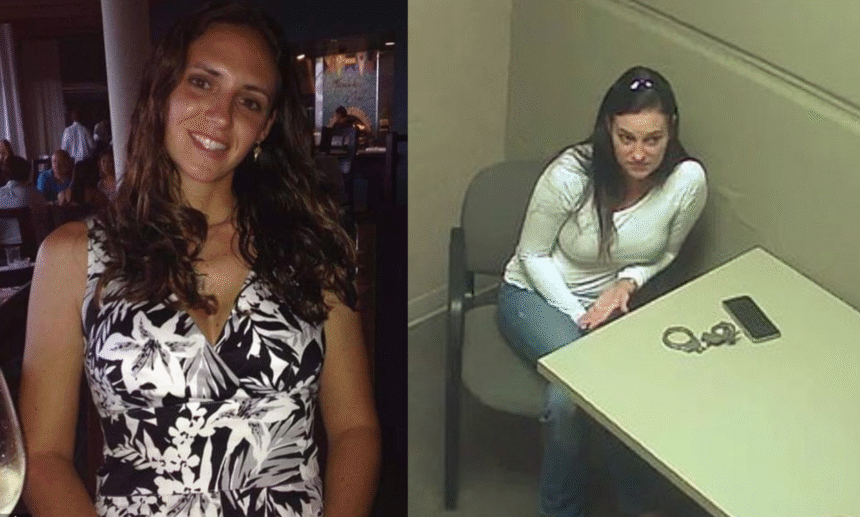
Taylor Wright was a former police officer and private investigator from North Carolina. She was murdered in 2017 by someone she completely trusted.
Taylor was born on April 23, 1984. She grew up mostly in North Carolina. When she was 13, she was placed in foster care. But a friend’s mom, Nancy Murchison, took her in instead. Nancy eventually adopted her.
Taylor grew up on the Murchison farm, riding horses and finally having a stable home. Nancy later said Taylor was the daughter she always wanted.
Taylor was known for being tough. Most people saw that side of her first. She wore a bullet necklace and a ring with the scales of justice on it. Those two things said a lot about who she was.
She wanted to work in law enforcement, and she made that happen. In 2008, she was sworn in as a police officer in Jacksonville, North Carolina. She worked hard and eventually reached SWAT-level training.
In 2003, she met Jeff Wright, a Marine stationed at Camp Lejeune. They had a lot in common and got married. In 2010, they had a son. Around that time, Taylor had also hoped to join the military, but a serious car accident stopped that from happening.
That accident did result in a $100,000 legal settlement, which she and Jeff put into a joint bank account together.
In late 2013, Jeff got a military transfer to Pensacola, Florida. Taylor had to leave her job and move with him. She became a stay-at-home mom, which was a big adjustment for her. She had worked hard to build her career, and giving it up was not easy.
The move put a serious strain on their relationship. By 2015, things had fallen apart completely and they divorced.
The divorce was messy. Jeff said he offered fair terms, including shared custody and financial support. People close to Taylor told a different story. They said she was blindsided when Jeff ended the marriage.
Whatever actually happened between them, the legal battles that followed were bitter and went on for years. There were two major disputes — one over custody of their son and one over that $100,000 settlement.
During one argument before the separation, Jeff recorded Taylor on his phone. She responded by poking him in the chest. He called the police, and she was arrested on a battery charge.
Jeff eventually dropped the charges, but the arrest was already on her record. That single incident stopped her from being rehired in law enforcement anywhere in Florida. So she pursued a career as a licensed private investigator instead.
Because she was going through financial difficulties after the divorce, Taylor temporarily agreed to let Jeff keep full custody of their son. She always planned to get custody back once things stabilized.
By mid-2017, she was in the middle of an active custody case. At the same time, the dispute over the $100,000 settlement was also still going on in court.
In June 2017, Taylor withdrew the full $100,000 from the joint account. A judge responded by ordering her to deposit $25,000 into an escrow account before her next hearing or face a contempt charge and possibly jail time. That deadline was hanging over her head as September approached.
Around this same time, Taylor started a relationship with a woman named Cassandra Waller. They had met on a dating app earlier in the year. By early September 2017, Taylor had started moving into Cassandra’s home. Their relationship had some rough patches, but things were moving forward.
Taylor’s closest friend at the time was Ashley McArthur. They had only known each other for about a year, but had grown very close. Ashley’s husband worked with Taylor, and he was the one who introduced them.
Ashley was a former crime scene technician. At the time, she and her parents ran a business called Pensacola Automatic Amusement, which supplied pool tables and jukeboxes to local bars.
Taylor trusted Ashley completely. So when she needed somewhere safe to keep her money away from any records Jeff could access during the court case, she turned to Ashley. She gave her a cashier’s check for $34,000 to hold.
She also gave her two separate cash amounts in July totalling $15,000. Taylor believed all of it was being kept in a Wells Fargo safety deposit box under Ashley’s name.
As September 8 approached, Taylor was running out of time to get that money back. She needed to deposit the $25,000 into the escrow account before her hearing or she would be held in contempt.
She sent Ashley message after message asking when they could go to the bank. Ashley kept making excuses. On September 7, the night before she disappeared, Taylor sent five separate messages urging Ashley to meet her first thing in the morning.
That same evening, Taylor, Ashley, and Cassandra all had dinner together. During that dinner, Taylor directly confronted Ashley about the repeated delays in getting her money back.
On the morning of September 8, Ashley arrived at Cassandra’s home at around 10:00 a.m. Taylor made breakfast, said goodbye to Cassandra, and left with Ashley. Their first stop was Ashley’s business warehouse, where Taylor planned to look at storage space for her moving boxes.
From there, they went back to Ashley’s home, where Ashley said she had the money ready. They then stopped briefly at Cassandra’s house, where Taylor went inside and came out with a small tactical bag.
The two also stopped at a gas station, where Ashley bought Taylor a beer. Ashley later noted that Taylor had already been drinking from a cup that morning, which she said was unusual behavior.
Cassandra started noticing something was off by early afternoon. Taylor was barely responding to messages. When she did reply, her texts felt strange and unlike her.
Cassandra reached out to Ashley, who said they had gone to her aunt’s farm in East Milton to help Taylor unwind before the court hearing. Ashley told Cassandra that Taylor had since taken an Uber to a local bar to get a drink on her own.
That evening, a text came through from Taylor’s phone saying she needed time to think and wasn’t angry.
Just before midnight, Ashley forwarded Cassandra a screenshot of a text she said Taylor had sent her, saying she needed a few days to herself and that the stress of the move and the court case was overwhelming her. Cassandra sent multiple unanswered messages expressing confusion and frustration.
By September 10, Cassandra was genuinely worried. She contacted the Pensacola Police Department and reported Taylor missing.
She told them everything — the custody dispute, the court deadline, and comments Taylor had made in the past about knowing how to disappear because of her work as a private investigator. Police initially did not treat it as urgent.
By September 14, Cassandra filed a formal missing persons report, and investigators began taking the case more seriously.
Three people were initially looked at — Cassandra, Jeff, and Ashley. Investigators searched Cassandra’s home and found Taylor’s ID, her passport, and a cashier’s check for $19,000 in her name. A revolver with one missing bullet was also found.
Cassandra explained she had borrowed the gun after feeling uneasy. She cooperated with investigators throughout and was eventually cleared.
Jeff was also questioned. He said he believed Taylor had left voluntarily to avoid going to jail over the escrow issue. Both he and Cassandra were eventually ruled out because each had solid alibis for September 8.
Ashley gave investigators a detailed timeline of that day. She said they visited the warehouse, then the farm in East Milton, then she dropped Taylor off and Taylor called an Uber. She came across as cooperative and was even friendly during the interview. But the details she gave started falling apart quickly.
Phone records showed that neither Ashley’s nor Taylor’s phone had pinged anywhere near East Milton. Instead, both phones placed them at a property in Cantonment, Florida, which was in the completely opposite direction.
When investigators ran Ashley’s maiden name through a property search, they found that the Cantonment address belonged to another one of her aunts — the same aunt Ashley had claimed she knew nothing about.
There was also no record of Taylor using any ride-share app on September 8. She had not used any app like that in months. There was also no transaction at any bar that day. And the texts sent that evening from Taylor’s phone had been traced back to Ashley’s home.
Bank records made everything worse for Ashley. She had told investigators the money was only at her house for a few days before she gave it back. That was not true.
Records showed she had added Taylor’s name to one of her accounts on August 10 and deposited the $34,000 check on August 16. The signature on the check was forged.
Within one day of the deposit, the money had already been moved into separate accounts that Taylor had no access to. Surveillance footage captured Ashley making multiple large cash transactions with the funds. The $15,000 in cash Taylor had given her in July was also gone.
On October 19, 2017, investigators executed three search warrants at the same time — at Ashley’s home, her warehouse, and the Cantonment farm.
While those searches were happening, they brought Ashley in for another interview, telling her it was just to return her phone. The plan was to keep her there long enough to get confirmation from the search teams.
During the interview, they showed her the cell tower data. She changed her story and said Taylor had a lockbox stored at the Cantonment farm and that Taylor had told her to keep the visit secret. She denied everything else.
Before investigators received any word from the search team, Ashley asked for a lawyer and had to be released.
Shortly after she walked out, the call came in. Searchers had found human remains at the Cantonment property, buried in a shallow grave along the tree line. The body was wrapped in a hammock and covered with potting soil and concrete.
Surveillance footage had already shown Ashley purchasing those exact materials at a Home Depot the morning after Taylor disappeared. Taylor’s identity was confirmed through dental records.
Her bullet necklace was found in the grave exactly where her neck would have been. The cause of death was a single gunshot wound to the back of the head. Ashley McArthur was arrested that same day and charged with second-degree murder, which was later upgraded to first-degree murder.
Ashley’s murder trial began on August 26, 2019. The defense argued that without physical evidence directly linking Ashley to the murder — no blood, no weapon — the jury could not convict.
They pointed to Taylor’s personal history and financial troubles as alternative explanations. The prosecution argued no one else had the same motive, means, and opportunity that Ashley did.
Both Jeff and Cassandra took the stand and were cleared in the eyes of the jury through their testimony. Cassandra’s account was especially important.
She explained exactly how desperate Taylor had been to get her money back before the hearing and described how Taylor had directly confronted Ashley about the delays during their dinner on September 7.
Three witnesses then testified about what Ashley had said and done around that same time. One said Ashley made comments at a bar on the night of September 7 suggesting the world would be better without Taylor.
The same witness said Ashley purchased cocaine that night with the intention of putting it in Taylor’s drink.
A second witness confirmed that the next day, Ashley told her she had attempted to put cocaine in Taylor’s beer but that Taylor had spit it out because it tasted bitter. A third witness testified that Ashley had told her directly that she had killed Taylor.
A man named Brandon Beatty also testified. He and Ashley had been in a romantic relationship. He said Ashley had spent large amounts of money on him, including a motorcycle and a boat.
He also testified that after Taylor’s disappearance, Ashley told him the body would never be found: “She’s gone. They’ll never find that b**”**.
The jury deliberated for only a few hours before finding Ashley McArthur guilty of first-degree murder. She was sentenced to life in prison with a minimum of 25 years before she could be considered for parole, making her earliest possible release date 2044. She filed an appeal in April 2021, which was denied.
Taylor Wright left behind a young son who was only seven years old when she was killed.


Recent Comments