
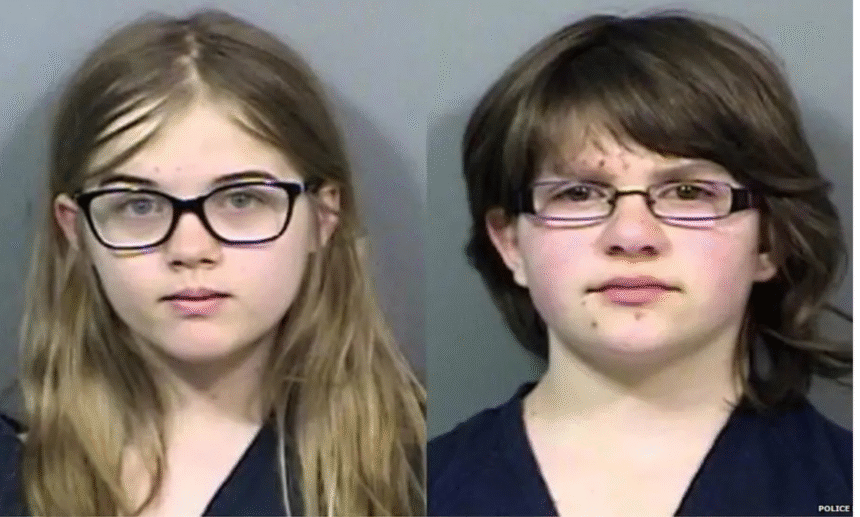
In May 2014, two twelve-year-olds stabbed their friend nineteen times in a Wisconsin park to appease a fictional internet character called Slender Man.
Morgan Geyser was born on May 16, 2002, in Waukesha, Wisconsin. Anissa Weier was born on November 10, 2001, and lived in the same city. The two became close because they lived in the same apartment building and both enjoyed a type of internet horror fiction called creepypasta.
One of the most popular characters in that world was Slender Man, a tall, faceless supernatural figure that existed entirely online.
Their mutual friend, Payton Isabella Leutner, also known as Bella, had been Geyser’s best friend since fourth grade. Leutner found creepypasta frightening and did not share their interest in it.
By September 2013, Geyser and Weier had become deeply obsessed with Slender Man. At some point, their interest crossed a line. They stopped seeing him as fiction and started believing he was real.
They became convinced he would harm them and their families unless they offered him a human sacrifice. They chose Leutner. She was their closest mutual friend, which made her the target, not a coincidence.
Before May 2014, they had considered killing her twice before, once while she slept and once in a bathroom, but neither attempt was carried out.
What made this even more disturbing was that Geyser had been experiencing serious mental health problems long before any of this began. Throughout her childhood, she saw figures she believed were ghosts, watched colors appear to melt down walls, and had imaginary companions she called Maggie and Sev.
One hallucination appeared repeatedly. She described a smoke-colored figure she named “It,” which she saw standing behind her in mirrors or shifting around corners. These were not passing thoughts. They were consistent, recurring experiences that had gone unaddressed for years.
By the spring of 2014, the plan had become concrete. Geyser and Weier decided to invite Leutner to a birthday sleepover on the night of May 30. The next morning, they would take her to Davids Park, a heavily wooded area near their neighborhood, and kill her there.
Geyser had already obtained a five-inch blade, which she kept hidden. Nothing about the sleepover suggested anything unusual to Leutner. She attended without any suspicion.
The following morning, May 31, 2014, the three girls went to Davids Park. Geyser and Weier told Leutner they were going for a walk and suggested a game of hide-and-seek in the wooded section of the park. Leutner agreed.
At some point during the game, Weier told Leutner to lie on the ground and cover herself with sticks and leaves. She framed it as part of the game. It was not. It was a way to get Leutner into a vulnerable position before the attack.
Geyser and Weier then pinned Leutner down and Geyser stabbed her nineteen times across her arms, legs, and torso. Two wounds hit major organs. One came within a hair’s width of a major artery.
Another went through her diaphragm and cut into her liver and stomach. After the attack, the two girls told Leutner to stay on the ground while they went for help. They did not seek help. They left.
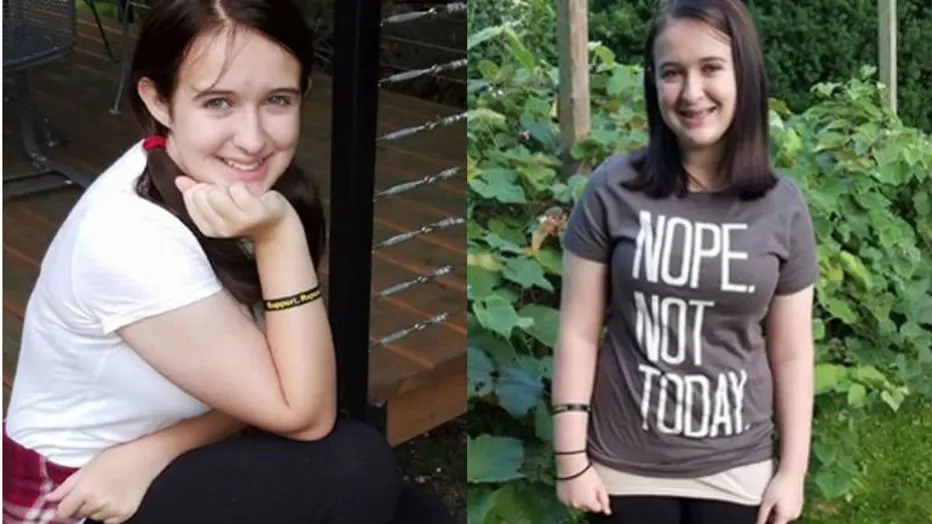
Leutner later described what followed. She could not focus clearly because her body was working so hard just to keep her alive. She dragged herself through the woods until she reached a road, where a passing cyclist found her and called emergency services.
Surgeons operated on her for six hours. Operating surgeon Dr. John Kelemen said that if the knife had gone the width of a human hair further, she would not have survived. Leutner stayed in the hospital for seven days and returned to school the following September.
While Leutner was fighting to survive, police were already looking for the two girls. About five hours after the attack, officers located Geyser and Weier near a furniture store along Interstate 94, roughly 4.9 miles from the park.
The knife was still in a bag they were carrying. When questioned, they said they were heading to the Chequamegon-Nicolet National Forest, nearly 200 miles away, because they believed Slender Man lived there in a place they called “Slender Mansion.” They were taken into custody immediately.
What followed was a lengthy investigation and a series of psychiatric evaluations that revealed just how serious Geyser’s mental state was. During questioning, she disclosed that the hallucinations she had experienced throughout her childhood were still ongoing.
After her arrest, her mother described her as becoming “floridly psychotic.”
Correctional officers reported that Geyser frequently talked to herself, pretended to be a cat, kept ants as pets, claimed to see unicorns, and said she was having conversations with fictional characters including Slender Man, Severus Snape, Lord Voldemort, and a Teenage Mutant Ninja Turtle.
In the fall of 2014, Geyser was moved to the Winnebago Mental Health Institute for a formal competency evaluation. On October 22, 2014, she was diagnosed with early-onset childhood schizophrenia.
Despite this diagnosis, her treatment over the next 20 months was inconsistent and considered clinically inadequate. That period of poor treatment is believed to have made her psychosis and delusions significantly worse.
It was not until November 2015 that she was placed on a steady, long-term regimen of antipsychotic medication. Once properly medicated, she began to show genuine feelings of guilt and remorse for what she had done.
On March 23, 2016, Geyser was returned to the county jail to await trial. Even with her medication, her mental health continued to decline due to the pressure and stress of confinement.
Weier’s evaluations had also established that her belief in Slender Man was not simply imaginative play. Psychiatrists determined that both girls had been suffering from a genuine mental disease or defect at the time of the crime.
Both were tried as adults in 2017, having been moved out of juvenile court given the seriousness of the charges. Weier was charged with attempted second-degree homicide.
She pleaded guilty to being a party to the attempted crime, and a jury found her not guilty by reason of mental disease or defect. She was sentenced to 25 years, structured as an indeterminate term requiring at least three years of confinement in a state forensic psychiatric institute, followed by supervised release until she turned 37.
Geyser faced the more serious charge of attempted first-degree intentional homicide. Under a plea agreement, she pleaded guilty and agreed to further psychiatric evaluation to determine how long she should be committed.
She was also found not guilty by reason of mental disease or defect, consistent with her schizophrenia diagnosis. The court gave her the maximum sentence of 40 years of confinement in a state forensic psychiatric institute.
Leutner had not spoken publicly during the trial, but in October 2019 she sat down with ABC’s 20/20. She said she did not think much of her scars and expected them to fade. She described meeting Geyser in fourth grade and wanting to help her feel less alone.
She noted that Weier had seemed jealous of their friendship. When asked what she would say to Geyser if she ever saw her again, she said she would thank her, because the attack had inspired her to pursue a career in medicine.
Her goal, she said, was to put everything behind her and live normally.
Weier’s path to release moved forward first. At a hearing in March 2021, she submitted a letter to the court expressing deep remorse, not only toward Leutner but toward the broader community.
She said that through extensive therapy, she had stopped hating herself for what she had done, even as she continued to hate the actions themselves. On July 1, 2021, Waukesha County Judge Michael Bohren ordered her release from the Winnebago Institute.
On September 13, 2021, she was released under strict conditions. These included 24-hour GPS ankle monitoring, a requirement to request permission before leaving Waukesha County, no contact with Leutner until 2039, no social media access, court-mandated psychiatric medication, regular supervised counseling, and a requirement to live with her father.
The GPS condition was later waived on September 11, 2023.
Geyser’s process was considerably longer and more complicated. A petition for release filed in January 2024 was denied at a hearing in April of that year. A new petition gained momentum after three psychologists reported considerable progress in her treatment.
However, in February 2025, a scheduled hearing was paused after new allegations emerged that she had engaged in what was described as “violent” communication with someone outside the facility and had been reading material involving themes of sexual sadism and murder.
Her lawyer denied any wrongdoing, and the three psychologists maintained their position that she was ready for release. After several postponements, a conditional release plan was signed by a judge on July 17, 2025.
Geyser, then 22, was placed in a group home and ordered to remain under supervision until 2058, with periodic evaluations to assess whether further treatment or institutionalization was needed.
Placing Geyser proved difficult. A proposed location in Milwaukee was rejected because it was too close to Leutner. A second option in Manitowoc was denied because the building was considered too isolated and other residents of the home objected to her placement.
She was eventually housed in a group home in Madison. Her attorney stated that despite these setbacks, Geyser remained calm, stable, and positive throughout the process.
That stability did not last. On the evening of November 22, 2025, Geyser cut off her monitoring bracelet and left the group home. She had befriended a transgender woman at a church in Madison several months after her release.
That woman had been denied official visitation rights and had allegedly entered the facility without authorization on multiple occasions. During those visits, the two developed a plan to travel by bus to Nashville, Tennessee.
Once Geyser left, they met at the church parking lot, took a bus to Chicago, then another to Posen, Illinois, where they ran out of money. They stopped at a Thorntons gas station along Interstate 57 and were found sleeping outside by local police the following morning.
Both initially gave false names to officers. Geyser identified herself as “Stephanie Gries.” Her companion gave the name “Charles M. Robertson.” After pressure from police, both provided their legal names.
The acquaintance told a local television station that Geyser had complained about being mistreated in the group home and that she stood by her decision to help.
The acquaintance was charged with criminal trespassing and obstructing identification before being released from custody. Geyser was returned to custody. The Wisconsin Department of Corrections moved to revoke her conditional release.
The case had already left a significant mark on public life well before any of this. After the original attack in 2014, the Waukesha School District blocked access to the Creepypasta Wiki, the primary online archive of Slender Man content.
On June 5, 2014, Eric Knudsen, the creator of the Slender Man character, released a public statement expressing deep sorrow over what had happened.
A former Creepypasta Wiki administrator stated that the stabbing was an isolated incident that did not represent the broader community, which he described as a creative writing space that in no way condoned violence.
Governor Scott Walker issued a proclamation declaring August 13, 2014, “Purple Hearts for Healing Day,” encouraging Wisconsin residents to wear purple in honor of Leutner.
On August 29, 2014, Madison held a bratwurst festival to raise money for her medical costs. More than 250 volunteers participated, and the event raised over $70,000.
The stabbing also set off a nationwide moral panic around Slender Man. Waukesha Police Chief Russell Jack publicly called the case “a wake-up call for all parents,” warning that the internet was full of dangerous content.
That warning was picked up and amplified by media outlets across the country. In June 2014, a woman in Cincinnati reported that her 13-year-old daughter had attacked her with a knife and had written dark fiction involving Slender Man.
In September 2014, a 14-year-old in Port Richey, Florida, allegedly set her family’s house on fire while her mother and younger brother were inside. Police noted she had been reading Slender Man content online.
During an early 2015 wave of suicide attempts among young people on the Pine Ridge Indian Reservation, Slender Man was cited as an influence. The Oglala Sioux tribe president noted that the figure bore resemblance to a traditional belief in a “suicide spirit” within their culture.
The case inspired the documentary Beware the Slenderman, the film Mercy Black, and several published books.


Recent Comments